
Social proof is a psychological principle — and a practical web design and marketing tool — based on the observation that people look to others’ experiences and behaviors when making decisions under uncertainty. In marketing, social proof refers to evidence that other people have chosen, used, and benefited from a product, service, or brand: customer reviews, testimonials, case studies, star ratings, trust badges, client logos, subscriber counts, and user-generated content all qualify.
The concept was formalized by psychologist Robert Cialdini in his research on influence and persuasion. In an online context where visitors can’t physically evaluate a product or shake hands with a service provider before committing, social proof functions as a trust signal — a substitute for the personal recommendation they’d get from a trusted colleague or friend. Research consistently shows its impact: 97% of consumers read online reviews before engaging with local businesses, and social proof elements on landing pages have been shown to lift conversion rates by measurable margins.
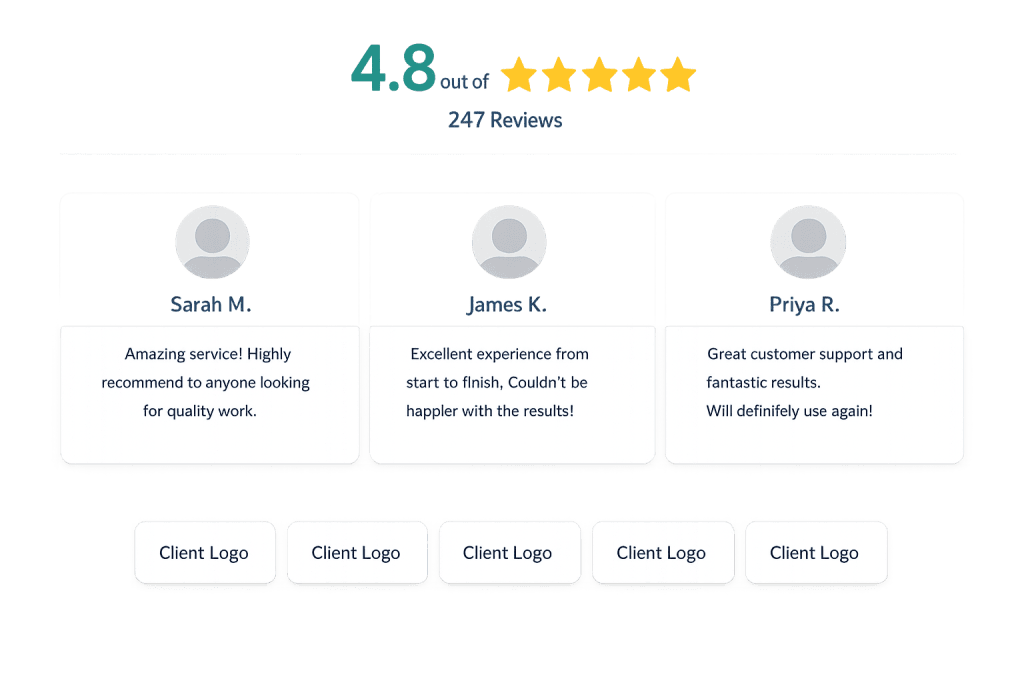
[Image: Example of a service page section showing a star rating, 3 customer testimonials with names and photos, and a row of recognizable client logos]
Types of Social Proof
Social proof takes many forms, each serving a slightly different trust-building function:
- Customer reviews and ratings — Text or star-based feedback from verified customers on platforms like Google, Yelp, or directly on a product/service page. The most common and widely trusted form of social proof.
- Testimonials — Curated quotes from clients describing their experience, typically displayed on a website with a name, photo, and sometimes company or role.
- Case studies — Detailed accounts of how a specific client solved a problem using a product or service. Particularly effective for B2B and high-consideration purchases.
- Trust badges and certifications — Security seals, industry accreditations, payment processor logos, and “as seen in” media logos. These signal legitimacy and reliability.
- Social media share counts and follower numbers — Numbers showing how many people follow, share, or engage with a brand’s content. Effective when the numbers are substantial; counterproductive if they’re low.
- User-generated content (UGC) — Customer photos, videos, and posts showing the product in real use. Functions as authentic social proof without being directly created by the brand.
- Authority endorsements — Recommendations from recognized experts, industry publications, or well-known institutions.
Purpose & Benefits
1. Builds Trust With Visitors Who Don’t Know You Yet
For a first-time visitor to a website, the brand is unknown. Social proof bridges the credibility gap — it shows that real people have made the same decision the visitor is considering, and that they were satisfied. This is especially important for service businesses where the outcome isn’t tangible until after the commitment is made. Our web design process incorporates social proof placement as a deliberate design decision, not an afterthought.
2. Directly Improves Conversion Rates
Studies from CXL and WiderFunnel confirm that social proof — particularly on landing pages and product pages — is one of the few elements that consistently lifts conversion rates across tests. The more uncertainty a visitor feels, the more impactful well-placed social proof becomes. For high-consideration decisions (hiring a service provider, making a significant purchase), social proof can be the deciding factor. Conversion rate optimization strategy almost always includes a social proof audit.
3. Supports E-E-A-T and Search Visibility
Google’s E-E-A-T framework (Experience, Expertise, Authoritativeness, Trustworthiness) is directly influenced by the presence and quality of third-party validation. Review signals from Google Business Profile, mentions in authoritative publications, and accumulated customer testimonials all contribute to a site’s perceived trustworthiness in Google’s quality evaluation. Social proof isn’t just a conversion tool — it’s part of the broader trust ecosystem that affects search visibility.
Examples
1. Service Business Homepage With Reviews
A professional services firm prominently displays its Google review aggregate (4.9 stars, 87 reviews) near the top of the homepage, followed by four curated testimonials with client names and photos. Below the fold, they include logos from recognizable clients. The combination — volume (87 reviews), quality (4.9 stars), and specificity (named testimonials) — provides layered trust signals that address multiple visitor objections simultaneously.
2. E-Commerce Product Page With UGC and Ratings
A WooCommerce store shows star ratings and review counts on product listing thumbnails before a shopper even clicks into a product. On the product page itself, customer photos appear in a gallery below the product images, showing the product in real home settings. Reviews are sorted by recency and include verified purchase labels. The social proof answers the implicit question: “Have real people bought this and been happy with it?”
3. B2B Landing Page With Case Study Results
A software company’s paid ad landing page features a brief case study in the hero area: “How [Company Name] reduced onboarding time by 40% in 60 days.” Below the form, they include a row of recognizable client logos and a data-driven testimonial from a specific named decision-maker with a title and company. The specificity and measurability of the claims make the social proof more credible than generic positive statements.
Common Mistakes to Avoid
- Using vague, unattributed testimonials — “Great service!” from “John D.” carries almost no credibility. Specific testimonials with full names, photos, companies, and concrete results are significantly more persuasive. Vague praise reads as fabricated, even when genuine.
- Hiding social proof below the fold — Many sites relegate testimonials to a “Testimonials” page that few visitors ever reach. High-impact social proof should appear near the primary call to action on key pages, not in a separate section visitors have to seek out.
- Displaying low numbers prominently — A “5 reviews” count or a “43 followers” social media counter can actually reduce trust by signaling that few people have engaged with the brand. Don’t display counts if the numbers are low; wait until they’re substantial enough to be persuasive.
- Not actively collecting reviews — Most satisfied customers don’t leave reviews unprompted. Building a process to request reviews after a positive experience — via email, post-purchase message, or direct request — is essential for accumulating social proof at meaningful volume.
Best Practices
1. Place Social Proof Near Decision Points
The most effective placement for social proof is near where visitors are deciding whether to act: adjacent to pricing, above the fold on a landing page, near the “add to cart” button on a product page, or alongside a contact form. Think about what hesitation a visitor might have at each conversion point and surface the appropriate social proof there — don’t make visitors search for reassurance.
2. Use Specific, Measurable Social Proof Where Possible
“This service changed my business” is less persuasive than “We saw a 35% increase in inbound leads within 90 days.” Specificity makes claims more believable and more memorable. When collecting testimonials, ask clients specific questions — “What specific outcome did you experience?” or “What would you tell someone considering working with us?” — to elicit more useful responses.
3. Keep Social Proof Fresh and Relevant
Old reviews lose their relevance. A testimonial from 2017 suggests the company hasn’t served clients recently. Actively refresh your social proof: request new reviews regularly, update featured testimonials, and ensure the dates on displayed reviews are within the last 12–18 months. For CRO purposes, testing different social proof placements and formats can reveal which types resonate most with your specific audience.
Frequently Asked Questions
What’s the most effective type of social proof?
It depends on context and audience. For local service businesses, Google reviews are typically the most trusted because they’re verified and independent. For e-commerce, product ratings and customer photos are particularly effective. For B2B, case studies with named clients and specific results carry the most weight. In general, specificity and independence (third-party validation rather than self-reported claims) increase credibility.
Can social proof hurt conversions if it’s not strong enough?
Yes. A low review count, generic testimonials, or a “0 people have shared this” counter can undermine trust more than having no social proof at all. The presence of weak social proof signals that few people have engaged, or that the brand is presenting unpersuasive validation. Audit your social proof critically — if it’s not genuinely compelling, it may be better not to feature it prominently.
How do I get more customer reviews?
Ask, specifically and at the right time. The best moment is shortly after a positive experience or successful project — when the client’s satisfaction is fresh. A brief follow-up email with a direct link to your Google review page removes friction. In e-commerce, a post-purchase email sequence with a review request typically generates 5–10x more reviews than waiting for customers to leave them unprompted.
Is social proof the same as testimonials?
Testimonials are one form of social proof, but social proof is broader. It includes reviews, ratings, UGC, case studies, trust badges, client logos, social media follower counts, press mentions, and any other third-party validation. Testimonials are curated and controlled by the brand; other forms of social proof — like independent reviews — are perceived as more trustworthy precisely because the brand doesn’t control them.
Related Glossary Terms
- Conversion Rate
- CRO (Conversion Rate Optimization)
- E-E-A-T
- Call to Action (CTA)
- User Experience (UX)
- Content Marketing
- Social Media Marketing
How CyberOptik Can Help
Getting social proof right takes strategy — knowing what to collect, where to place it, and how to present it in a way that actually moves visitors to act. Our team applies these principles to every site we design, ensuring that trust-building elements appear at the moments they matter most. Whether you’re building a new site or optimizing an existing one for conversions, we can help. See our web design services or contact us to start a project.