
E-E-A-T stands for Experience, Expertise, Authoritativeness, and Trustworthiness — a framework drawn from Google’s Search Quality Rater Guidelines that defines what high-quality, helpful content looks like from a user’s perspective. Google’s human quality raters use this framework when evaluating whether search results are actually serving users well, which in turn informs how Google’s automated ranking systems are trained and refined.
The framework began as E-A-T (Expertise, Authoritativeness, Trustworthiness) but in December 2022, Google added the first “E” for Experience — recognizing that firsthand, lived knowledge of a topic represents a distinct quality dimension from academic or professional expertise. A medical professional has expertise; a patient who documented their treatment journey has experience. Both matter, for different reasons and different types of content.
Why E-E-A-T Matters
It’s worth being clear on what E-E-A-T is and isn’t. It is not a direct ranking factor in the sense of a signal Google’s algorithm explicitly measures on every page. There’s no “E-E-A-T score” attached to your content. What it represents is a framework that guides the training of Google’s ranking systems — meaning that the characteristics it describes genuinely correlate with how well content performs in search over time.
E-E-A-T applies to all content, but it carries the most weight for YMYL (Your Money or Your Life) topics — subjects where inaccurate or low-quality information could significantly harm someone’s health, finances, safety, or legal standing. Medical advice, financial guidance, legal information, and news coverage of critical events are evaluated against E-E-A-T standards most stringently. A blog post about cooking receives less scrutiny than one recommending investment strategies.
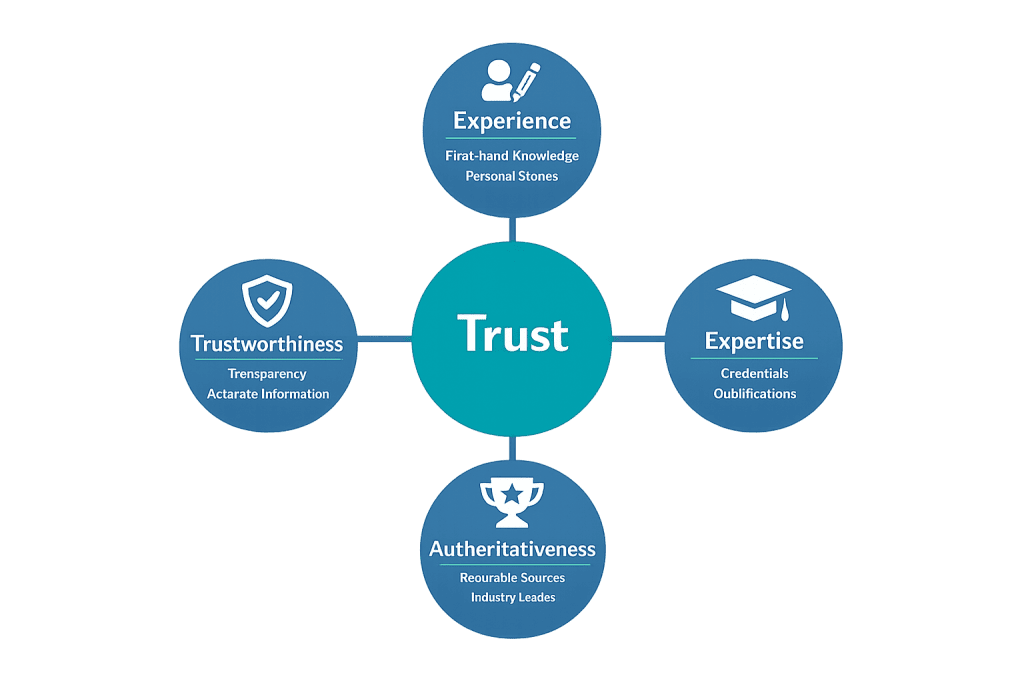
The four components work together, with Trust sitting at the center:
- Experience — Does the content creator have firsthand, real-world engagement with the topic?
- Expertise — Does the creator have relevant knowledge, credentials, or demonstrated skill?
- Authoritativeness — Is the creator and the site recognized as a reliable source by others in the field?
- Trustworthiness — Is the content accurate, honest, safe, and transparent? Google explicitly states: trust is the most important element. Untrustworthy pages have low E-E-A-T regardless of how experienced, expert, or authoritative they may otherwise appear.
[Image: Diagram of the four E-E-A-T components arranged around Trust at the center, with examples of signals for each component]
How to Demonstrate Each Component
Experience:
– Use personal examples, case studies, and real outcomes from your work
– Include original photos, screenshots, or documentation that only someone with direct involvement would have
– Reference specific client situations (anonymized where necessary) rather than hypothetical scenarios
– Video content showing actual process or results
Expertise:
– Author bios with relevant credentials, certifications, and professional background
– “Reviewed by” attributions from qualified subject matter experts on technical content
– Deep, accurate coverage that goes beyond what a surface-level research session would produce
– Citations to authoritative external sources
Authoritativeness:
– Backlinks from respected publications and industry sources
– Mentions, citations, and references from other experts in your field
– Speaking engagements, publications, and professional affiliations
– A consistent track record of accurate, useful content over time
Trustworthiness:
– Transparent contact information and clear business identity
– HTTPS across the entire site
– Accurate, up-to-date content with clear publication and update dates
– Clear disclosure of any financial relationships, affiliations, or conflicts of interest
– Genuine customer reviews and testimonials
Purpose & Benefits
1. Builds Long-Term Search Visibility
Content that genuinely demonstrates E-E-A-T tends to perform better in search over time than content optimized purely for keywords. Google’s systems have grown increasingly capable of distinguishing content written by people with real knowledge from content that strings together keywords. Our SEO services and content strategy work are grounded in building the genuine authority signals that sustain rankings.
2. Protects Rankings Through Algorithm Updates
Many of Google’s major algorithm updates have specifically targeted low-quality, thin, or untrustworthy content. Sites with strong E-E-A-T signals tend to be resilient to these updates; sites that relied on keyword manipulation without substance tend to see the largest declines. Building E-E-A-T is, in this sense, a hedge against future algorithm changes.
3. Converts Visitors More Effectively
The same qualities that Google’s framework rewards — genuine experience, demonstrated expertise, transparent and accurate presentation — are the qualities that make visitors trust you enough to act. E-E-A-T optimization and conversion rate optimization are not separate workstreams; they reinforce each other.
Examples
1. Professional Services Firm Demonstrating Experience
A law firm publishes blog posts written by attorneys who describe specific case outcomes (anonymized for privacy), practical challenges they encountered, and how their approach differs from typical handling. This firsthand case knowledge is something a content writer summarizing legal procedures cannot replicate — and it’s exactly what E-E-A-T’s “Experience” component rewards.
2. Health and Wellness Site Building Expertise Signals
A health information site adds detailed author bios to all articles, identifies the specific credentials of each author, and adds a “Reviewed by [Medical Professional]” section to any article containing clinical or diagnostic information. Updating older articles with accurate dates and adding citations to peer-reviewed sources rounds out the trustworthiness layer.
3. Agency Building Authoritativeness Through Content
A marketing agency consistently publishes original research — survey results, data analysis from client campaigns, proprietary findings — that other publications cite. These citations create backlinks and brand mentions from respected industry sources, building the authoritativeness dimension of E-E-A-T over time. This is the work our SEO and content teams do for clients building topical authority.
Common Mistakes to Avoid
- Publishing AI-generated content without human review — AI-written content that lacks firsthand experience and is published without expert review directly contradicts the Experience and Expertise components. Content that reads as generic or formulaic may be accurate but signals low E-E-A-T. Human knowledge and editorial oversight are not optional.
- Anonymous content — Content with no author attribution makes it impossible for readers or algorithms to evaluate who is speaking. Every piece of content should be attributable to a person with a real professional background.
- Neglecting site-level trust signals — E-E-A-T isn’t just about individual articles. A site with no contact information, no About page, no privacy policy, or with mixed reviews creates a low-trust environment that affects how Google evaluates all content on the domain.
- Chasing credentials without substance — Adding impressive-sounding author bios to thin content is not a substitute for actually producing content that demonstrates knowledge. Quality raters are humans reading real content — the substance has to back up the claims.
Best Practices
1. Invest in Author Profiles
Create detailed author profiles for everyone who publishes content on your site. Include professional background, relevant experience, credentials, professional affiliations, and links to external profiles (LinkedIn, professional organization memberships). These profiles signal that real, qualified people stand behind your content — a prerequisite for establishing expertise and experience signals.
2. Make Content Specific, Not General
Generic content that could apply to any business in any situation demonstrates nothing unique. Specificity — “in our experience working with service businesses on WordPress sites, this problem appears most often in X scenario” — signals firsthand knowledge that algorithms and readers alike can distinguish from research-assembled summaries. This is the intersection of E-E-A-T and genuine content strategy.
3. Maintain Content Accuracy Over Time
Outdated content with information that’s no longer accurate actively undermines trustworthiness. Establish a content audit process that identifies high-traffic pages with outdated statistics, deprecated product information, or changed best practices. Update the content and note the revision date. Search engines reward content that is demonstrably maintained — and penalize sites where outdated information accumulates unchecked.
Frequently Asked Questions
Is E-E-A-T a Google ranking factor?
Not directly — there’s no numeric E-E-A-T score that affects rankings. But the qualities E-E-A-T describes are deeply embedded in how Google’s systems evaluate content quality. Pages that demonstrate experience, expertise, authoritativeness, and trustworthiness tend to rank better over time, especially for YMYL topics. Think of it as describing what good content looks like rather than being a lever to pull.
When did Google add “Experience” to E-A-T?
Google updated the Search Quality Rater Guidelines in December 2022 to add the first “E” for Experience, expanding E-A-T to E-E-A-T. The addition reflects Google’s increasing emphasis on content produced by people with genuine firsthand knowledge of a topic — a direct response to the rise of AI-generated content that can sound expert without reflecting real experience.
What are YMYL topics, and do they affect my site?
YMYL stands for Your Money or Your Life — topics where low-quality or inaccurate information could meaningfully harm users. Medical, legal, financial, and safety content receives the strictest E-E-A-T evaluation. If your content touches these categories, demonstrating expertise and trustworthiness isn’t optional — it’s the baseline requirement for competitive performance in search.
Can small businesses compete on E-E-A-T?
Yes. A local plumber who documents real job outcomes, shares behind-the-scenes expertise, and builds an honest, transparent website can compete on E-E-A-T with much larger companies. E-E-A-T rewards genuine knowledge and authentic presence — neither of which is exclusive to enterprises with large content teams.
How is E-E-A-T different from technical SEO?
Technical SEO focuses on how search engines crawl, index, and render your site — site structure, page speed, schema markup, canonical tags. E-E-A-T focuses on the quality and credibility of your content and the people behind it. Both matter, but they solve different problems. A technically perfect site with low-quality content still won’t perform well; neither will expertly written content on a site search engines can’t crawl.
Related Glossary Terms
How CyberOptik Can Help
E-E-A-T is not a checkbox — it’s the result of consistently publishing content that reflects real knowledge, real experience, and genuine care for the reader. Our SEO and copywriting teams work together to build the kind of content and authority signals that hold up to algorithm scrutiny and actually serve your audience. Whether you need an SEO audit, a content strategy, or ongoing production, we can help. Contact us for a free website review, explore our SEO services, or learn about our copywriting services.