
Quality Score is a diagnostic metric in Google Ads that estimates the quality and relevance of your ads, keywords, and landing pages on a scale of 1 to 10. A score of 10 indicates excellent alignment between what a searcher wants, what your ad promises, and what your landing page delivers. A score of 1 signals a significant mismatch somewhere in that chain. Quality Score is visible at the keyword level in your Google Ads account.
Quality Score matters because it directly influences your Ad Rank — the formula Google uses to determine whether your ad appears, where it appears on the page, and how much you pay per click. Higher Quality Scores allow you to achieve better ad positions at lower cost-per-click (CPC) than competitors with lower scores who are bidding the same or more. In this sense, quality score rewards advertisers who build relevant, well-matched campaigns.
[Image: Google Ads keyword report showing Quality Score column alongside Expected CTR, Ad Relevance, and Landing Page Experience component scores]
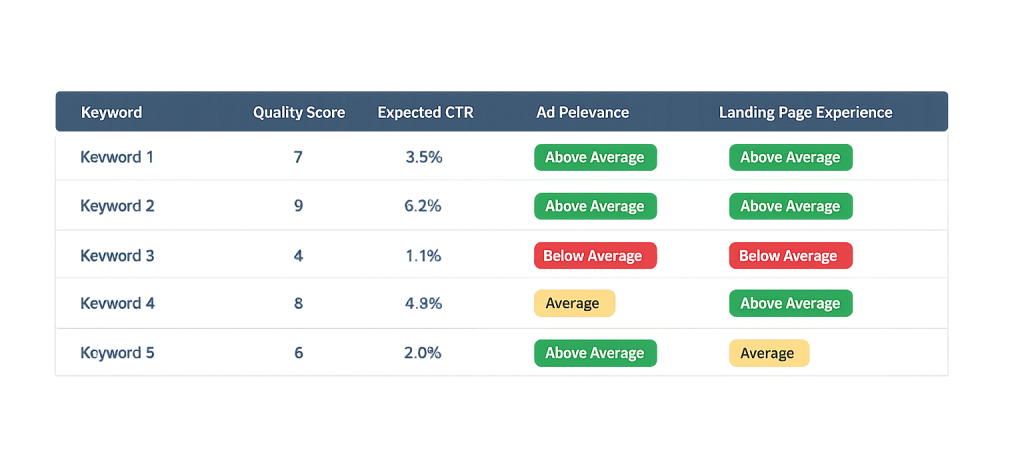
How Quality Score Is Calculated
Google calculates Quality Score from three component metrics, each rated as “Above average,” “Average,” or “Below average”:
1. Expected Click-Through Rate (CTR)
How likely Google estimates your ad will be clicked when shown for a given keyword — based on historical performance of your keyword and ad combination, compared to other advertisers showing for the same searches.
2. Ad Relevance
How closely your ad copy matches the intent and language of the keywords in your ad group. If someone searches “emergency plumber” and your ad talks about general home services, ad relevance will be low.
3. Landing Page Experience
How relevant and useful your landing page is to visitors who click your ad. Google evaluates whether the page content matches the ad’s promise, how fast it loads (see PageSpeed), how mobile-friendly it is, and whether visitors engage with it or immediately leave.
The 1–10 score is a summary diagnostic — the real auction calculation runs in real time for every search and incorporates these signals along with contextual factors like device, time of day, and user signals.
Purpose & Benefits
1. Lower Cost Per Click
Advertisers with high Quality Scores pay less per click for the same ad position. Google rewards relevance — if your ads are better aligned with user intent than competitors’, you earn better placement at a lower cost. Research consistently shows that improving Quality Score from 5 to 8 can reduce CPC by 20–50% on competitive keywords. This translates directly to more clicks for the same budget, or the same clicks for less spend.
2. Better Ad Positions
Ad Rank, the formula determining where your ad appears on the search results page, combines your bid with your Quality Score. A lower bid paired with a high Quality Score can outrank a higher bid with a low Quality Score. The top ad positions — which receive dramatically higher click-through rates (CTR) — are accessible to well-structured campaigns without necessarily requiring the highest bids in the auction.
3. Diagnostic Clarity for Campaign Improvement
Quality Score’s three component metrics give you a roadmap for improvement. If Ad Relevance is “Below average,” tighten your keyword groups and rewrite ad copy to better match keywords. If Landing Page Experience is “Below average,” investigate PageSpeed, content relevance, and mobile usability. If Expected CTR is lagging, test more compelling ad copy. The score shows you where to focus attention rather than guessing.
Examples
1. High Quality Score Driving Low CPC
A SaaS company targets the keyword “project management software” with an ad group containing closely related keywords, ad copy that specifically mentions project management features, and a landing page dedicated to that exact product category. Their Quality Score is 9/10. Despite bidding $8 per click, they outrank a competitor bidding $12 with a Quality Score of 5. They also pay less per click when their ad does win a position.
2. Low Quality Score Caused by Poor Ad Relevance
A home services company creates one large ad group with keywords ranging from “plumber” to “electrician” to “roofer” — all served by the same generic ad. Google rates Ad Relevance as “Below average” because the ad doesn’t specifically address what any of these searches want. Splitting into tightly themed ad groups — one for plumbing, one for electrical — with ads written specifically for each theme would improve relevance and Quality Score.
3. Landing Page Experience Dragging Down Performance
An e-commerce store runs ads for “leather wallets” but sends all traffic to the generic homepage rather than a wallet category or product page. The landing page has a slow load time and visitors immediately bounce when they see no relevant products. Landing Page Experience is “Below average.” Redirecting to a specific wallet landing page — fast-loading, mobile-optimized, with relevant content — directly improves this component and raises the Quality Score.
Common Mistakes to Avoid
- Using broad ad groups with many loosely related keywords — Lumping “web design,” “logo design,” and “business cards” into one ad group makes it impossible to write an ad relevant to all three. Tight, theme-based ad groups are the foundation of high Quality Scores.
- Directing all traffic to the homepage — The homepage is almost never the right landing page for a PPC ad. Create or use pages that directly match the ad’s specific message and keyword intent.
- Chasing a perfect 10 — Quality Score is a diagnostic, not a goal in itself. A score of 7 or 8 on a profitable keyword is fine; obsessing over 10/10 everywhere wastes optimization effort better spent on other improvements.
- Ignoring the component scores — The overall 1–10 number tells you there’s a problem. The three component ratings tell you where. Work from the component scores, not the summary number.
Best Practices
1. Build Tightly Themed Ad Groups
Each ad group should contain a small set of closely related keywords — ideally 5–15 terms with the same user intent. Write ad copy that specifically addresses those terms. This “Single Keyword Ad Group” or tight-theme approach consistently produces higher Ad Relevance scores than broad groupings. The extra setup time is recovered in lower CPC and better positions.
2. Match Landing Pages to Keyword Intent
Every ad group should link to a landing page specifically relevant to those keywords. If someone searches “emergency HVAC repair,” they should land on a page about emergency HVAC services — not your homepage or a general services page. Match the language in your ad to the language on the landing page. Message consistency is the core of good Landing Page Experience scores.
3. Monitor and Test Ad Copy for CTR
Expected CTR is influenced by ad copy quality. Run at least two ad variations per ad group and regularly replace the underperformer. Test different headlines, benefit statements, and calls to action. An ad with consistently high CTR improves this component and — over time — positively influences your overall Quality Score. Competitive research through Google’s ad transparency tools can inform what copy resonates in your market.
Frequently Asked Questions
Does Quality Score directly determine ad position?
Not directly. Ad position is determined by Ad Rank, which combines your bid with your Quality Score (and other contextual factors). Quality Score is a major component of Ad Rank, but a higher Quality Score doesn’t guarantee top position — it makes it achievable at a lower bid relative to competitors with lower scores.
Can I see Quality Score for all keywords?
Quality Score is available at the keyword level in your Google Ads campaigns. In the Keywords report, add the Quality Score, Expected CTR, Ad Relevance, and Landing Page Experience columns. Note that keywords with insufficient impression data may not show a score immediately.
How quickly does Quality Score change?
Quality Score can change frequently as Google updates its estimates based on recent performance data. Significant improvements to ad relevance or landing page experience can affect scores within days to weeks. Expected CTR changes more slowly because it’s tied to historical data accumulation.
Is Quality Score used in automated/smart bidding campaigns?
Quality Score remains relevant in automated bidding environments, though the relationship is less direct. Google’s smart bidding algorithms factor in real-time quality signals during each auction — the 1–10 score you see is a proxy for these signals. Improving the underlying components (relevance, landing page quality, CTR) benefits performance regardless of whether you’re using manual or automated bidding.
Does a low Quality Score mean I should pause a keyword?
Not necessarily. A low Quality Score on a keyword that converts profitably is less alarming than a low score on an expensive keyword that doesn’t convert. Use Quality Score alongside conversion data to prioritize which keywords deserve optimization effort. Pause keywords that have low Quality Scores, high spend, and no conversions — that’s where you’re losing money.
Related Glossary Terms
- Google Ads
- Cost Per Click (CPC)
- Click-Through Rate (CTR)
- Landing Page
- PPC (Pay-Per-Click)
- PageSpeed
- Conversion Rate
How CyberOptik Can Help
Quality Score improvement requires work across three distinct areas — ad copy, keyword organization, and landing page optimization — and we handle all three for PPC clients. If your Google Ads costs are higher than they should be or your campaigns aren’t producing the results you expect, Quality Score is often where the problem lives. Get in touch to discuss your marketing goals or explore our marketing services.