PPC (Pay-Per-Click) is an online advertising model in which advertisers pay a fee each time a user clicks on their ad. Rather than paying a flat rate for ad placement, you pay only when someone takes action — making it a performance-based model tied directly to traffic. The most common PPC platforms are Google Ads (search and display), Microsoft Ads (Bing), and paid social channels like Meta, LinkedIn, and Pinterest.
PPC gives businesses the ability to appear at the top of search results immediately — something organic SEO can take months to achieve. For product launches, time-sensitive promotions, or competitive markets where organic rankings are hard to win, PPC fills the gap quickly. Managed well, it delivers measurable ROI. Managed poorly, it burns budget with little to show for it.
How PPC Advertising Works
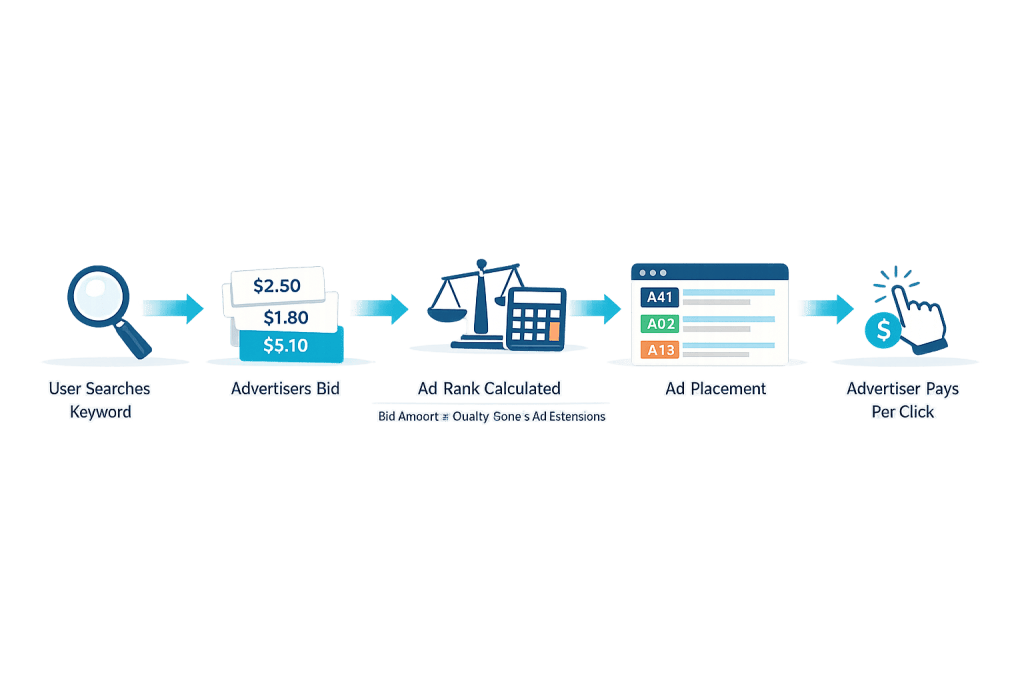
Every PPC platform operates on an auction system. When a user performs a search or loads a page, an auction runs in milliseconds to determine which ads appear and in what order. The outcome is determined by a combination of your bid and your ad quality — not bid alone.
The core mechanics:
- Keyword targeting — You select keywords or audience signals that trigger your ad to show
- Bid setting — You set a maximum amount you’re willing to pay per click, or choose an automated bid strategy
- Quality Score — Platforms like Google evaluate your ad relevance, expected click-through rate (CTR), and landing page experience (see Quality Score)
- Ad Rank — Your bid multiplied by your Quality Score determines where and whether your ad appears
- Cost per click — You pay the actual market price for that placement, which may be less than your maximum bid
[Image: Diagram showing the PPC auction process from keyword search to ad placement and cost determination]
Beyond search ads, PPC encompasses display advertising, shopping ads, video ads, and social media paid placements — all using variations of this pay-per-click or pay-per-impression model.
Purpose & Benefits
1. Immediate, Controllable Traffic
Unlike SEO, which builds traffic gradually, PPC can generate targeted visits within hours of launching a campaign. You control the budget, the targeting, and the timing. This makes PPC particularly valuable for new businesses, product launches, or seasonal promotions where waiting for organic results isn’t an option. Our PPC management services are built around making this immediacy work efficiently.
2. Precise Audience Targeting
PPC platforms offer targeting depth that no other channel matches. You can target by keyword intent, geographic area, device type, time of day, demographic, and behavioral signals. This precision means your cost-per-click (CPC) is spent reaching people who are genuinely likely to be interested in what you offer — rather than broadcasting to an untargeted audience.
3. Measurable and Attributable Results
Every PPC click, conversion, and dollar spent is trackable. With proper conversion tracking setup, you can see exactly which campaigns, ad groups, and keywords generate leads and sales — and calculate return on ad spend (ROAS). This level of measurement makes PPC one of the most accountable channels in digital marketing.
Examples
1. Google Search Ads for a Local Service
A plumbing company runs Google Ads targeting keywords like “emergency plumber” and “water heater installation.” Their ads appear at the top of search results when someone searches those terms. They pay around $15–25 per click — but each qualified lead that becomes a customer is worth several hundred dollars. The math works when the campaign is properly structured and the landing page converts well.
2. E-Commerce Shopping Ads
An online retailer uses Google Shopping ads to display product images, prices, and their store name directly in search results. When someone searches for a specific product, the ad appears with a photo and price — no click required to see key details. These ads are highly effective for bottom-of-funnel shoppers who are ready to purchase.
3. Microsoft Ads for a B2B Software Company
A SaaS company runs Microsoft Ads (Bing) in addition to Google Ads. While Bing has a smaller search volume, it tends to attract an older, professional demographic — often decision-makers with purchasing authority. CPC on Microsoft Ads is frequently lower than Google for the same keywords, making it a cost-efficient complement to a Google campaign.
Common Mistakes to Avoid
- Sending all traffic to the homepage — A PPC ad should direct users to a landing page directly relevant to the ad’s message. Dropping paid traffic on a generic homepage wastes clicks and kills conversion rates.
- Ignoring negative keywords — Without a robust negative keyword list, your ads show for irrelevant searches. A plumber’s ad appearing for “plumber costume” is a wasted click. Negative keywords prevent your budget from being consumed by irrelevant traffic.
- Setting and forgetting campaigns — PPC requires ongoing management. Bids, budgets, Quality Scores, and competitive dynamics change constantly. Campaigns left unattended typically deteriorate in performance over time.
- Not tracking conversions — Running PPC without conversion tracking means you have no idea which clicks generate results. You’re flying blind. Always set up conversion tracking before launching campaigns.
Best Practices
1. Structure Campaigns Around Tight Themes
Organize campaigns and ad groups by tightly related keyword themes. Each ad group should contain keywords with very similar intent, and the ads within should closely match those keywords. Tight structure improves Quality Scores, which lowers CPC and improves ad rank. A well-organized account is easier to manage and consistently outperforms a loosely structured one.
2. Match Landing Pages to Ad Messages
Every ad should link to a landing page that delivers exactly what the ad promised. If your ad says “Free Consultation,” the landing page should feature that offer prominently. Message match reduces bounce rates, improves conversion rates, and boosts your landing page experience score — a direct component of Quality Score.
3. Test Ad Copy Continuously
Run two or more ad variations per ad group and let data determine which performs better. Test different headlines, value propositions, and calls to action. Replace underperforming ads regularly. Over time, continuous testing compounds — the ads that remain are your best performers, and CTR improvements directly lower what you pay per click.
Frequently Asked Questions
How much does PPC advertising cost?
It varies widely by industry, keyword competition, and platform. A CPC of $1–3 is common in low-competition niches; legal and insurance keywords can exceed $50 per click. Budget depends on how much traffic you want and what you can afford to pay per conversion. We typically recommend a starting monthly budget that allows for at least 100–300 clicks to gather meaningful performance data.
What’s the difference between PPC and SEO?
PPC delivers immediate, paid traffic for as long as you’re spending. SEO builds organic (unpaid) traffic over time. PPC stops the moment you stop paying; SEO has compounding effects that persist. Most businesses benefit from running both — PPC for immediate results and competitive gaps, SEO for long-term, sustainable growth.
What is a good click-through rate for PPC ads?
Average CTR for Google search ads is roughly 3–5%, though this varies significantly by industry and ad position. A CTR above that benchmark indicates strong ad relevance and compelling copy. Below average CTR drags down your Quality Score and raises costs.
What’s the difference between PPC and display advertising?
PPC traditionally refers to search ads where you pay per click. Display advertising places banner or visual ads on websites across ad networks — these are often sold on a cost-per-thousand-impressions (CPM) basis rather than per click, though display clicks can also be tracked. Both fall under the broader umbrella of paid digital advertising.
Do I need a professional to manage PPC?
Not required, but expertise matters significantly. Google Ads has a steep learning curve, and mistakes — like poor campaign structure, missing negative keywords, or misaligned landing pages — cost real money. Many businesses find that professional management more than pays for itself in avoided waste and improved performance.
Related Glossary Terms
- Google Ads
- Cost Per Click (CPC)
- Quality Score
- Click-Through Rate (CTR)
- Conversion Tracking
- Conversion Rate
- Landing Page
How CyberOptik Can Help
Running PPC effectively requires more than setting a budget and choosing keywords — it demands strategic structure, ongoing optimization, and disciplined measurement. Our team manages PPC campaigns for clients across a range of industries, building campaigns designed to generate qualified traffic and trackable results. Whether you’re starting from scratch or looking to improve the performance of an existing account, we can help. Get in touch to discuss your marketing goals or explore our PPC services.