
Click-through rate (CTR) is the percentage of people who saw a search result, ad, email, or link and then clicked it. In Google Search Console, CTR measures how often impressions from Google Search turned into website clicks.
CTR matters because visibility alone does not guarantee traffic. If your page appears in search results but people do not click, the title, description, offer, or ranking position may need improvement.
If you saw CTR in your monthly report, start with the report-specific explanation in How to Read Your Monthly Website Care Report.
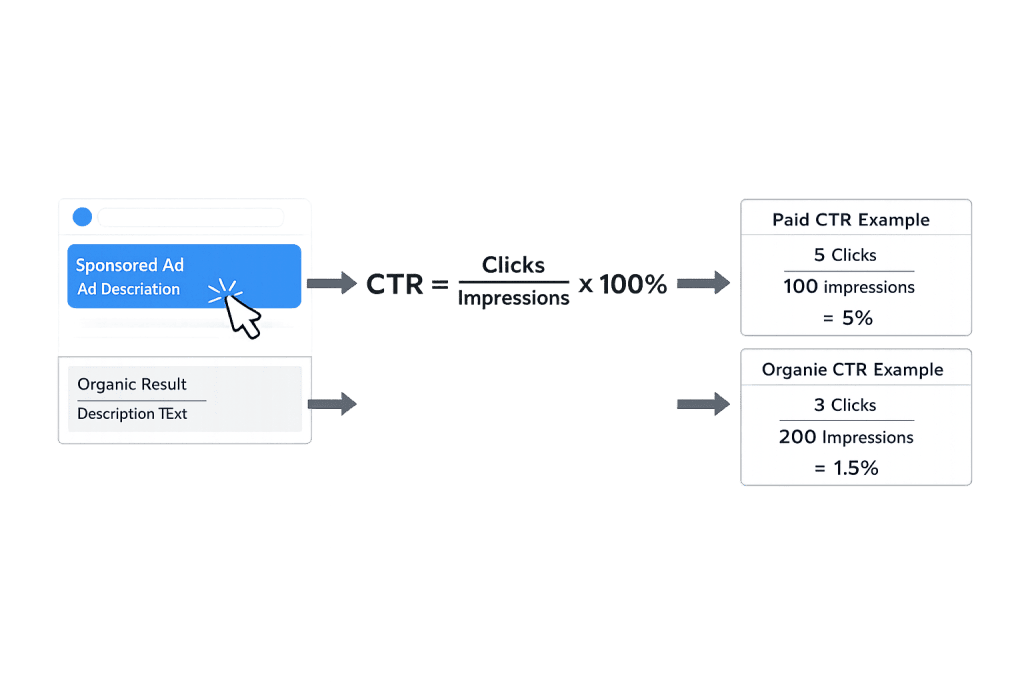
How Click-Through Rate Works
CTR is calculated with a simple formula:
Clicks ÷ Impressions × 100 = CTR
If a page appears in Google results 1,000 times and receives 50 clicks, the CTR is 5%. In Google Search Console, CTR can be viewed by query, page, country, device, or date range.
CTR changes based on context. Branded searches often have a high CTR because the searcher is already looking for a specific company. Broad informational searches usually have a lower CTR because searchers are comparing many options.
Purpose & Benefits
1. Shows Whether Search Results Are Compelling
A page can have strong search visibility but weak traffic if people do not click. CTR helps identify search results that need clearer titles, better meta descriptions, or stronger alignment with intent.
2. Helps Prioritize SEO Improvements
High-impression, low-CTR pages are often good opportunities. The page is already being shown; improving the search result may increase traffic without creating a brand-new page.
3. Connects Rankings to Visitor Behavior
Average position matters, but CTR shows how real searchers respond. A result in position 3 with a strong title may outperform a result in position 2 with a vague one.
Examples
1. Better Page Title
A service page has 10,000 monthly impressions but only a 1% CTR. Updating the title to clearly mention the service, benefit, and audience may make the search result more relevant and improve clicks.
2. Branded Search
A company name may have a CTR of 40% or higher because people searching that name usually want that specific website. That is normal and should not be compared directly with broad non-branded searches.
3. Stronger Local Service Result
A local service page appears often in search but receives few clicks. Updating the title and description to better match what the searcher needs can help turn existing visibility into more visits.
Common Mistakes to Avoid
- Comparing every CTR equally — Branded, local, informational, and competitive searches naturally have different CTR ranges.
- Ignoring ranking position — Lower rankings usually receive fewer clicks. A low CTR may be normal if the page ranks far down the results.
- Writing titles only for keywords — Keyword-stuffed titles can rank but still fail to earn clicks. Write for humans first.
- Overreacting to small samples — A page with 10 impressions and one click has a 10% CTR, but that is not enough data to guide big decisions.
Best Practices
1. Review CTR With Impressions
CTR is most useful when paired with impression volume. A low CTR on a high-impression page is more important than a low CTR on a page few people saw.
2. Improve Titles and Meta Descriptions
Clear titles and meta descriptions help people understand why your page is worth clicking. Use natural language, match search intent, and avoid vague promises.
3. Segment Branded and Non-Branded Searches
Separate searches that include your business name from broader industry searches. This gives a cleaner view of how well your SEO content attracts new prospects.
Frequently Asked Questions
What is a good CTR?
It depends on the channel, query type, and ranking position. A branded search result may have a very high CTR, while a broad informational query may be much lower. Trend and context matter more than one universal benchmark.
Can improving CTR help SEO?
CTR is one signal among many, and Google has not made it a simple ranking lever. Practically, better CTR still matters because it turns existing visibility into more traffic.
Why did CTR drop when impressions increased?
That can happen when your site starts appearing for broader or lower-position searches. More impressions are good, but the new searches may not be as likely to click.
Related Glossary Terms
- Website Impression
- Organic Search
- Organic Keyword
- Meta Description
- Search Engine Results Page (SERP)
- Search Visibility
Related Report Help
- How to Read Your Monthly Website Care Report
- Understanding Google Search Console Metrics in Your Report
How CyberOptik Can Help
Improving CTR is often a practical SEO win because it helps more people click the visibility you already have. We review search queries, page titles, meta descriptions, and content alignment to find those opportunities. Explore our SEO services or contact us for a free website review.