
Customer Lifetime Value (CLV) — sometimes written as LTV or CLTV — is the total revenue a business can expect to receive from a single customer over the entire duration of their relationship. It’s a forward-looking metric that answers a critical business question: how much is a customer actually worth, not just on their first purchase, but over time?
CLV reframes how businesses think about acquisition and retention. A customer who makes a single $50 purchase and a customer who makes twelve $50 purchases over three years have vastly different values — but they might look identical at the point of acquisition. Businesses that understand CLV make better decisions about how much to spend acquiring customers, which customer segments to prioritize, and where to invest in retention and loyalty.
How CLV Is Calculated
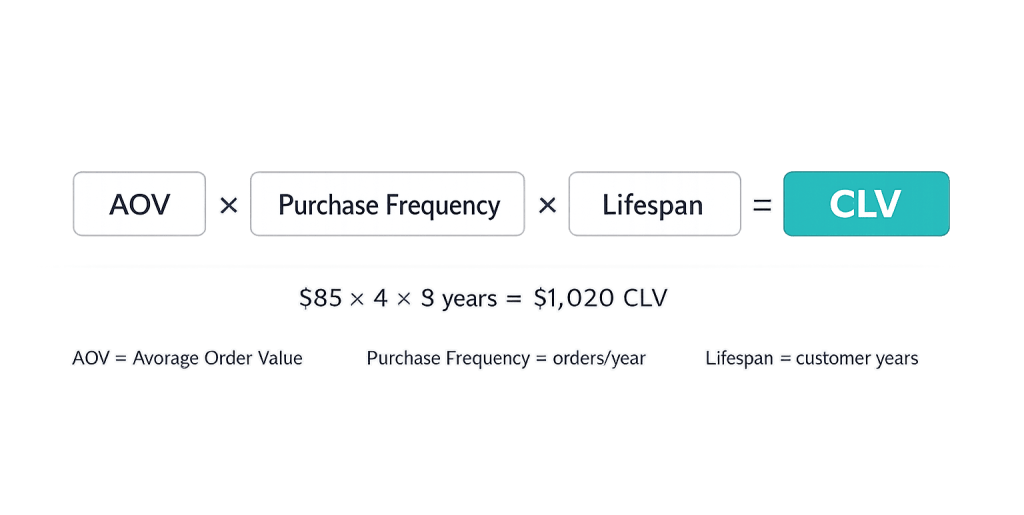
The basic formula:
CLV = Average Order Value (AOV) × Purchase Frequency (per year) × Customer Lifespan (years)
For a business where customers spend an average of $120 per order, purchase three times per year, and remain customers for four years:
CLV = $120 × 3 × 4 = $1,440
A profit-adjusted version multiplies by gross margin:
CLV (profit-based) = $1,440 × 0.40 = $576
This is the contribution to profit that single customer represents. If customer acquisition cost (CAC) is $80, the relationship is highly profitable. If CAC is $600, the business is losing money on every new customer, regardless of what the revenue numbers look like.
Average CLV varies widely by industry and business model. Subscription businesses tend to have high CLV due to recurring revenue; transactional businesses with infrequent purchases need either high average order value or very low acquisition costs to make the math work.
[Image: Formula diagram showing AOV × Purchase Frequency × Lifespan = CLV, with an example calculation]
Purpose & Benefits
1. Sets the True Ceiling on Acquisition Spend
Knowing CLV tells you how much you can afford to spend acquiring a new customer and still be profitable. If your CLV is $800 and your target profit margin requires a CAC below $200, you have clear boundaries for paid advertising bids, commission rates, and promotional offers. Without CLV, acquisition spending is essentially guesswork — you might be profitable or you might be eroding margins without realizing it.
2. Identifies Your Most Valuable Customer Segments
Not all customers have the same CLV. Segmenting by purchase frequency, category preferences, or acquisition channel often reveals that a small percentage of customers drives a disproportionate share of long-term revenue. Understanding which segments have the highest CLV allows marketing budgets and retention efforts to be concentrated where they generate the most return.
3. Justifies Investment in Retention and Experience
It costs five times more to acquire a new customer than to retain an existing one. A 5% increase in customer retention can increase profits by 25–95%. These figures make CLV optimization one of the highest-ROI investments available — improving conversion rate on repeat purchases, reducing churn, and building loyalty programs all increase CLV directly. Our marketing services and eCommerce development work both support CLV-driven strategies.
Examples
1. E-Commerce Store Evaluating Google Ads Spend
An online retailer calculates their CLV at $480 (AOV $80 × 3 purchases/year × 2-year average lifespan). With a 40% margin, the profit-adjusted CLV is $192. This means the business can afford to spend up to $96 per acquired customer (50% of profit CLV) while still being sustainable. They use this to set their Target CPA in Google Ads, avoiding the mistake of bidding based on first-order value alone.
2. SaaS Business with Monthly Subscriptions
A software company has a monthly subscription price of $49 and an average customer lifespan of 18 months before cancellation. CLV = $49 × 12 × 1.5 = $882. With a gross margin of 75%, profit CLV is $661.50. This company can invest heavily in customer success and onboarding — reducing churn even by 10% dramatically increases CLV and has more impact on revenue than equivalent effort put into new customer acquisition.
3. WooCommerce Store Segmenting by Acquisition Channel
A WooCommerce store analyzes CLV by the channel that first acquired each customer. Customers acquired through referrals have an average CLV of $620; customers from paid social have a CLV of $180. The data shows referral customers buy more often and stay longer. This analysis shifts marketing investment toward a referral program and away from a poorly performing paid social budget.
Common Mistakes to Avoid
- Using revenue CLV instead of profit CLV for decisions — Making acquisition spending decisions based on revenue rather than profit can produce unprofitable growth. Always factor in margins when using CLV to set acquisition targets.
- Treating CLV as a fixed number — CLV changes over time as customer behavior evolves, your product mix changes, and market conditions shift. Recalculate CLV quarterly or after significant product or pricing changes.
- Applying an average CLV to all customers equally — The average can mask significant variation between segments. High-CLV customers deserve different retention strategies than average-CLV customers. Use segment-level CLV for targeted decisions.
- Focusing entirely on acquisition and ignoring retention — Many businesses spend 90%+ of their marketing budget on acquisition while neglecting post-purchase experience. A structured retention strategy — email sequences, loyalty programs, proactive customer support — is often the most direct way to increase CLV.
Best Practices
1. Build Post-Purchase Touchpoints to Increase Frequency
Email automations triggered by purchase behavior — follow-up sequences, cross-sell recommendations, reorder reminders — are one of the most cost-effective ways to increase purchase frequency and CLV. A customer who buys once and receives no follow-up communication has a much lower probability of returning than one who receives relevant, timely outreach. Connect this to your cart abandonment strategy as well.
2. Track CLV Alongside Average Order Value (AOV)
AOV measures transaction size; CLV measures relationship value. Both are important and each can be improved through different tactics. AOV improvement typically comes from upsells, bundles, and minimum order incentives. CLV improvement comes from retention, repeat purchase triggers, and reducing churn. Tracking both together gives a complete picture of revenue performance.
3. Use CLV Data to Qualify Your Ideal Customer Profile
Businesses that know their highest-CLV customer segments can work backward to understand what those customers have in common — industry, company size, acquisition channel, product category, or first-purchase behavior. This profile informs targeting decisions in paid advertising, content strategy, and sales prioritization. Acquiring more customers who look like your best customers is more efficient than optimizing for any customer.
Frequently Asked Questions
What is a good Customer Lifetime Value?
There’s no universal benchmark — CLV is meaningful only relative to your customer acquisition cost (CAC). A healthy CLV:CAC ratio is generally 3:1 or higher, meaning each customer generates at least three times what it cost to acquire them. If CLV is close to or below CAC, the business model needs attention either in acquisition cost reduction or retention improvement.
How is CLV different from revenue?
Revenue is a backward-looking measure of what has already been collected. CLV is a forward-looking estimate of total value a customer will generate over their relationship with your business. Revenue answers “how much did we make?” CLV answers “what is each customer relationship worth going forward?”
Can small businesses calculate CLV?
Yes, and it’s worth doing even with simple math. If you know your average sale size, roughly how many times a typical customer buys per year, and how long they typically stay a customer, you can calculate a useful CLV estimate. This doesn’t require a data science team — a basic spreadsheet calculation provides actionable guidance.
How do I increase Customer Lifetime Value?
The most effective levers are: improving repeat purchase rate (email marketing, loyalty programs, product quality), increasing average order value per transaction, and extending customer lifespan through better customer service and experience. Reducing cart abandonment at each purchase improves frequency, while excellent post-purchase experience extends the relationship.
Does CLV apply to service businesses, not just e-commerce?
Absolutely. Any business with ongoing or repeat client relationships has a customer lifetime value — law firms, marketing agencies, accountants, contractors. The calculation adapts: instead of purchase frequency, use contract renewal rate or annual engagement value. CLV thinking is equally important for service businesses where long-term client relationships are the primary revenue driver.
Related Glossary Terms
- Average Order Value (AOV)
- Conversion Rate
- Cart Abandonment
- Conversion Tracking
- Attribution Model
- E-Commerce
How CyberOptik Can Help
Improving customer lifetime value comes from better marketing strategy, a smoother customer experience, and the right analytics to measure what’s working. Our team works at the intersection of digital marketing and eCommerce development — from building WooCommerce stores optimized for repeat purchase to setting up the analytics infrastructure to track CLV accurately. Explore our marketing services and eCommerce services, or get in touch.