
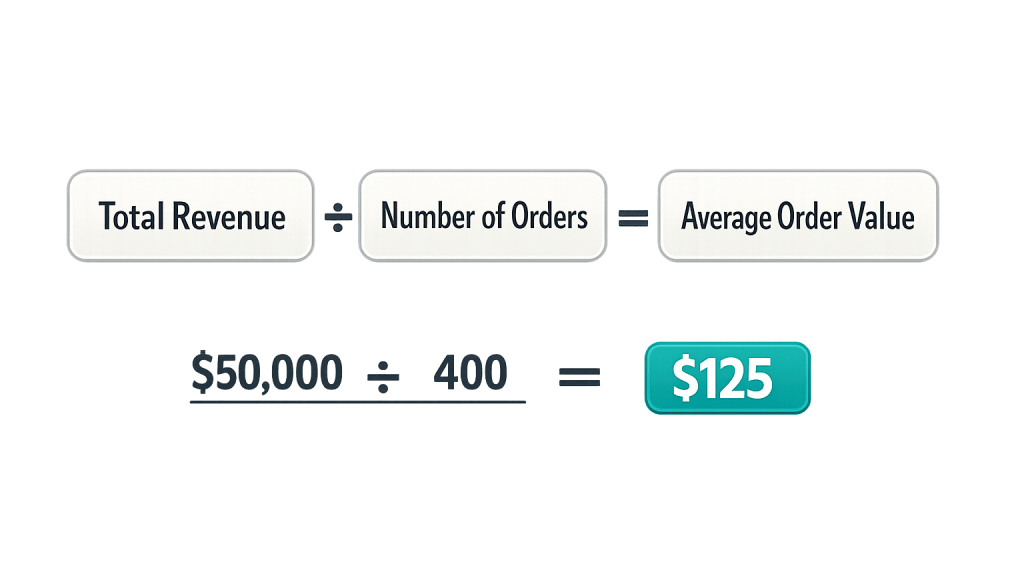
Average Order Value (AOV) is the average amount of revenue generated per transaction in an online store. The formula is straightforward: divide total revenue by the number of orders placed in a given period. If your store generated $50,000 from 400 orders in a month, your AOV is $125.
AOV is one of the three levers that drive e-commerce revenue — alongside the number of customers and the purchase frequency. While acquiring new customers gets most of the attention (and budget), increasing AOV is often the faster and cheaper path to revenue growth. You’re working with customers already committed enough to place an order, so there’s no acquisition cost attached. In 2024, the global e-commerce average order value reached approximately $144, with WooCommerce stores averaging around $122 — though AOV varies dramatically by industry, product type, and business model.
[Image: Simple formula graphic: Total Revenue ÷ Number of Orders = Average Order Value, with an example showing $50,000 ÷ 400 = $125]
How AOV Is Used
AOV serves as a benchmark for evaluating the effectiveness of your store’s merchandising, pricing, and promotional strategy. Tracked over time, it reveals whether changes to your store are moving customers toward larger purchases or smaller ones. Compared against industry benchmarks, it highlights whether your store is under- or over-performing relative to peers.
AOV is also a critical input for calculating Customer Lifetime Value (CLV) and determining how much you can afford to spend to acquire a customer. If your AOV is $100 and your margin is 40%, you’re generating $40 of gross profit per order. Knowing that number tells you what a profitable customer acquisition cost looks like.
Worth understanding: desktop shoppers consistently generate higher AOV than mobile shoppers — desktop AOV runs roughly 50–75% higher than mobile on most platforms. This gap represents an opportunity for mobile checkout optimization.
Purpose & Benefits
1. Revenue Growth Without Additional Customers
Increasing AOV generates more revenue from the traffic you already have. A 15% increase in AOV produces the same revenue impact as a 15% increase in customer count — with none of the marketing cost required to attract new buyers. This makes AOV improvement one of the most efficient levers available to e-commerce businesses.
2. Improved Return on Ad Spend
When your AOV rises, your return on paid advertising spend improves proportionally. If you’re spending $50 to acquire a customer and your AOV goes from $80 to $110, your advertising economics shift meaningfully. Our team builds WooCommerce stores with AOV optimization built in from the start — product page layouts, cart upsells, and checkout flows all contribute.
3. Better Customer Lifetime Value
AOV feeds directly into Customer Lifetime Value. Customers who spend more per transaction and return to buy again are significantly more valuable than single-purchase, low-AOV customers. Strategies that increase AOV also tend to increase engagement and repurchase rates, compounding the revenue impact over time.
Strategies to Increase AOV
1. Upselling and Cross-Selling
Upselling encourages the customer to purchase a more expensive version of what they’re already considering. Cross-selling suggests complementary products alongside the main purchase. Cross-selling is responsible for up to 35% of Amazon’s revenue and can be implemented on product pages, in the cart, and at checkout in WooCommerce. The key is relevance — suggestions that clearly fit the customer’s purchase perform; random additions feel pushy.
2. Product Bundles and Kits
Bundles combine related items at a slight discount compared to buying them individually. When customers perceive a bundle as a good deal, 72% of bundle builder sessions end with items added to cart, according to e-commerce research. Effective bundles have a logical relationship between products, make the value obvious, and are priced to feel like a better deal than individual purchase — without eroding margin.
3. Free Shipping Thresholds
Offering free shipping above a minimum order value directly nudges customers toward higher purchases. If your average order is $65 and you set a free shipping threshold at $85, you give shoppers a concrete reason to add one more item. The threshold should sit roughly 20–30% above your current AOV to be effective — low enough to feel achievable, high enough to meaningfully impact revenue. This is one of the most commonly effective AOV tactics in WooCommerce stores.
Examples
1. Free Shipping Threshold in Action
An outdoor gear store has an AOV of $72. They implement free shipping on orders over $90. Within the first month, they see customers adding lower-priced accessories (socks, water bottle clips, sunscreen) to reach the threshold. AOV climbs to $88. The store gives away some shipping cost but generates substantially more revenue per order.
2. Cart Upsell at Checkout
A skincare brand integrates a post-add-to-cart upsell in their WooCommerce checkout: “Add a travel-size version of this moisturizer for $12.” The offer is directly relevant, low-friction (one click), and positioned before the customer has mentally closed the purchase. This type of upsell typically converts at 10–15%, adding meaningful AOV impact across all orders without disrupting the checkout flow.
3. Product Bundle Strategy
A coffee subscription company offers their beans individually at $18 each. They create a “3-Bag Sampler Bundle” at $48 (versus $54 if bought separately). Customers who discover the bundle are more likely to choose it because the savings are visible and the value is clear. The company’s AOV jumps on bundle transactions while customers get more variety — reducing churn in the process.
Common Mistakes to Avoid
- Setting a free shipping threshold too high — If the threshold is far above your AOV, it feels unachievable to customers and won’t change behavior. The goal is to nudge, not frustrate. A threshold 20–30% above your current AOV is the practical range.
- Upselling irrelevant products — Suggesting a kitchen appliance to someone buying sneakers doesn’t increase AOV — it just looks like bad algorithm work. Upsells and cross-sells need to be logically connected to the original purchase to convert.
- Discounting your way to higher AOV — Heavy blanket discounts can temporarily increase transaction size but erode margin. Targeted promotions (spend $X, save $Y) are more effective than sitewide percentage discounts for improving AOV without margin damage.
- Ignoring mobile checkout optimization — Desktop orders consistently generate higher AOV than mobile. If your WooCommerce checkout is clunky on phones, you’re leaving revenue on the table at the most critical step.
Best Practices
1. Implement WooCommerce Upsells and Cross-Sells Natively
WooCommerce has built-in support for upsells (shown on product pages) and cross-sells (shown in the cart). Use these fields intentionally for every product, connecting items that genuinely complement each other. For stores with large catalogs, plugins like Cart Upsell for WooCommerce or similar tools can automate suggestions based on cart contents and purchase history.
2. Test Threshold Positions and Bundle Combinations
AOV optimization benefits from systematic testing. Run your free shipping threshold at two different values for a month each and compare the impact on both AOV and order volume. Test different bundle combinations and price points. What works for one product category may not work for another — data from your own store is more reliable than industry generalizations. Conversion rate and AOV often move together when tested thoughtfully.
3. Track AOV Alongside Conversion Rate
AOV and conversion rate can be in tension. Some tactics that raise AOV (requiring a minimum order for discounts, for example) may slightly reduce overall conversion rate. Monitor both metrics together to ensure that AOV improvements aren’t coming at the cost of fewer completed purchases. The goal is total revenue growth, not optimization of a single metric in isolation.
Frequently Asked Questions
What is a good AOV for an e-commerce store?
It depends heavily on your industry and product type. In 2024, the global e-commerce average was approximately $144. WooCommerce stores average around $122, while Shopify stores average closer to $92. Luxury and jewelry stores average $380–$436. The most useful comparison is against your own historical performance and against direct competitors, not against an aggregate benchmark.
How is AOV different from revenue per visitor?
AOV only counts orders that were placed — it’s revenue per transaction. Revenue per visitor factors in your overall traffic and conversion rate. A high AOV with low conversion rate may generate less revenue than a lower AOV with a higher conversion rate. Both metrics matter; AOV in isolation doesn’t tell the full story.
Does increasing AOV affect customer acquisition cost calculations?
Yes, significantly. Customer Lifetime Value calculations use AOV as a key input. As AOV rises, the maximum profitable customer acquisition cost rises with it — meaning you can invest more in paid advertising or other acquisition channels and still maintain healthy margins. This is why AOV is worth tracking alongside your paid media performance.
Can I increase AOV without reducing my conversion rate?
Often, yes — if the tactics are well-implemented. Free shipping thresholds, product bundles, and post-purchase upsells are generally low-friction and don’t interrupt the checkout flow. Overly aggressive upsells during checkout or mandatory add-on steps can reduce conversion. The best AOV tactics feel like they’re helping the customer, not extracting from them.
What WooCommerce tools help with AOV?
Native WooCommerce upsell and cross-sell fields are a strong starting point. Popular plugins include Booster for WooCommerce (includes order minimum settings), WooCommerce Product Bundles, and various cart upsell plugins. For more sophisticated recommendation engines, Retainful and CartFlows offer flow-based upsell sequences.
Related Glossary Terms
- WooCommerce
- Cart Abandonment
- Conversion Rate
- Customer Lifetime Value (CLV)
- Checkout Flow
- E-Commerce
- Conversion
How CyberOptik Can Help
Building a WooCommerce store that’s optimized for AOV requires thoughtful product page design, smart cart and checkout flows, and the right plugin configuration. We build and optimize WooCommerce stores with revenue metrics like AOV in mind — from upsell placement to free shipping threshold strategy to post-purchase email sequences. If your store is generating traffic but leaving revenue on the table per transaction, we can help identify and fix the gaps. Contact us to start your e-commerce project or explore our e-commerce services.