Cart abandonment occurs when an online shopper adds items to their shopping cart but leaves the website before completing the purchase. Based on data aggregated across 50 studies by the Baymard Institute, the average cart abandonment rate sits at approximately 70% — meaning seven out of every ten shoppers who add items to a cart never check out.
For businesses running WooCommerce stores, cart abandonment represents real, recoverable revenue. A store processing 1,000 “add to cart” actions per month with a 70% abandonment rate is potentially losing 700 sales. The good news: many of those lost sales can be recovered with the right combination of checkout design, transparency, and follow-up strategy.
[Image: Funnel diagram showing Browse → Add to Cart → Begin Checkout → Complete Purchase, with drop-off percentages at each stage]
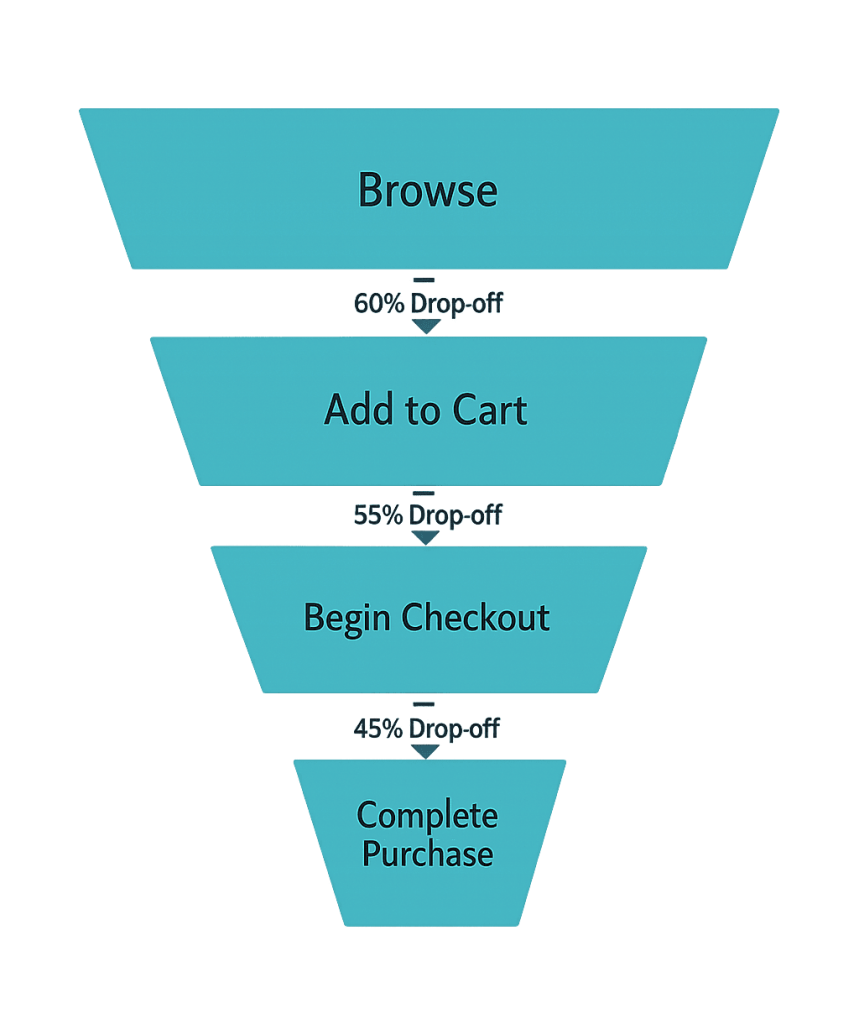
Why Cart Abandonment Happens
Shoppers abandon carts for a range of reasons, and understanding which ones apply to your store is the first step toward reducing the rate:
- Unexpected costs — Shipping fees, taxes, or handling charges that appear for the first time at checkout are the leading cause. According to Baymard, 39% of shoppers abandon due to extra costs being too high.
- Forced account creation — Requiring users to register before purchasing adds friction. Guest checkout options reduce this barrier significantly.
- Complex checkout process — Too many steps, too many required fields, or a confusing layout causes drop-off. Every extra step costs a percentage of potential buyers.
- Security concerns — If the checkout experience doesn’t feel trustworthy — no SSL certificate, unfamiliar payment gateway, or outdated design — shoppers hesitate.
- Just browsing or price comparing — Some abandonment is intentional research behavior. The shopper isn’t ready to buy yet.
- Mobile friction — Mobile abandonment rates average around 80%, compared to 70–73% on desktop, largely because checkout forms are harder to complete on small screens.
Purpose & Benefits of Addressing Cart Abandonment
1. Recover Lost Revenue
Cart recovery strategies — automated email sequences, exit-intent popups, and retargeting ads — can recapture a meaningful percentage of otherwise lost sales. For a store generating $50,000/month in potential checkout revenue, even a 5–10% recovery rate represents $2,500–$5,000 in additional monthly revenue without additional marketing spend. Our eCommerce services include checkout optimization as part of every store build.
2. Reveal Friction in the Checkout Flow
Analyzing abandonment patterns exposes exactly where shoppers drop off — and why. This data drives improvements to the checkout flow that benefit all shoppers, not just those who would have abandoned. A store that fixes its surprise-shipping-cost problem improves conversion for every visitor going forward.
3. Build Customer Relationships
Cart abandonment emails, when written well and timed thoughtfully, can turn a browser into a buyer — and a buyer into a repeat customer. A personalized reminder that acknowledges the abandoned cart and offers helpful information (or a modest incentive) demonstrates that you value the customer’s business.
Examples
1. Automated Email Recovery Sequence
A WooCommerce store connects a cart abandonment plugin that triggers a three-email sequence:
– Email 1 (1 hour after abandonment): “You left something behind” — a simple reminder with a link back to the cart and product images
– Email 2 (24 hours later): “Still thinking it over?” — includes customer reviews and a clear return policy statement
– Email 3 (72 hours later): A modest discount or free shipping offer for completing the purchase
This sequence, which is standard practice for established eCommerce stores, recovers a portion of carts that would otherwise be permanently lost.
2. Exit-Intent Popup
When a shopper moves their cursor toward the browser’s close or back button during checkout, an exit-intent popup appears. It might highlight free shipping eligibility, display a trust badge, or offer a limited-time incentive. This targets the specific moment of hesitation and gives the shopper a reason to stay.
3. Retargeting Campaigns
A shopper who added a specific product to their cart but didn’t purchase later sees that exact product advertised on social media or other websites they visit. Retargeting campaigns serve as persistent (but not intrusive) reminders that bring warm leads back to complete their purchase.
Common Mistakes to Avoid
- Hiding shipping costs until checkout — If shipping isn’t free, show estimated costs on the product page or cart page. Surprise fees at the final step are the single biggest driver of abandonment.
- Sending recovery emails too aggressively — Daily emails after abandonment come across as desperate and can damage brand perception. A well-spaced 3-email series over 3–7 days is the standard best practice.
- Neglecting mobile checkout — With mobile abandonment rates averaging around 80%, a checkout form that’s hard to complete on a phone is a significant revenue leak. Mobile-first checkout design isn’t optional anymore.
- Conditioning shoppers to expect discounts — If every recovery email includes a coupon, savvy shoppers may learn to abandon intentionally to trigger the discount. Save incentives for the second or third email, and vary the offers.
Best Practices
1. Simplify the Checkout Process
Reduce the number of form fields and steps required to complete a purchase. WooCommerce supports one-page checkout configurations and guest checkout — both of which demonstrably reduce abandonment. Every field you eliminate is a moment of friction removed. Consider which fields are truly necessary and which are just convenient for your records.
2. Be Transparent About All Costs Early
Display shipping costs, taxes, and any fees as early as possible — ideally on the product page or in the cart, before the customer reaches checkout. A shipping cost calculator on the WooCommerce cart page is a practical solution that sets expectations correctly before shoppers commit to the checkout process.
3. Use Multiple Recovery Channels
Don’t rely solely on email. Combine cart recovery emails with retargeting ads, SMS reminders (for opted-in customers), and on-site exit-intent messaging. Each channel captures a different segment of abandoning shoppers. Together, they create a recovery system that works even when any single channel misses.
Frequently Asked Questions
What is a good cart abandonment rate?
The global average is approximately 70% (Baymard Institute). If your rate is below 60%, you’re performing well relative to benchmarks. If it’s above 80%, there’s likely a significant friction point in your checkout that warrants immediate attention — most often surprise costs or a complicated checkout flow.
Do cart abandonment emails actually work?
Yes. Cart recovery emails consistently outperform most other email types in open rates and conversions. Studies show they average a 40–45% open rate and can recover 5–15% of abandoned carts, depending on the industry, timing, and quality of the email sequence.
What WooCommerce plugins help with cart abandonment?
Popular options include WooCommerce Cart Abandonment Recovery (free), Retainful, CartFlows, and Metorik. These plugins automate email sequences, track abandonment data, and support coupon generation for recovery campaigns.
Is offering a discount always the right recovery strategy?
Not necessarily. Discounts work, but they train shoppers to abandon intentionally. Free shipping is often a more sustainable incentive — it addresses the most common abandonment reason (unexpected costs) without cutting into your margin on the product itself. Test both approaches to see what works best for your customer base.
Should I prioritize reducing abandonment or recovering abandoned carts?
Both, but reducing abandonment first. A checkout redesign that prevents 10% more shoppers from leaving is worth more than a recovery campaign that recaptures 5% of those who left. Fix the checkout experience, then layer recovery campaigns on top for the remaining abandonment that’s unavoidable.
Related Glossary Terms
How CyberOptik Can Help
Cart abandonment is a revenue problem with a design and strategy solution. We build WooCommerce stores optimized for conversion — from streamlined checkout flows and transparent cost displays to automated recovery email sequences. If your store is losing sales at checkout, we can help identify the friction points and fix them. Contact us to discuss your eCommerce project or explore our eCommerce development services.