AI Overview (Google AIO) is Google’s AI-generated summary that appears at the top of search results for eligible queries — above traditional organic listings, featured snippets, and paid ads. Powered by Google’s Gemini AI, these summaries synthesize information from multiple sources to answer a search query directly on the results page, with citations linking back to the sources used.
Google rolled out AI Overviews to all U.S. users in May 2024, following an extended test period under the name “Search Generative Experience” (SGE). By the time of that launch, the search landscape was already shifting — and AI Overviews have since become one of the most significant changes to organic search in years. They appear more frequently on informational queries (how-to, what-is, explanatory) than transactional or navigational ones.
[Image: Screenshot of a Google search results page showing an AI Overview box at the top, with citation links on the side, followed by traditional organic results below]
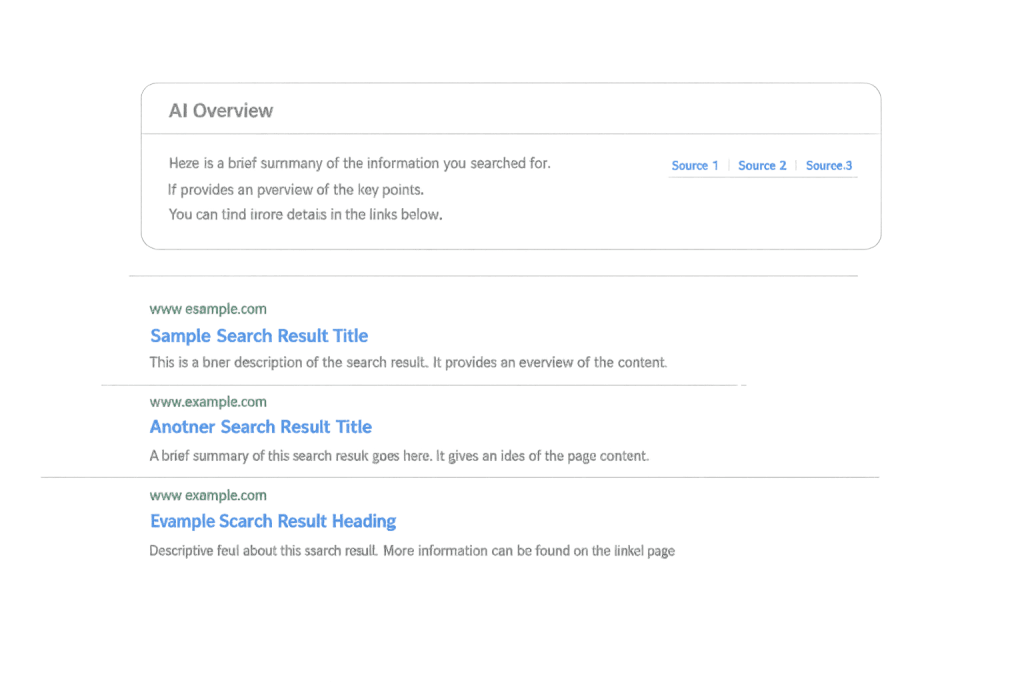
How Google AI Overviews Work
When a user enters a query, Google’s systems determine whether an AI Overview is appropriate. If triggered, Gemini synthesizes a response drawing from multiple indexed web pages, displaying a paragraph or set of bullet points as the answer. The right side of the Overview (or an expandable section) shows the sources cited.
Key mechanics:
- Not all queries trigger AIOs — Informational, educational, and how-to queries are most likely to trigger an Overview. Branded searches, local queries (“near me”), highly transactional queries, and breaking news are less likely.
- You cannot opt out of being cited — If your content is indexed and relevant, Google may cite it in an AIO without any direct action from you (or any warning).
- Citation ≠ ranking — A page cited in an AI Overview may not be in the top 10 organic results. The AIO has its own source selection logic, separate from traditional ranking.
- AIOs evolve — Google continues to adjust how frequently they appear, which queries trigger them, and how they’re displayed.
Purpose & Benefits
1. Understanding the New Click Landscape
Research by Seer Interactive analyzed 3,119 informational queries across 25.1 million organic impressions from June 2024 through September 2025. Their findings: organic click-through rates for queries with AI Overviews dropped 61% (from 1.76% to 0.61%). Paid CTR dropped 68%. Even queries without AI Overviews saw organic CTR fall 41% — suggesting a broader behavioral shift, not just an AIO effect. For any business dependent on organic search traffic, understanding this shift is now essential to realistic planning.
2. The Citation Advantage Is Real
The same Seer Interactive research found that brands cited in an AI Overview earned 35% more organic clicks and 91% more paid clicks than brands not cited at all. Being cited doesn’t replace rankings — but it provides a meaningful visibility layer above traditional results. Optimizing for AIO citation is becoming a distinct component of a comprehensive SEO strategy.
3. Shifting Success Metrics
With fewer clicks happening for any given query, measuring success only by traffic and click volume becomes incomplete. AI Overviews accelerate a shift toward “share of voice” and “visibility” metrics — how often your brand appears in AI-generated answers, not just how many clicks it receives. This requires different tracking approaches and a broader definition of SEO success.
Examples
1. Informational Query Triggering an AIO
A user searches “how to improve website page speed.” An AI Overview appears summarizing techniques: image compression, caching, minimizing render-blocking scripts, using a CDN. The Overview cites 4–6 sources. A website that ranks #4 organically but is cited in the AIO may actually receive more visibility than if the AIO weren’t present — even with overall lower click rates.
2. Transactional Query Without an AIO
A user searches “hire a web design agency.” No AI Overview appears — Google recognizes this is a service-intent query, not an informational one. The traditional results page (with local maps, organic listings, and paid ads) remains intact. This distinction matters for businesses whose primary conversions come from high-intent searches — those queries are largely unaffected by AIOs.
3. A Business Gets Cited Without Optimizing for It
A small law firm publishes a thorough guide on their website about what to expect during a personal injury case. They rank #6 organically for related queries. Google’s AI Overview for “what happens in a personal injury lawsuit” cites their guide as a source — appearing above the #1 organic result. Their organic clicks increase despite not targeting AIO optimization specifically. Comprehensive, authoritative content earns citations.
Common Mistakes to Avoid
- Assuming AIOs eliminate all organic value — Transactional, local, branded, and navigational queries are largely untouched by AIOs. Businesses whose leads come primarily from these query types face less disruption than informational-heavy content sites.
- Treating AIO optimization as separate from general SEO — The content signals that earn AIO citations overlap heavily with good SEO fundamentals: clear structure, authoritative sourcing, comprehensive topic coverage, strong E-E-A-T signals. There’s no shortcut separate from building genuinely good content.
- Ignoring the change in traffic measurement — If organic traffic appears to be declining, it’s worth checking whether AI Overviews are now appearing for your key queries. The traffic may be lower, but your brand visibility in the AIO (and its citation value) is worth measuring separately.
- Trying to “game” AIO citation — Google doesn’t publish a formula for what gets cited. Tactics that try to reverse-engineer citation selection (keyword stuffing, mimicking AIO output structure artificially) carry the same risks as other manipulative SEO approaches.
Best Practices
1. Structure Content for Direct Answers
AI Overviews favor content that answers questions clearly and directly. Use descriptive H2 and H3 headers that mirror natural search queries. Open each section with a clear, concise answer before expanding into detail. This “answer-first” structure serves both users and AI summarization systems — and it’s the same structure that tends to earn featured snippets, which preceded AIOs.
2. Build Topical Authority, Not Just Individual Pages
Google’s AI systems are designed to surface sources that demonstrate deep expertise on a topic. A single well-written page rarely outperforms a site that has built comprehensive coverage across related topics. An SEO strategy aimed at AIO visibility should include content clusters that cover a topic from multiple angles — not just isolated, high-volume target pages.
3. Invest in E-E-A-T Signals
AI Overviews disproportionately cite content from authoritative sources. This means author credentials, factual accuracy, citing external sources, regular content updates, and building genuine expertise signals are more important than ever. Content that demonstrates real experience — specific examples, original insights, genuine expertise — earns citation and trust where generic content doesn’t.
Frequently Asked Questions
Do Google AI Overviews hurt organic traffic?
For informational queries, yes — the data is clear. Seer Interactive found a 61% drop in organic CTR for queries with AI Overviews. Ahrefs found a 58% reduction in CTR for position one content. However, being cited in an AIO partially offsets this — cited brands earn 35% more clicks than non-cited brands. The impact varies significantly by query type and industry.
Can I opt out of appearing in Google AI Overviews?
Not currently through a specific opt-out mechanism. You can use nosnippet meta tags or data-nosnippet HTML attributes to prevent Google from using specific sections of your content in snippets — which may reduce AIO citation likelihood. But there’s no direct, targeted way to opt out of AIO citation specifically.
How is an AI Overview different from a featured snippet?
A featured snippet pulls a verbatim excerpt from a single page and displays it in a box above organic results. An AI Overview synthesizes information from multiple sources into a generated paragraph or list, with citations. AIOs are longer, draw from multiple sources, and are generated rather than extracted. Both can reduce click-through for the queries they appear on.
What types of queries are most affected by AI Overviews?
Informational queries — “how to,” “what is,” “why does,” “explain” style questions — are most likely to trigger AIOs and see the largest CTR impacts. Transactional queries (“buy,” “hire,” “pricing”), navigational queries (brand names), and local queries (“near me”) are far less likely to trigger AIOs.
Is optimizing for AI Overviews different from regular SEO?
The fundamentals overlap significantly. Clear structure, comprehensive content, strong E-E-A-T, and authoritative sourcing are valuable for both. The main additions for AIO optimization are: structuring content with direct answers first, building topic clusters rather than isolated pages, and shifting measurement to include share-of-voice alongside click metrics.
Related Glossary Terms
- AI-Powered Search
- AI Content Detection
- E-E-A-T
- Click-Through Rate (CTR)
- On-Page SEO
- Search Engine Results Page (SERP)
- Content Strategy
- Featured Snippet
How CyberOptik Can Help
AI Overviews have fundamentally changed what it means to rank well in Google. Traffic metrics alone no longer tell the full story. Our SEO team tracks AIO citation visibility, builds content strategies aligned with AI-era search patterns, and helps clients adapt measurement to what actually matters now. Whether you need a fresh SEO audit, a content strategy built for topical authority, or help making sense of shifting traffic data, we’re here. Learn about our SEO services or learn about our AI & SEO services. Contact us to talk through your situation.