
AI content detection refers to the tools, technologies, and methods used to identify whether a piece of writing was generated (fully or partially) by artificial intelligence rather than written by a human. As AI writing tools like ChatGPT, Claude, and Gemini have become widely used for content creation, AI detection has grown into its own category — used by educators, publishers, SEO professionals, and content teams to assess content authenticity.
The practical stakes vary by context. For academic institutions, detecting AI-generated student submissions is an integrity issue. For businesses managing content at scale, AI detection tools help maintain quality standards and editorial consistency. For SEO and digital marketing, the question is more nuanced: Google has stated its focus is on content quality and helpfulness rather than how content was produced — but the execution matters considerably.
How AI Content Detection Works
Detection tools analyze text using machine learning models trained to recognize patterns common in AI-generated writing. Two primary signals most tools measure:
- Perplexity — A measure of how predictable the text is. AI models tend to choose statistically likely word sequences, resulting in lower perplexity scores. Human writing is less predictable, producing higher perplexity.
- Burstiness — Human writers naturally vary sentence length and structure. AI output often has more uniform sentence patterns, resulting in lower burstiness. Detection tools flag this uniformity as an AI indicator.
Leading tools as of 2025–2026 include:
- Originality.ai — Designed for professional content teams; combines AI detection with plagiarism checking. Claims 99% accuracy on pure AI-generated content.
- GPTZero — Widely used in academic settings; shows perplexity and burstiness scores alongside an overall assessment. Benchmarked at ~99% accuracy for pure AI text on the RAID dataset.
- Copyleaks — Focuses on plagiarism alongside AI detection; commonly used by institutions.
- Winston AI — Another option used by publishers and content agencies.
Detection accuracy is highest on purely AI-generated text and decreases with heavily edited AI output or content that blends human and AI writing. False positives — flagging human writing as AI — remain an ongoing limitation, particularly for non-native English writers and highly technical content.
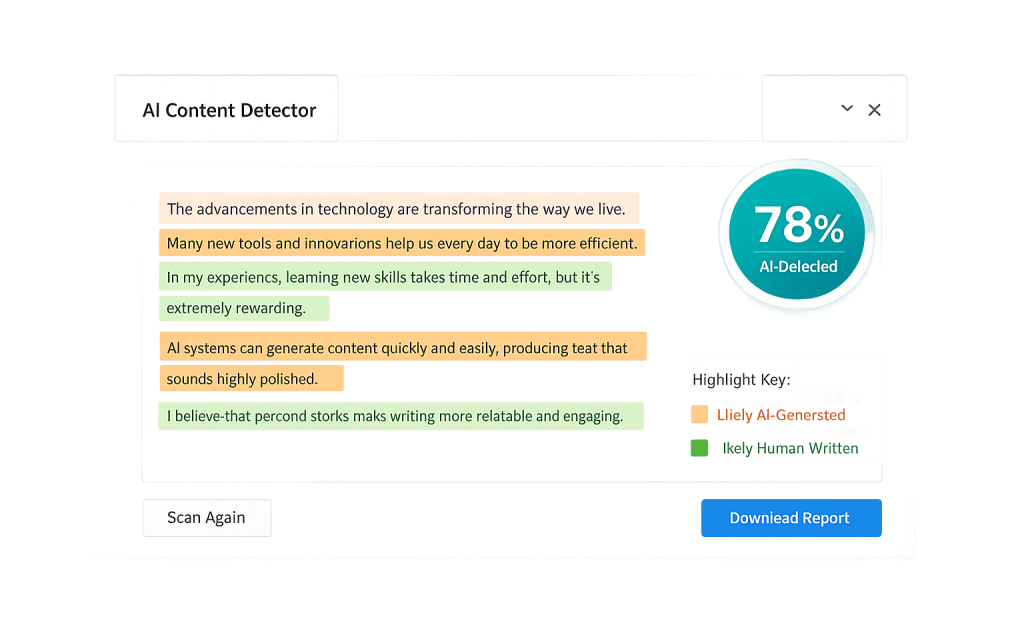
[Image: Screenshot showing an AI detection tool’s output for a sample passage, with highlighted sentences and a percentage score]
Purpose & Benefits
1. Maintain Content Quality and Brand Voice
AI tools produce text quickly, but not always accurately or authentically. Detection helps content teams spot unreviewed AI output before it’s published — catching generic phrasing, factual errors, or writing that doesn’t match your brand voice. A business publishing AI content wholesale, without editorial oversight, risks a disconnect between what they publish and what they actually know and believe. Our copywriting services are grounded in human expertise, not automated generation.
2. Manage SEO Risk Intelligently
Google’s official position (updated 2023) is that AI-generated content is not inherently penalized — what matters is whether content demonstrates E-E-A-T (Experience, Expertise, Authoritativeness, Trustworthiness) and serves users well. However, a 16-month study by SE Ranking found that purely AI-generated content on new domains saw ranking collapse after about three months, dropping from 28% of pages in the top 100 to just 3%. Detection tools help teams assess where AI-assisted content may need more human depth before publication.
3. Preserve Editorial Standards
For publishers, agencies, and businesses that accept contributed content, AI detection is a practical screening tool. It doesn’t replace editorial judgment, but it flags content that warrants closer review. When combined with fact-checking and brand voice assessment, it helps maintain the standards that matter for building authority over time.
Examples
1. Content Agency Quality Control
A digital marketing agency uses Originality.ai to screen every article before delivery to clients. Pieces that score above 30% AI probability are flagged for additional human editing — adding specific examples, expert quotes, and brand-appropriate language. The tool doesn’t reject AI assistance outright; it ensures AI-generated drafts receive proper human review before publication.
2. Academic Integrity Screening
A university writing center uses GPTZero to screen submitted papers. Submissions flagged as high-probability AI content go to a faculty review rather than automatic rejection — because false positives occur, and a policy of flagging for human review (rather than automatic penalization) reduces the risk of unfairly penalizing students whose genuine writing happens to score poorly.
3. In-House Content Team Workflow
A B2B software company uses AI to generate first drafts of blog posts, then runs them through a detection tool before editing. Not because they’re trying to “hide” AI use, but because they’ve found that highly-AI-scored drafts tend to be generic and need more substantive rewriting. The score has become a proxy for “does this need more work?”
Common Mistakes to Avoid
- Treating detection scores as definitive — No current tool is 100% accurate on all content types. False positives happen, especially for formal or technical writing styles. Use detection as one signal, not a final verdict.
- Assuming detection tools can catch everything — Heavily edited AI content, content passed through “humanizing” tools, or content that blends AI and human writing extensively can score low even when AI was heavily involved. Detection has real limitations.
- Conflating AI detection with Google penalties — Google does not currently penalize content for being AI-generated. It penalizes content that is unhelpful, thin, or manipulative — whether written by humans or AI. Don’t let detection scores drive publish/no-publish decisions without considering actual content quality.
- Ignoring the false positive problem — Non-native English writers, highly formulaic content (legal disclaimers, product specs), and academic writing styles often score as AI-generated. Any workflow that automatically rejects high-scoring content needs human review built in.
Best Practices
1. Use Detection as an Editorial Trigger, Not a Gatekeeper
Rather than blocking content based on a score, use AI detection to identify which pieces need more human input. A high AI probability score should prompt a closer read and a question: “Does this content demonstrate real expertise? Does it say something only we could say?” That question matters more than the score.
2. Combine AI Assistance with Human Expertise
The most defensible approach to AI-assisted content is using AI for structure and speed, then adding human expertise, specific examples, original data, and genuine editorial voice. Content that demonstrates real experience and specific knowledge is both more useful to readers and more durable in search — regardless of how it was drafted.
3. Stay Current as Tools Evolve
AI writing models update frequently, and detection tools update in response. A tool that was highly accurate six months ago may perform differently on content from the latest model versions. If detection is part of your content workflow, periodically re-evaluate the tool you’re using against current AI output.
Frequently Asked Questions
Can Google detect AI-generated content?
Google hasn’t confirmed whether it uses AI detection internally. What Google has confirmed is that it evaluates content quality based on helpfulness and E-E-A-T signals — not production method. However, a 16-month experiment tracking AI content on zero-authority domains found that pure AI content rankings collapsed within months, suggesting quality assessment (not detection) is the mechanism at work.
Are AI content detection tools accurate?
The leading tools (Originality.ai, GPTZero) claim 99% accuracy on purely AI-generated text. Accuracy decreases on edited or hybrid content — and false positive rates vary. GPTZero reports a low false positive rate; other tools can over-flag naturally formal or structured human writing. Treat any score as indicative, not definitive.
Does AI content hurt SEO?
Not automatically. Google’s guidance is clear: well-written, helpful, original content can perform well regardless of how it was produced. The risk is when AI content is published at scale without human review — that often produces thin, generic content that fails on quality signals, which does hurt rankings.
What is a “false positive” in AI detection?
A false positive is when a detection tool flags human-written content as AI-generated. This happens most often with formal writing styles, repetitive content formats, and non-native English. It’s a real limitation — no current tool is reliable enough to be used as an automated judgment system without human review.
Should I disclose when content is AI-assisted?
There’s no universal legal or SEO requirement to disclose AI assistance currently. Google does not require it. However, some editorial and journalistic standards are beginning to recommend disclosure for fully or substantially AI-generated content. The practical question is usually about quality and authenticity rather than disclosure.
Related Glossary Terms
- AI Overview (Google AIO)
- AI-Powered Search
- E-E-A-T
- Content Strategy
- Content Marketing
- Blog / Blogging
- Black Hat SEO
How CyberOptik Can Help
AI is reshaping how content is produced — and quality standards are the differentiator between content that builds authority and content that doesn’t. Our copywriting team produces content grounded in genuine expertise and editorial review, using AI tools as assistants rather than replacements. Whether you need a content strategy, ongoing blog production, or help establishing standards for your in-house team, we can help. Explore our copywriting services or learn about our AI & SEO services. Contact us to discuss your content goals.