People Also Ask (PAA) is an interactive SERP feature that Google displays on search results pages as a set of expandable question boxes related to the original search query. When a user clicks on a question, Google expands the box to reveal a concise answer pulled from a specific webpage, along with a link to that page. As users interact with the questions, Google dynamically loads additional related questions beneath the answers — making PAA an ever-expanding discovery tool for searchers.
People Also Ask boxes typically appear near the top of search results, often right below the first organic result or immediately following a featured snippet. For businesses and content creators, appearing in a PAA box means prominent SERP visibility — even if the underlying page ranks on page two or lower for that query. PAA has grown significantly, with prevalence increasing over 34% on mobile and 37% on desktop from early 2024 to early 2025, according to seoClarity research.
[Image: Screenshot of a Google SERP showing People Also Ask boxes with expandable question-answer pairs]
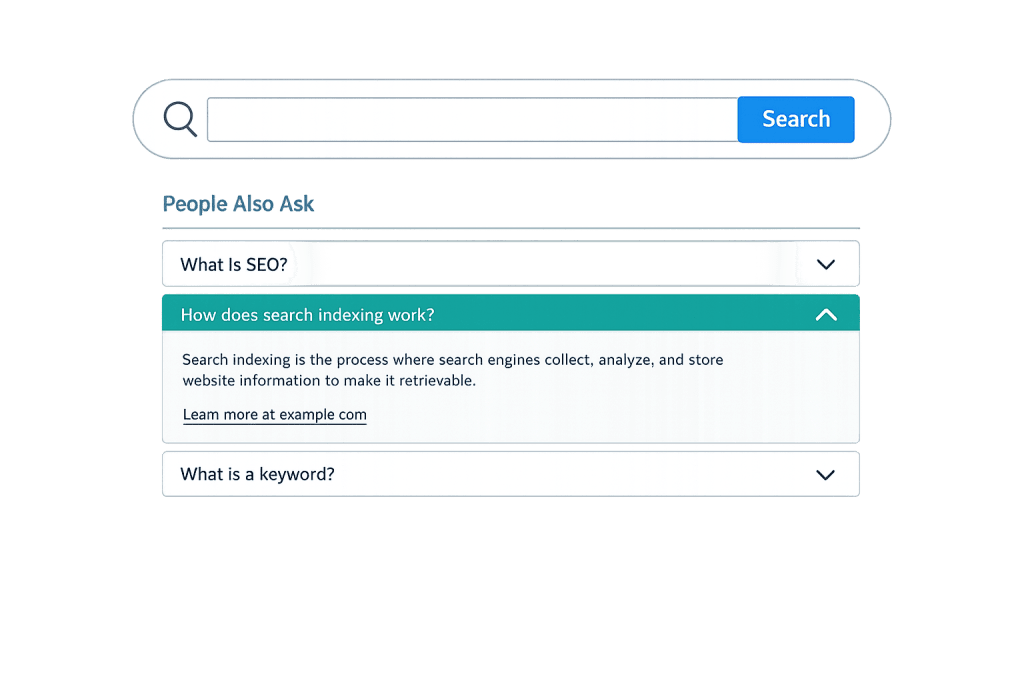
How People Also Ask Works
Google generates PAA questions through natural language processing, analyzing patterns in real user search behavior. The questions reflect what searchers commonly look up after their initial query, or related questions they refine their search with. Google’s algorithm:
- Tracks what users search after their initial query
- Identifies knowledge gaps in the search journey
- Surfaces questions that bridge those gaps
- Updates questions in real time based on user interactions
Unlike featured snippets, which show a single answer to the original query, PAA boxes present multiple questions and pull answers from multiple different sources. A page doesn’t need to rank in the top 10 organically to appear in PAA — which makes it one of the more accessible SERP features for newer or lower-authority sites.
The answers in PAA boxes can take several formats: a paragraph, a numbered list, a bullet list, an image, a table, or even a video.
Purpose & Benefits
3 Key Benefits of Targeting People Also Ask
1. SERP Visibility Beyond Your Organic Rankings
PAA boxes appear above many organic results, meaning a page featured in PAA can receive clicks even when it ranks on page two or three for the query. This is especially valuable for competitive terms where ranking in the top three organically is difficult. Our SEO services include PAA opportunity identification as part of comprehensive SERP feature targeting.
2. Direct Insight Into Your Audience’s Questions
Each PAA question reflects a real search query your audience is asking. Analyzing the PAA boxes that appear for your target keywords reveals content gaps — topics your audience wants answered that your site may not currently address. This intelligence feeds directly into a stronger content strategy and helps you understand search intent at a granular level.
3. Positioning for AI-Powered Search
PAA is increasingly relevant as Google integrates AI into search. The structured question-and-answer content patterns that help pages appear in PAA — clear questions as headings, concise direct answers beneath them — are the same patterns that AI search systems extract to generate summaries. Optimizing for PAA today also positions your content well for evolving AI-driven SERP features.
Examples
1. Service Business Capturing PAA on Competitive Terms
A plumbing company can’t rank on page one for “how much does it cost to replace a water heater” — the query is dominated by major home improvement sites. But by creating a well-structured FAQ page that directly answers related PAA questions like “What factors affect water heater replacement cost?” and “How long does it take to install a water heater?” they capture PAA visibility for those questions, driving discovery even without a top-10 organic ranking.
2. eCommerce Product Questions
An online pet supply store targeting “best dog food for senior dogs” notices the PAA box includes questions like “What ingredients should senior dog food have?” and “Is grain-free food good for older dogs?” The store creates a content piece directly addressing these questions, earns PAA placement, and drives traffic that converts because the searcher’s questions are answered before they decide to buy.
3. B2B Company Building Thought Leadership
A software company answers PAA questions like “What is the difference between ERP and CRM?” by adding a clearly structured FAQ section to a comparison page. The content earns PAA placement for the question, introduces the brand to researchers early in the buying journey, and supports overall topical authority in their space.
Common Mistakes to Avoid
- Writing answers that are too long — PAA answers are typically 40–60 words. Long, meandering explanations are less likely to be selected. Answer the question directly in the first sentence, then provide supporting context.
- Burying the answer in the content — If the answer to a question appears on paragraph 12 of a 3,000-word article, Google is unlikely to extract it for PAA. Structure your content so each question has a clearly delineated answer directly beneath it.
- Ignoring the question format — Content must actually answer the question. A page about “SEO tips” that never directly addresses the question “What does SEO do for a website?” will not appear in PAA for that question.
- Only targeting PAA for your highest-volume keywords — PAA boxes appear for a wide range of query types, including niche, low-volume questions. These are often easier to win and can drive highly relevant traffic.
Best Practices
1. Structure Content Around Question-and-Answer Pairs
Use H2 or H3 headings formatted as questions, followed immediately by a direct, concise answer in the first sentence. FAQ sections are natural candidates for PAA. Adding FAQ schema markup to these sections signals to search engines that your page contains structured question-and-answer content, improving your chances of appearing in PAA and related SERP features.
2. Research PAA Questions for Your Target Keywords
Before creating content, search your target keywords in Google and document the PAA questions that appear. These are content opportunities — real questions your audience is asking that Google has already validated as relevant. Build your content to answer them directly. Tools like Ahrefs, SEMrush, and Google Search Console can help identify PAA opportunities at scale.
3. Update Existing Content to Capture PAA
You don’t always need new content to earn PAA appearances. Audit your existing pages that rank on pages two through five for target queries. Add a structured FAQ section answering the relevant PAA questions that appear for those terms. This is often a faster path to PAA placement than creating new content from scratch.
Frequently Asked Questions
Can I optimize my content to appear in People Also Ask?
Yes, but it’s not a guarantee. Structuring content with clear question headings and direct, concise answers beneath each one significantly improves your chances. Adding FAQ schema markup, keeping answers in the 40–60 word range, and ensuring the page loads quickly on mobile all support PAA eligibility.
Does appearing in PAA help my organic rankings?
Appearing in PAA doesn’t directly affect your organic ranking position — they’re separate. However, the traffic from PAA clicks is additive, and the signals around user engagement with your content can indirectly support rankings over time. More practically, PAA gives you visibility on page one for queries where you don’t rank organically.
What is the difference between PAA and featured snippets?
A featured snippet shows a single answer to the original search query, pulled from one source, and appears above all organic results (“position zero”). PAA boxes show multiple questions related to the original query, with answers from multiple sources. A page can appear in both simultaneously for different queries.
How many PAA questions typically appear on a search results page?
Google typically shows three to four PAA questions initially. As users click and expand questions, Google loads additional related questions dynamically — users can theoretically expand PAA indefinitely. The initial three to four questions represent the highest-visibility placement.
Does PAA work for local businesses?
Yes. Local businesses appear in PAA for queries related to their services and industry. A question like “How often should you service your HVAC system?” could feature a local HVAC company’s blog content. The audience signal — a local person researching HVAC services — makes these placements potentially high-value despite appearing informational.
Related Glossary Terms
- SERP Features
- Featured Snippet
- Search Intent
- Topical Authority
- Content Strategy
- Schema Markup (Structured Data)
- Search Engine Results Page (SERP)
How CyberOptik Can Help
People Also Ask optimization is part of how we approach content strategy and SEO for clients — identifying the questions your audience is already asking and structuring content to answer them in ways search engines can surface. Whether you need a content audit to uncover PAA opportunities or a full SEO strategy, we can help. Contact us for a free website review or learn more about our SEO services.