
SERP features are the special, non-standard elements that appear on a search engine results page (SERP) alongside — or in place of — traditional organic blue-link results. Where a standard organic result shows a clickable title, a URL, and a brief description, SERP features present information in enhanced formats: expanded answer boxes, image carousels, video panels, local business listings, rating stars, and more.
SERP features represent Google’s ongoing effort to answer users’ questions directly on the results page — reducing the need to click through to a website, while also surfacing more relevant content types for specific queries. For businesses and SEOs, SERP features are both an opportunity and a challenge. Capturing a feature like a featured snippet or the People Also Ask box can dramatically increase visibility and click-through rates. But SERP features also compress the traditional organic results down the page — meaning that even a #1 ranking generates less traffic than it once did when multiple features appear above it.
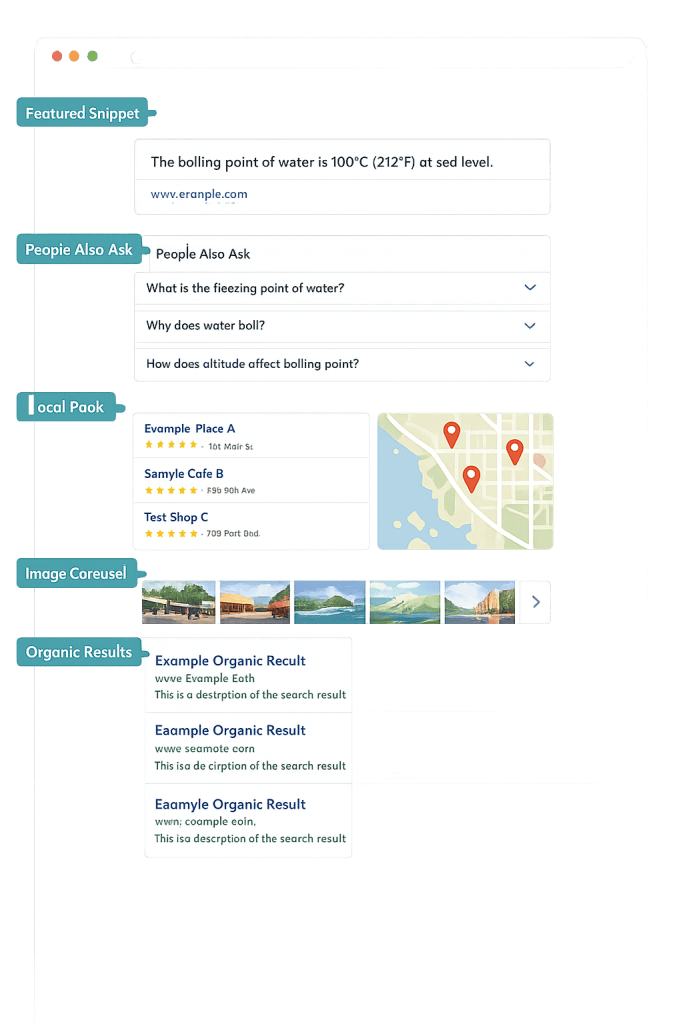
[Image: Annotated SERP screenshot showing featured snippet at top, People Also Ask boxes, local pack with map, image carousel, and traditional organic results below]
Types of SERP Features
Google displays dozens of distinct SERP features, but the most commonly encountered include:
- Featured Snippet — A highlighted excerpt from a web page that directly answers a query. Appears in a box above the organic results (“position zero”). Can be a paragraph, list, table, or video.
- People Also Ask (PAA) — An expandable question-and-answer section that surfaces related queries and brief answers from various sites. Clicking a question expands the answer and typically adds more questions dynamically.
- Knowledge Panel — An information box in the right sidebar (desktop) or above results (mobile) that aggregates structured data about an entity — a person, business, brand, or place. Pulled from Google’s Knowledge Graph and sources like Wikipedia.
- Local Pack — A map with three local business listings that appears for queries with local intent (“web designer near me,” “coffee shop”). Shows business name, rating, address, and hours. Powered by Google Business Profile data.
- Image Pack — A row of image results embedded in the SERP for visually-oriented queries. Links to Google Images rather than the source pages directly.
- Video Carousel — Thumbnail previews of relevant video content, typically from YouTube, that appear for queries where video content is the best format.
- Shopping Results — Product listing ads with images, prices, and retailer names. Appear for product-specific queries and are paid placements, though they occupy SERP real estate alongside organic features.
- Site Links — Secondary links to internal pages of a site that appear beneath the main result for navigational queries (typically brand name searches).
- Review Snippets / Rich Snippets — Star ratings, review counts, and other structured information embedded directly in organic results. Enabled by schema markup.
Purpose & Benefits
1. Capture Visibility Beyond Traditional Rankings
SERP features allow a page ranked #4 or #5 organically to appear above all organic results if it wins the featured snippet. For question-based and informational queries, a well-structured page can capture a People Also Ask answer box, generating impressions and clicks from positions that would otherwise be invisible. This means SERP features are a distinct SEO opportunity separate from — and sometimes more impactful than — climbing organic rankings.
2. Build Brand Awareness at the Query Level
Appearing in a Knowledge Panel, Local Pack, or Shopping Result increases brand exposure even when users don’t click. Repeated appearances for relevant queries build familiarity and credibility. Our SEO services focus on capturing these visibility opportunities alongside traditional organic ranking improvements.
3. Align Content Strategy With Feature Eligibility
Understanding which features appear for target queries shapes content creation decisions. A query that triggers a featured snippet is best served with a page that includes a direct, concise answer in a clear format. A query that triggers a video carousel suggests video content may outperform written content. Analyzing SERP features before creating content ensures the format matches what Google is rewarding for that query type.
Examples
1. Featured Snippet Capture for a Definition Query
A WordPress agency publishes a detailed glossary page defining “content delivery network.” The page opens with a two-sentence definition and includes a structured explanation of how a CDN works. Google selects the opening paragraphs as the featured snippet, displaying them at the top of the SERP for “what is a CDN.” The page receives significant traffic from this position even though it ranks #6 in traditional organic results.
2. Local Pack Visibility for a Service Business
A web design agency with a complete Google Business Profile — accurate hours, services listed, responded-to reviews, and regular posts — appears in the Local Pack for relevant queries. Despite not ranking #1 organically, the Local Pack placement with a 4.9-star rating drives more inbound contact form submissions than many first-page organic results.
3. People Also Ask Expansion
A financial planning firm answers the question “How much should I save for retirement?” on a blog post with a concise, well-structured paragraph. Google includes that answer in the People Also Ask section for multiple retirement-related queries. Each appearance introduces the firm’s brand to users across a range of related queries — multiplying visibility from a single piece of content.
Common Mistakes to Avoid
- Optimizing content for featured snippets without checking if the feature exists — Not every query triggers a featured snippet. Before restructuring content to win position zero, confirm that a featured snippet actually appears for the target query. Optimizing for a non-existent feature wastes effort.
- Ignoring the Local Pack for location-relevant businesses — Businesses with physical locations or defined service areas often see a greater ROI from Local Pack optimization than from traditional organic ranking. A neglected Google Business Profile is a missed opportunity.
- Treating all SERP feature appearances as positive — Featured snippets can sometimes reduce clicks by satisfying queries directly on the SERP (zero-click searches). For purely informational queries, capturing the snippet may mean fewer site visits even as impressions rise. Factor this into how you measure SERP feature success.
- Using generic answers that don’t stand out — Featured snippet competition rewards concise, direct answers that cover the query better than competitors. Vague or hedged answers rarely win. Specific, well-structured content designed to answer a question in 40–60 words is the format that wins most snippet opportunities.
Best Practices
1. Structure Content to Answer Specific Questions
Format content with clear H2 or H3 questions followed by direct, concise answers. Featured snippets and PAA boxes are won by content that’s written to answer questions explicitly — not content that buries answers in long paragraphs. A 40–60 word answer to a specific question, followed by deeper explanation, is a proven structure for snippet capture.
2. Implement Schema Markup for Eligible Content Types
Schema markup is a prerequisite for many SERP features: FAQPage schema for FAQ panels, Product schema for shopping result eligibility, Review schema for star ratings, and LocalBusiness schema for Knowledge Panel accuracy. A properly implemented SEO plugin handles common schema types automatically, but custom schema requires additional configuration.
3. Optimize Google Business Profile for Local Pack Eligibility
For the Local Pack, your Google Business Profile is the primary input. Complete every field: business category, hours, services offered, photos, and a detailed description. Respond to all reviews promptly. Post updates regularly. Businesses with complete, well-maintained profiles consistently outperform those with incomplete ones in local search features.
Frequently Asked Questions
How do I get a featured snippet?
There’s no guaranteed path, but pages that rank in the top 5 for a query are most likely to be selected. Structure your content with a clear answer to the query in the first paragraph, use lists and tables for list-format snippets, and ensure your page genuinely answers the question better than competitors. Schema markup doesn’t directly influence featured snippet selection.
Do SERP features replace organic rankings?
They complement them rather than replace them. Many SERP features pull content from the same pages that rank organically — winning a featured snippet typically requires a first-page ranking. However, features do compress traditional organic results further down the page, making the competition for top positions more impactful than it used to be.
Can I control what appears in a Knowledge Panel for my business?
Partially. You can claim your Google Business Profile to influence local business Knowledge Panels. For entity Knowledge Panels (a brand or person), you can provide structured data and ensure your website clearly establishes your entity information, but Google ultimately decides what to display and what sources to draw from.
Do SERP features affect mobile and desktop results differently?
Yes. The mix and placement of features differ by device. Featured snippets and knowledge panels are prominent on mobile where screen space is limited. Local Pack results are heavily weighted on mobile due to proximity signals from the device. Desktop SERPs typically show a sidebar Knowledge Panel; mobile shows it inline above results.
How do AI Overviews affect traditional SERP features?
Google’s AI Overviews (formerly SGE) appear above most SERP features for eligible queries and generate AI-synthesized answers from multiple sources. This further compresses the visibility of traditional organic results and SERP features on affected queries. Being cited within an AI Overview is an emerging goal — it often requires strong E-E-A-T signals and high-quality, well-structured content.
Related Glossary Terms
- Featured Snippet
- People Also Ask
- Rich Snippet
- Knowledge Panel
- Schema Markup
- Search Engine Results Page (SERP)
- Technical SEO
How CyberOptik Can Help
Capturing SERP features requires both technical implementation (schema markup, site structure) and strategic content decisions (format, targeting, answer quality). Our SEO team identifies feature opportunities for your target queries and builds the technical and content foundation needed to capture them. Contact us for a free website review or learn more about our SEO services.