
Opt-in and opt-out are the two fundamental models of consent for receiving marketing communications. In an opt-in model, a person must actively choose to subscribe — they give explicit permission before receiving emails, SMS messages, or other marketing. In an opt-out model, a person is added to a communication list by default and must take action to remove themselves. Most reputable email marketing operates on an opt-in basis; opt-out practices are increasingly restricted by laws like GDPR and CAN-SPAM.
For any business running email marketing, understanding the distinction between opt-in and opt-out — and specifically between single and double opt-in — is both a compliance requirement and a quality-of-list question. How you acquire subscribers directly affects deliverability, engagement rates, and legal exposure. The cleaner and more explicit the consent, the better your list performs and the less your business risks.
[Image: Diagram comparing Single Opt-in (form submit → immediately subscribed) vs. Double Opt-in (form submit → confirmation email → click to confirm → subscribed)]
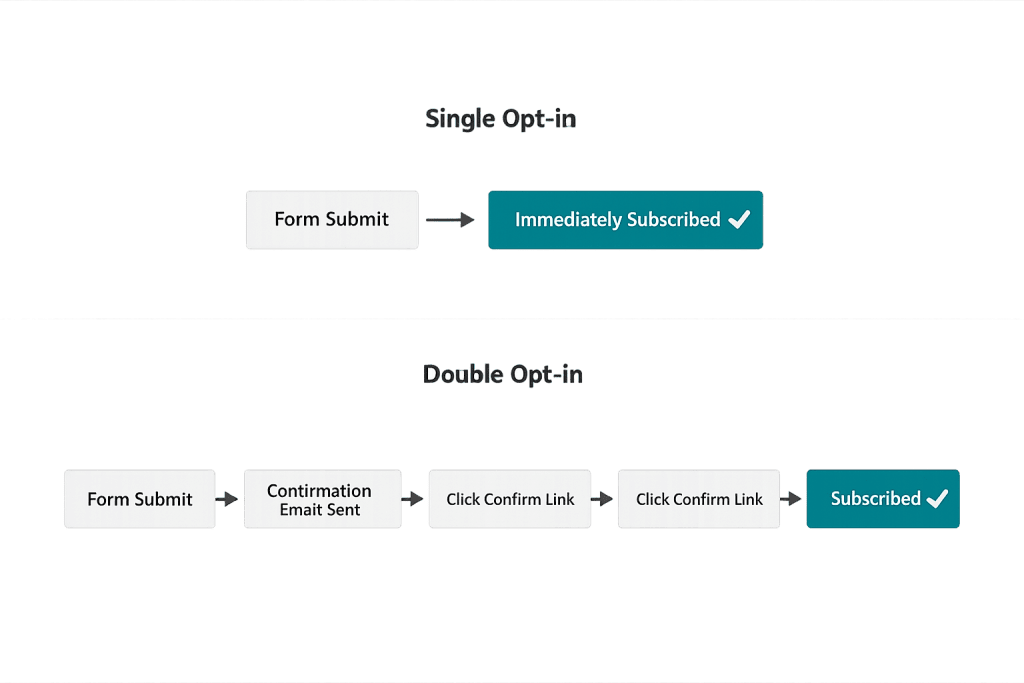
Single Opt-in vs. Double Opt-in
Single opt-in: A person fills out a subscription form and is immediately added to your email list. No additional confirmation is required. Simpler and faster — fewer steps means more completions — but has drawbacks: fake email addresses pass through, bots can fill forms, and there’s no verification that the email address belongs to the person who submitted it.
Double opt-in (confirmed opt-in): After submitting the form, the subscriber receives a confirmation email with a link they must click to verify their address and complete the subscription. Only then are they added to the active list. This adds a step — and reduces the number of people who complete the process — but the subscribers who make it through are definitively real, have a valid email address, and have demonstrated genuine interest by taking two deliberate steps.
The trade-offs:
| Single Opt-in | Double Opt-in | |
|---|---|---|
| List growth speed | Faster | Slower |
| List quality | Lower | Higher |
| Fake/bot signups | More common | Filtered out |
| Deliverability | More variable | Generally better |
| Compliance strength | Moderate | Strong |
Opt-out in email: Under CAN-SPAM (US) and GDPR (EU), every marketing email must include a clear unsubscribe mechanism. When a recipient opts out (unsubscribes), you must stop sending them marketing email promptly — CAN-SPAM requires processing opt-outs within 10 business days. Honoring opt-outs immediately is both legally required and a basic standard of respect for your audience.
Purpose & Benefits
1. Build a Higher-Quality, More Engaged List
Double opt-in filters out invalid email addresses, bots, and casual signups who aren’t genuinely interested. The resulting list is smaller but more engaged — subscribers who went through the confirmation step tend to have higher open rates, higher click-through rates, and lower unsubscribe rates. A list of 5,000 genuinely interested subscribers outperforms a list of 10,000 low-quality contacts by most metrics that matter: conversions, revenue, and sender reputation.
2. Protect Deliverability and Sender Reputation
Email service providers (ESPs) and internet service providers (ISPs) monitor the complaint rate and bounce rate associated with your sending domain. High bounce rates (from invalid addresses) and high spam complaint rates (from people who don’t remember opting in) damage your sender reputation — causing future emails to land in spam folders rather than inboxes. Strong opt-in practices create lists that generate fewer bounces and complaints, protecting the deliverability your entire email program depends on.
3. Demonstrate Compliance with Email Regulations
GDPR requires that consent be freely given, specific, informed, and unambiguous. Double opt-in creates a documented record of consent — the subscriber’s IP, the time of submission, and the confirmation click are all logged. Under GDPR, this is considered the gold standard for demonstrating that consent was genuine. Single opt-in can still comply with GDPR with proper consent language and documentation, but double opt-in provides stronger evidence if consent is ever challenged.
Examples
1. Newsletter Signup with Double Opt-in
A financial advisory firm uses double opt-in for their newsletter. After submitting their email through the website form, subscribers receive an email: “Please confirm your subscription to [Firm Name] insights.” Clicking the link in that email adds them to the active list. The firm logs the confirmation timestamp and IP address. If a subscriber later disputes receiving emails, the firm has clear, timestamped evidence of explicit consent.
2. E-Commerce Single Opt-in with Clear Consent Language
An online retailer uses single opt-in but includes an unchecked checkbox on the checkout page: “I’d like to receive product updates and promotions from [Store Name].” Customers who check that box are subscribed; those who don’t aren’t. The opt-in is active (not pre-checked), specific (states what emails will be sent), and clearly visible. This is compliant under most email marketing regulations and standard practice in e-commerce.
3. Re-Engagement Campaign Before Opt-Out
A software company notices that 30% of their email list hasn’t opened or clicked any email in 12 months. Rather than continuing to send (which harms deliverability), they run a re-engagement campaign: “We haven’t heard from you in a while — do you still want to hear from us?” Subscribers who click “Yes, keep me subscribed” are kept; those who don’t respond within two weeks are removed from the active list. This is a proactive opt-out process that protects list quality.
Common Mistakes to Avoid
- Pre-checked subscription boxes — Under GDPR and generally considered a dark pattern, pre-checked opt-in checkboxes don’t represent genuine consent. Users who don’t notice the checkbox may be added to your list without meaningful choice. Always default to unchecked and require active selection.
- Burying opt-out in small print — Subscribers must be able to unsubscribe easily. Legal requirements and basic ethics align here: making the unsubscribe process difficult increases spam complaints, which damages your deliverability far more than the few extra subscribers retained.
- Not processing opt-outs promptly — Under CAN-SPAM, ignoring unsubscribe requests is a legal violation. Under GDPR, continuing to market to someone who has withdrawn consent is too. Most email platforms handle this automatically, but be aware of edge cases like manual imports and multi-platform data.
- Confusing “no spam” promises with legitimate consent — Telling subscribers “we’ll never spam you” is not a substitute for a proper opt-in process. Consent must be documented, specific, and actively given.
Best Practices
1. Use Double Opt-in for Highest-Quality List Building
For most businesses, especially those subject to GDPR or building a long-term email program, double opt-in is the recommended approach. Yes, it reduces immediate signup volume — typically by 20–30% compared to single opt-in. But the subscribers who complete the confirmation step are definitively real and genuinely interested. The list is smaller and better, which translates to better performance metrics and lower risk of deliverability problems down the line.
2. Make Your Consent Language Clear and Specific
Whether you use single or double opt-in, the consent language must be clear: what list they’re joining, what type of content they’ll receive, and how frequently. Vague language like “join our community” is less defensible than “subscribe to receive our weekly small business marketing newsletter.” Specific consent language creates clear expectations, reduces unsubscribes from people surprised by what they receive, and provides stronger documentation if consent is challenged.
3. Maintain a Clean List with Regular Re-Engagement Campaigns
Even a perfectly opt-in list accumulates disengaged subscribers over time. Quarterly or semi-annual re-engagement campaigns — or automated sunset flows for subscribers who haven’t engaged in 6+ months — keep your list healthy. Offer disengaged subscribers a clear choice: stay subscribed (and potentially update their preferences) or opt out. Removing non-engaged subscribers proactively protects your sender reputation and improves the engagement metrics your email segmentation strategies depend on.
Frequently Asked Questions
Is double opt-in required under GDPR?
GDPR doesn’t explicitly require double opt-in — but it requires consent to be unambiguous, specific, and demonstrable. Double opt-in is the most robust way to document that consent was genuine. Single opt-in can be compliant with proper consent language and record-keeping, but double opt-in provides stronger evidence. In practice, most GDPR-focused marketers use double opt-in for peace of mind.
What happens if I don’t honor unsubscribe requests?
Failing to honor opt-outs is a violation of CAN-SPAM (US), GDPR (EU), CASL (Canada), and similar laws in other jurisdictions. Penalties range from fines to lawsuits depending on the regulation and severity. Beyond legal risk, continuing to email people who’ve opted out generates spam complaints that can destroy your sender reputation and cause all your emails — including to engaged subscribers — to land in spam folders.
Can I re-add someone who unsubscribed?
Generally, no — not without obtaining fresh, explicit consent. If someone unsubscribes from your marketing emails, sending them additional marketing is a violation of their stated preference and potentially illegal depending on your jurisdiction. The only appropriate contact after an unsubscribe is transactional email related to existing orders or services, not marketing.
Does a business card exchange count as an opt-in?
In most jurisdictions, no — at least not for ongoing email marketing. Exchanging business cards implies a one-time follow-up connection, not consent to be added to a marketing list. To use a contact for email marketing, you need explicit consent for that specific purpose. A follow-up email asking for permission to add them to your newsletter is the appropriate path.
What’s the difference between unsubscribing and marking email as spam?
Unsubscribing uses the opt-out mechanism in the email footer; the subscriber is removed from your list cleanly. Marking as spam sends a complaint signal to the ESP and ISP, which counts against your sender reputation — even if the subscriber was legitimately opted in and chose to report rather than unsubscribe. High spam complaint rates (above 0.1%) can get your sending domain blocked by major email providers. Making unsubscribing easy reduces the likelihood that frustrated subscribers resort to the spam button instead.
Related Glossary Terms
How CyberOptik Can Help
Email remains one of the highest-ROI channels in digital marketing, and building your list the right way — with clean opt-in processes that comply with regulations and attract genuinely interested subscribers — is the foundation it all rests on. Our team can help you set up compliant signup flows, configure double opt-in, and build email programs that deliver real results. Contact us to discuss your email strategy or learn about our marketing services.