
Email marketing is the practice of sending targeted, permission-based emails to a list of subscribers with the goal of building relationships, nurturing leads, and driving sales or other desired actions. It encompasses everything from weekly newsletters and promotional campaigns to automated welcome sequences and transactional receipts — all delivered to people who have opted in to hear from your business.
Among digital marketing channels, email consistently delivers the highest return on investment. Current industry data puts the average email marketing ROI at $36 to $42 for every dollar spent, with eCommerce brands reporting returns as high as $72 per dollar. That performance is why 82% of marketers worldwide use email marketing and why 4 out of 5 marketers say they’d rather give up social media than email. The channel works because it reaches people directly, at scale, with messages they’ve agreed to receive.
[Image: Email marketing flow diagram — list → campaign creation → send → open → click → conversion]
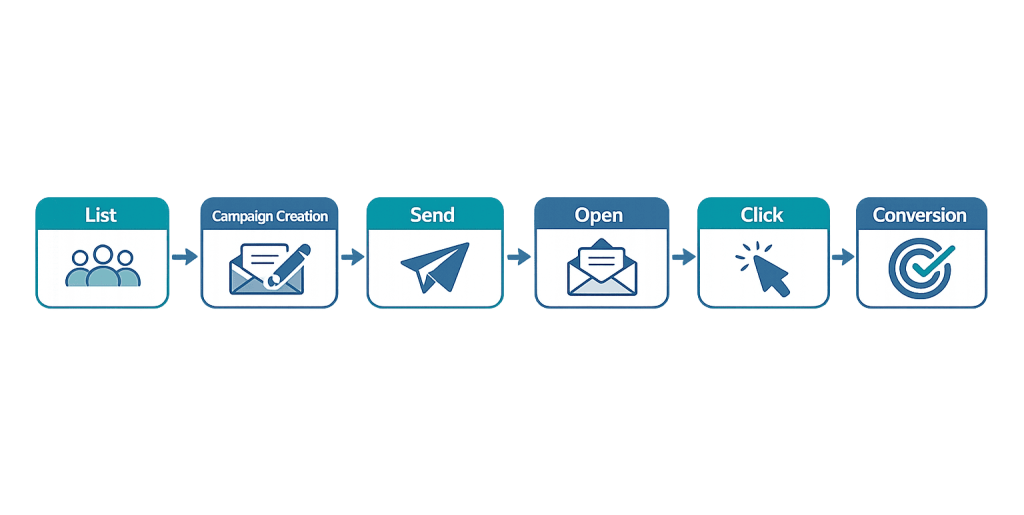
Key Concepts in Email Marketing
Email marketing encompasses several distinct campaign types, each serving a different purpose:
- Newsletters — Regular sends (weekly, monthly) that deliver value through content, updates, and insights
- Promotional campaigns — Time-sensitive offers, product launches, and sales announcements
- Drip campaigns — Automated series of emails sent over time based on a trigger or schedule
- Transactional emails — Order confirmations, shipping notices, password resets (triggered by user actions)
- Autoresponders — Automated single-email responses triggered by specific actions, like a welcome email after sign-up
- Re-engagement campaigns — Targeted sends to inactive subscribers to win back their attention
The performance of any email campaign is measured through key metrics: open rate (percentage who open the email), click-through rate (percentage who click a link), conversion rate (percentage who complete a desired action), and unsubscribe rate. Industry averages vary by sector, but a well-maintained list with strong segmentation typically outperforms generic averages on all metrics.
Purpose & Benefits
1. Highest ROI of Any Digital Channel
Email marketing consistently outperforms paid search, social media advertising, and display advertising on return on investment. At $36–$42 per dollar spent on average — and up to $72 per dollar for eCommerce — it’s the most cost-effective way to reach an audience you’ve already built a relationship with. The scalability is a key factor: the cost per additional email sent is minimal, so ROI improves as your list grows.
2. Direct Access to a Permission-Based Audience
Unlike organic search traffic or social reach, email puts your message directly in front of people who asked to hear from you. There’s no algorithm filtering what percentage of your subscribers see your content. An email sent to 1,000 subscribers lands in 1,000 inboxes — with approximately 22–35% opening it, depending on your industry and list quality.
3. Measurable Performance and Ongoing Optimization
Every email campaign generates clear, attributable data. You can see exactly who opened, who clicked, what they clicked, and what actions they took afterward. This makes email one of the most measurable channels in a digital marketing strategy, enabling continuous improvement through A/B testing subject lines, send times, content, and calls to action.
Examples
1. Local Service Business Nurturing Leads
A landscaping company collects emails from website visitors who request a quote but don’t immediately hire. They set up a 4-email nurture sequence that goes out over 3 weeks: an intro to their team, a before-and-after project showcase, a seasonal tips guide, and a limited-time offer. A meaningful percentage of those initial inquiries convert to booked jobs — without any additional ad spend.
2. eCommerce Store Driving Repeat Purchases
An online home goods retailer uses behavioral email triggers to boost repeat purchases. When a customer buys for the first time, they receive a post-purchase sequence: a thank-you email, a “how to use your product” guide, and a cross-sell recommendation based on what they purchased. Customers in this sequence generate 2–3x more lifetime revenue than those who receive only standard promotional emails.
3. B2B Business Staying Top of Mind
A professional services firm sends a monthly newsletter to 800 clients and prospects. The newsletter shares a brief industry insight, a recent case study, and one practical tip. No hard selling — just consistent, useful contact. When a subscriber’s business need eventually aligns with the firm’s services, the firm is already trusted and remembered. Three to five new client relationships per year trace directly back to newsletter engagement.
Common Mistakes to Avoid
- Sending to an uncleaned list — Sending to bounced addresses, spam traps, or long-inactive subscribers damages your sender reputation with email providers, reducing deliverability for everyone on your list.
- Sending the same message to everyone — Email segmentation exists because different subscribers have different needs. Sending one generic campaign to your entire list is the fastest way to see low engagement and rising unsubscribes.
- Neglecting mobile formatting — Approximately 46% of emails are opened on mobile devices. If your emails aren’t easy to read on a phone — clear text, tappable buttons, single-column layout — you’re losing a large share of your potential engagement.
- No clear goal per email — Every email should have one primary call to action. Emails that ask subscribers to do five different things typically result in them doing none.
Best Practices
1. Build and Maintain a Quality List
List quality matters more than list size. Focus on growing your email list through genuine opt-ins — web forms, checkout prompts, lead magnets — and prune inactive subscribers regularly. An engaged list of 1,000 subscribers consistently outperforms a bloated list of 10,000 disengaged contacts in both deliverability and conversion.
2. Personalize and Segment
Personalized emails generate 6x higher transaction rates than generic sends. Even basic personalization — using a subscriber’s first name, referencing their last purchase, or sending content relevant to how they joined your list — meaningfully improves performance. Pair personalization with email segmentation to ensure each group receives the most relevant content for where they are in the customer journey.
3. Test, Measure, and Improve Continuously
Email marketing’s measurability is one of its greatest strengths. Run A/B tests on subject lines, send times, and content formats. Monitor open rates, click rates, and conversions for every campaign. Organizations that consistently A/B test their email programs report higher ROI than those that send without testing. Use the data to make informed decisions about what to send next.
Frequently Asked Questions
What’s the difference between email marketing and email automation?
Email marketing is the broader practice — it includes all forms of email communication with your audience. Email automation is a specific component of it: the use of software to send emails automatically based on triggers, schedules, or subscriber behavior, rather than manually sending each campaign.
How often should I send marketing emails?
For most businesses, one to four times per month works well for standard marketing emails. The more important factor is consistency — subscribers should know roughly what to expect. High-frequency senders (daily or several times per week) can work, but only if the content genuinely justifies that frequency. Watch your unsubscribe rate as a signal: a consistent uptick after sends suggests you’re exceeding your audience’s tolerance.
Is email marketing still effective in 2025 and beyond?
Yes. Despite predictions of its decline, email marketing has grown in effectiveness over the past decade. The global email marketing industry was valued at $12.33 billion in 2024. ROI figures have held steady or improved. Email remains the most reliable direct channel — not tied to any platform’s algorithm or policy — which makes it more durable than social media as a long-term marketing investment.
Do I need an email marketing platform, or can I use regular email?
For anything beyond a handful of contacts, you need a dedicated platform. Platforms like Mailchimp, Klaviyo, ActiveCampaign, or Constant Contact provide unsubscribe management (legally required), deliverability infrastructure, analytics, templates, and automation. Sending marketing emails through Gmail or Outlook to a large list risks being flagged as spam and provides no compliance or measurement capabilities.
What’s a good open rate for email marketing?
It depends heavily on your industry and list quality. Industry-wide averages for 2024–2025 hover around 22–35% for unique opens, though these figures are influenced by Apple Mail Privacy Protection, which auto-opens emails. A more reliable indicator of genuine engagement is click-to-open rate (CTOR) — the percentage of openers who actually click something. Focus on trends over time rather than absolute benchmarks.
Related Glossary Terms
- Email Automation
- Autoresponder
- Drip Campaign
- Open Rate
- Email List / Mailing List
- Email Segmentation
- Newsletter
- Opt-in / Opt-out
How CyberOptik Can Help
Email remains one of the highest-ROI channels in digital marketing, and getting the strategy right — from list building to campaign execution — makes all the difference. Our team can help you build campaigns that reach the right people with the right message, set up automations that work while you’re focused on running your business, and connect your email platform seamlessly to your WordPress site. Contact us to discuss your email strategy or learn about our marketing services.