
Display advertising refers to visual ads — banners, images, rich media, and video — placed on third-party websites, apps, and platforms to reach audiences while they browse content unrelated to your brand. Unlike search ads that appear when someone actively looks for something, display ads reach people based on who they are, what they’ve done, or which content they’re consuming. The goal is typically to build awareness, drive retargeting campaigns, or stay visible to audiences as they move across the web.
The Google Display Network (GDN) alone reaches over 35 million websites, apps, and Google-owned properties, touching an enormous share of internet users daily. Programmatic advertising — automated buying and selling of ad inventory through real-time bidding — now accounts for roughly 90% of all display ad spend globally, replacing the manual insertion orders that dominated the industry a decade ago.
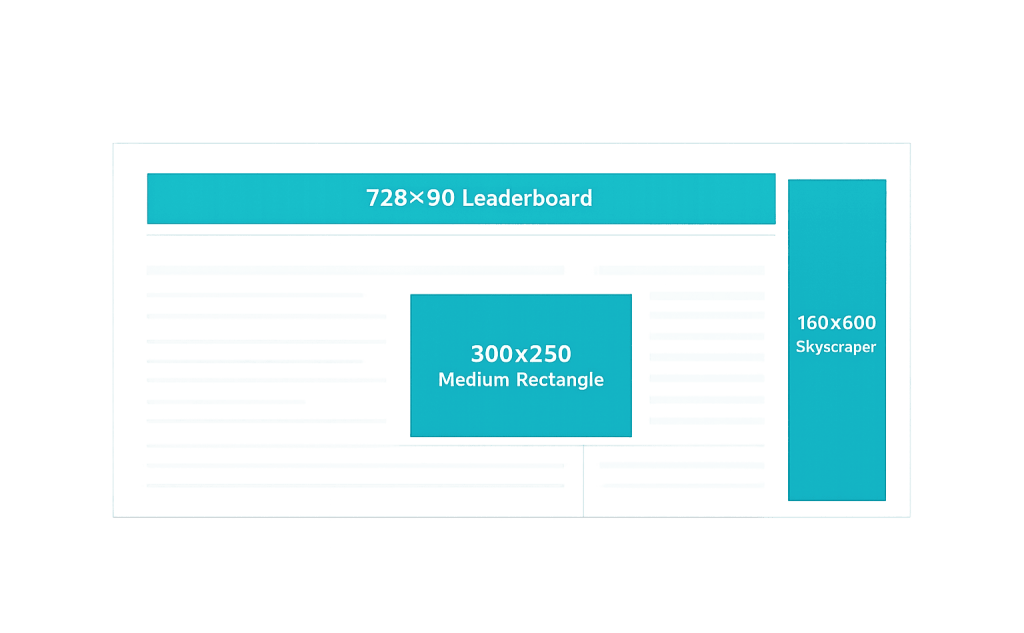
[Image: Examples of different display ad formats — leaderboard (728×90), medium rectangle (300×250), and skyscraper (160×600) — shown on a sample webpage layout]
Types of Display Advertising
Display advertising encompasses several formats and buying methods:
Ad Formats:
– Banner ads — Static or animated image ads in standard sizes (300×250, 728×90, 160×600)
– Responsive display ads — Flexible ads that adapt to available ad space; Google assembles them from headlines, descriptions, and images you provide
– Rich media ads — Interactive ads with video, audio, or expandable elements
– Video ads — Pre-roll, mid-roll, and banner video units served across display networks
Buying Methods:
– Programmatic / Real-Time Bidding (RTB) — Automated auctions where ad impressions are bought and sold in milliseconds based on audience targeting
– Direct buys — Negotiated placements directly with a publisher; often premium placements at premium prices
– Private Marketplace (PMP) — Invitation-only programmatic auctions with selected publishers and advertisers
Targeting Options:
– Contextual targeting — Matching ads to page content
– Audience targeting — Reaching users based on demographics, interests, or in-market behavior
– Remarketing/Retargeting — Serving ads to users who previously visited your site or interacted with your brand
– Placement targeting — Selecting specific websites or apps where your ads will appear
Purpose & Benefits
1. Build Brand Awareness at Scale
Display advertising reaches people earlier in the buying process than search — when they’re not yet searching for your product or service. Consistent visual presence across relevant websites and apps builds brand familiarity over time, which influences search behavior later. Our digital marketing services include display campaign strategy as part of a full-funnel approach.
2. Re-Engage Previous Visitors
Retargeting — serving display ads to people who have already visited your site — is consistently one of the highest-ROI uses of display advertising. These audiences already know who you are; the ad serves as a reminder when they’re ready to decide. Retargeting campaigns typically achieve significantly higher click-through rates than standard prospecting campaigns.
3. Support Other Channels Across the Funnel
Display advertising works best as part of a broader strategy. It supports awareness at the top of the funnel, reinforces search campaigns by keeping your brand visible between searches, and can accelerate decision-making for prospects in the research phase. Combining it with search and conversion funnel optimization typically produces better results than running it in isolation.
Examples
1. Retargeting Campaign for a Professional Services Firm
A consulting firm runs a 30-day retargeting campaign targeting visitors who viewed their services pages but didn’t submit a contact form. The campaign shows display ads on business news sites and industry publications, keeping the firm top-of-mind. Average CPM for this type of targeted retargeting campaign is significantly lower than for broad prospecting, and conversion rates are substantially higher.
2. Programmatic Awareness Campaign
A software company launches a new product and wants to build awareness among IT managers. Using programmatic targeting, they serve display ads to users who match their audience profile — job titles, industry, past browsing behavior on technology content — across thousands of websites simultaneously. The campaign runs on real-time bidding, automatically optimizing toward placements that generate the most engagement.
3. Google Display Network for Local Business
A home services company uses Google Display Network to show responsive display ads to homeowners within a specific radius who have recently searched for home improvement topics. Google’s audience signals help identify likely customers even before they’ve actively searched for the specific service. The ads run alongside paid search campaigns for full-funnel coverage.
Common Mistakes to Avoid
- Judging display campaigns by CTR alone — The average CTR for programmatic display is 0.05–0.08%. Applying the same performance expectations as search ads misunderstands the medium. Display builds awareness; evaluate it by reach, frequency, view-through conversions, and downstream impact on branded search.
- Running display without audience exclusions — Serving ads to people who already converted, employees, or low-quality audience segments wastes budget. Building exclusion lists is as important as building target lists.
- Ignoring ad blockers — Approximately 42% of users globally use ad blockers. Display campaigns won’t reach this portion of your potential audience, which should inform how you allocate budget across channels.
- Setting and forgetting — Display campaigns require active management. Placement reports regularly surface low-quality or irrelevant sites burning budget. Reviewing and excluding poor placements weekly improves efficiency.
Best Practices
1. Prioritize Retargeting Before Prospecting
If you’re new to display advertising, start with retargeting campaigns before broad prospecting. Retargeting reaches people who have already expressed interest — your conversion rates will be higher, and you’ll learn what messaging works before scaling to cold audiences.
2. Create Multiple Ad Sizes and Test Creatives
Different placements favor different ad sizes. The 300×250 medium rectangle and 728×90 leaderboard together account for a large share of available display inventory. Providing multiple sizes increases your eligibility for more placements. Test different visual approaches and headlines — what resonates with your audience often surprises you.
3. Connect Display to Your Full Funnel Strategy
Display campaigns generate impressions, not just clicks. Set up view-through conversion tracking to understand how display exposure influences users who later convert through other channels. Tie display spend to your conversion funnel goals rather than measuring it as a standalone channel. Our marketing team takes this integrated approach for every client.
Frequently Asked Questions
How is display advertising different from search advertising?
Search ads appear when someone actively searches for a keyword — they’re intent-driven. Display ads appear while someone browses other content — they’re interruption-based and serve awareness, reminder, and retargeting functions. Both work best when used together, serving different parts of the buying journey.
What is programmatic advertising?
Programmatic advertising is the automated buying and selling of ad inventory through real-time technology platforms. Instead of negotiating placements manually with individual publishers, programmatic systems buy ad impressions through instant auctions based on audience targeting criteria. It’s now the dominant method for purchasing display ads.
How much does display advertising cost?
Display advertising is priced on a CPM (cost per thousand impressions) basis. CPMs vary widely by targeting precision, audience quality, and placement context — from a few dollars for broad prospecting to $20+ for premium, highly targeted placements. Retargeting typically costs more per impression but generates higher returns due to audience relevance.
Is display advertising effective for small businesses?
It can be, especially for retargeting. Small budgets spread across broad prospecting campaigns often don’t generate enough frequency to build meaningful awareness. A focused retargeting campaign on a small budget — reaching people already familiar with your brand — typically delivers better results than spending the same amount on cold audiences.
Related Glossary Terms
- Retargeting
- Cost Per Mille (CPM)
- Click-Through Rate (CTR)
- Conversion Funnel
- Cost Per Click (CPC)
- Attribution Model
- Bid Strategy
How CyberOptik Can Help
Getting display advertising right takes strategy, consistent execution, and clear measurement — all things our marketing team delivers for clients every day. Whether you need retargeting campaigns, programmatic prospecting, or a full-funnel digital advertising plan, we can help you reach the right audiences with the right message. Explore our marketing services or get in touch.