Conversion funnel is the path that a potential customer follows from first becoming aware of a business to completing a desired action — a purchase, a form submission, a phone call, or any other defined conversion. The term “funnel” reflects the shape of the journey: a large number of people enter at the top (awareness), and a progressively smaller number move through each stage until a subset completes the final action at the bottom.
Understanding the conversion funnel isn’t just a marketing abstraction — it’s a practical framework for diagnosing where a business is losing potential customers. A site with 10,000 monthly visitors and 50 conversions has a 0.5% conversion rate. But where are the other 9,950 visitors going? The funnel breaks the visitor journey into stages so you can see exactly which stage has the biggest drop-off and focus optimization there first.
The Stages of a Conversion Funnel
Most conversion funnels follow some version of a progression from awareness to action:
1. Awareness — The visitor becomes aware of the business for the first time. Sources include search results, paid ads, social media, referrals, and direct word of mouth.
2. Interest — The visitor engages with the site — reading pages, watching videos, browsing products, or exploring services. They’re evaluating whether the business might meet their need.
3. Consideration — The visitor is actively comparing options. They may visit pricing pages, read reviews, download a guide, or return to the site multiple times. This is where trust-building content matters most.
4. Intent — The visitor signals strong buying intent: adding to cart, starting a checkout, filling in part of a form, or requesting a quote.
5. Conversion — The visitor completes the desired action: purchases, submits a contact form, calls, or signs up.
6. Retention (post-conversion) — For businesses focused on customer lifetime value, the funnel continues after the first conversion. Repeat purchases, renewals, referrals, and upsells are post-conversion conversion goals.
[Image: Funnel diagram showing the stages from Awareness through Conversion and Retention, with decreasing width at each stage representing drop-off]
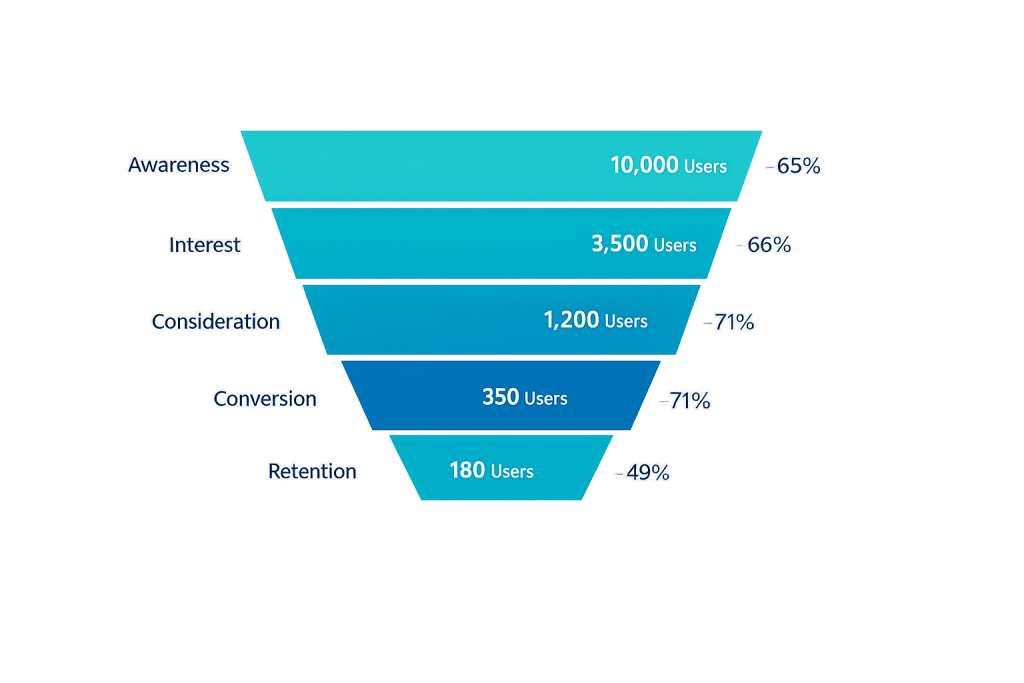
Not every funnel has all six stages. A local service business may have a simpler path: search result → landing page → phone call. A complex B2B sale may have dozens of touchpoints across weeks before conversion. The right funnel model reflects the actual buying process for your specific audience.
Purpose & Benefits
1. Identifies Where Visitors Drop Off
The funnel’s primary diagnostic value is showing where you’re losing people. High drop-off between consideration and intent might mean pricing isn’t clear, trust signals are missing, or the process for taking the next step is confusing. High drop-off between interest and consideration might mean the site isn’t answering the right questions. Each stage drop-off points to a specific problem to investigate. Our web design services regularly use funnel analysis to prioritize what to fix first.
2. Prioritizes CRO Efforts
Without funnel data, conversion rate optimization is guesswork. With it, you can quantify the value of fixing each stage. If 40% of visitors who start your checkout process abandon before completing it, and your average order value is $150, then improving checkout completion by 10 percentage points has a calculable revenue impact. Funnel analysis transforms CRO from intuition to prioritized investment.
3. Aligns Marketing and Design Around the Buyer Journey
The funnel framework helps marketing, design, and content teams work toward the same goal. Top-of-funnel content (blog posts, social media, ads) should attract and engage. Mid-funnel content (service pages, case studies, comparison guides) should build consideration. Bottom-of-funnel design (forms, CTAs, checkout flows) should reduce friction and complete the conversion. Aligning each element of the site to its funnel stage produces more coherent, effective user experiences.
Examples
1. Service Business Funnel
A landscaping company’s funnel: Google search → local service page → contact form → phone call confirmation → booked job. Analytics show that 70% of visitors to service pages bounce without viewing a contact page. A redesign adds trust signals (reviews, before/after photos, a clear CTA) to the service pages. The bounce rate drops and contact form submissions increase.
2. E-Commerce Funnel
An outdoor gear retailer’s conversion funnel: homepage → category page → product page → add to cart → checkout → purchase. Analytics reveal a 65% cart abandonment rate — visitors add items but don’t complete checkout. The team identifies that unexpected shipping costs appear at checkout as the primary cause. Adding a shipping cost estimator on the product page and a free-shipping threshold banner reduces cart abandonment by 18%.
3. B2B Lead Generation Funnel
A software company’s funnel spans multiple touchpoints over several weeks: blog post → email sign-up → email nurture sequence → webinar registration → free trial sign-up → demo request → closed sale. Each transition is a measurable conversion event. Funnel analysis shows that webinar attendees convert to demos at 45%, while blog-only readers convert at 8% — pointing to the webinar as a high-value mid-funnel asset worth more investment.
Common Mistakes to Avoid
- Treating the funnel as linear — Real buyer journeys rarely follow a straight path. Visitors jump between stages, return to the site multiple times, and arrive at different stages depending on how they found you. Use the funnel as a framework for analysis, not a rigid template that every visitor must follow.
- Ignoring mobile funnel performance — Mobile and desktop users often have very different funnel behaviors. A checkout that works on desktop might be difficult to complete on a phone. Always analyze funnel drop-off rates by device to identify mobile-specific friction points.
- Optimizing for only one stage — Businesses often focus all CRO attention on the bottom of the funnel (the conversion itself) while ignoring the middle stages where most of the drop-off actually happens. Improving mid-funnel engagement — the pages where visitors decide whether to trust you — often has a bigger impact than optimizing the form itself.
- Not establishing baseline funnel metrics — Before making changes, document the current conversion rates at each funnel stage. Without a baseline, you can’t measure whether an intervention worked or how significant the improvement was.
Best Practices
1. Map Your Funnel to the Actual Buyer Journey
Before optimizing, understand how your customers actually buy. Interview recent customers: How did you find us? What did you look at before contacting us? What almost stopped you from converting? This qualitative insight, combined with quantitative funnel data, reveals friction points that analytics alone might miss. A funnel model grounded in real buyer behavior is more actionable than a generic template.
2. Use Analytics to Find the Biggest Drop-Off First
Identify the stage with the highest percentage drop-off and the most visitors — that’s where optimization will have the greatest impact. A 30% drop-off between a page receiving 5,000 monthly visitors is a bigger opportunity than a 50% drop-off on a page with 200 visitors. Prioritize by the combination of drop-off rate and volume, not just the rate alone.
3. Test Changes Systematically With A/B Tests
When you identify a funnel stage to improve, test your hypotheses with controlled A/B testing rather than gut-feel redesigns. Change one variable at a time — the headline, the CTA copy, the form length, the layout — and measure the impact against the baseline. This prevents the “we changed everything and our conversion rate improved, but we don’t know why” problem that makes results impossible to replicate.
Frequently Asked Questions
What’s the difference between a conversion funnel and a sales funnel?
The terms are often used interchangeably. “Sales funnel” tends to be used in sales contexts and often refers to the stages of a deal progressing through a CRM pipeline. “Conversion funnel” is more commonly used in marketing and web analytics contexts, referring to the path website visitors take toward completing a defined goal. Both describe the same concept of staged progression toward a final action.
How do I set up funnel tracking?
In Google Analytics 4, you can create funnel explorations that map any sequence of pages or events to a funnel visualization. Define the steps that represent each stage, assign the relevant page paths or event triggers to each step, and GA4 will show conversion rates and drop-off percentages between stages. Most analytics platforms offer similar funnel visualization tools.
How many stages should my conversion funnel have?
Define as many stages as reflect meaningful decision points in your specific buyer journey — typically three to six for most businesses. Too few stages and you lose diagnostic granularity; too many and the model becomes unwieldy. If you can’t articulate what a visitor needs to do or decide at each stage, that stage probably doesn’t need to be in your model.
What is a “leaky funnel”?
A leaky funnel is one where visitors are dropping off at an unexpected or disproportionate rate at a specific stage — essentially, leads or potential customers are “leaking out” before reaching conversion. Identifying and patching leaky stages (through design improvements, clearer messaging, or friction reduction) is the central goal of funnel optimization.
Related Glossary Terms
- Conversion
- Conversion Rate
- CRO (Conversion Rate Optimization)
- Conversion Tracking
- A/B Testing
- Bounce Rate
- Call to Action (CTA)
How CyberOptik Can Help
Getting conversions right takes strategy, consistent execution, and clear measurement. We analyze conversion funnels for clients, identify where visitors are dropping off, and implement design and content improvements that move more visitors through to action. Whether you need a new site designed with conversion in mind from the start or a systematic review of an existing funnel, our team can help. Explore our marketing services and web design services, or get in touch.