
Organic keyword is a search term that brings visitors to your website through unpaid search engine results. When someone types a query into Google or another search engine and clicks on a result that isn’t marked as an advertisement, the term they searched is an organic keyword for the page they landed on. These keywords are the foundation of every SEO strategy because they determine which searches your website can appear for without paying per click.
Understanding organic keywords matters because search behavior directly reflects what your potential customers want. A business that knows which organic keywords drive traffic to its site — and which ones it could be ranking for but isn’t — has a clear roadmap for what content to create, optimize, and promote. Organic search drives approximately 53% of all website traffic, making keyword strategy one of the highest-leverage activities in digital marketing.
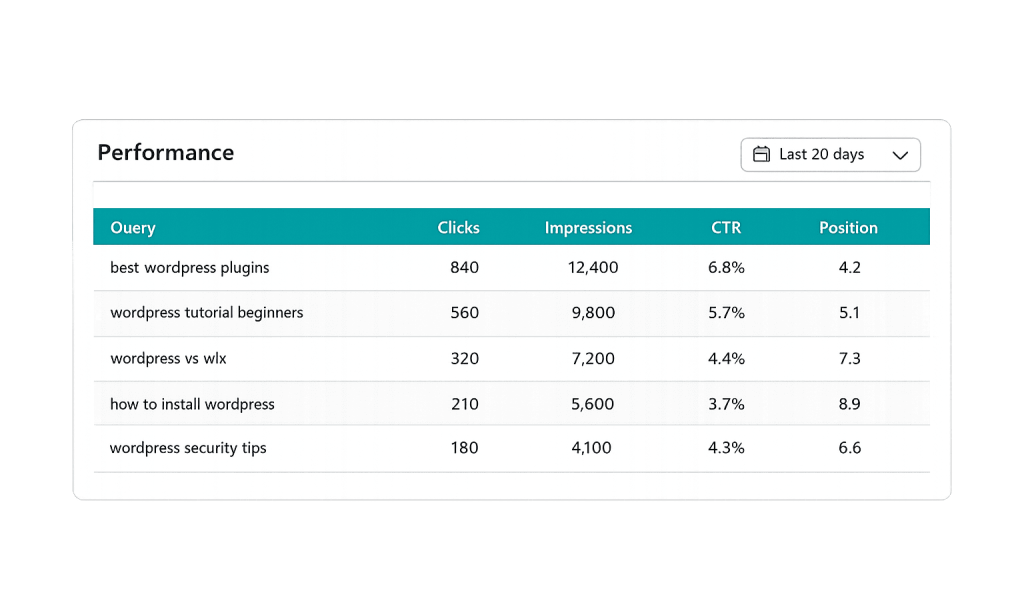
[Image: Screenshot of Google Search Console Performance report showing top organic keywords, their impressions, clicks, and average position]
How Organic Keywords Work
When a user types a query into a search engine, the engine’s algorithm matches that query against its index of web pages. Pages that are deemed most relevant — based on content, backlinks, technical signals, and dozens of other factors — appear as organic results. The keywords that trigger those appearances are organic keywords.
Organic keywords fall into a few broad categories:
- Informational keywords — The user wants to learn something: “how does SSL work,” “what is a meta description,” “best practices for WordPress security”
- Navigational keywords — The user wants to find a specific site or brand: “CyberOptik website design,” “WordPress.org login”
- Transactional keywords — The user is ready to take action: “hire WordPress developer,” “custom web design pricing”
- Commercial investigation keywords — The user is comparing options: “best WordPress page builders,” “Elementor vs Divi”
Understanding which keyword categories drive traffic to your site — and which your audience is searching in — shapes both your content strategy and your conversion funnel.
Purpose & Benefits
1. Sustainable Traffic Without Ad Spend
Unlike paid search, organic keyword rankings don’t stop delivering traffic when you pause a campaign. A well-ranked page can generate consistent visitors for months or years. Our SEO services focus on building these durable rankings — the kind that compound over time rather than reset the moment a budget runs out.
2. Signals That Reveal Customer Intent
Every organic keyword that brings someone to your site tells you something about what they were looking for. Analyzing this data in Google Search Console reveals which topics resonate, which questions your audience asks most, and where gaps in your content exist. This intelligence shapes smarter decisions across content, product, and marketing.
3. Foundation for On-Page Optimization
Organic keywords anchor your on-page SEO. Once you know which terms you want to rank for, you can optimize page titles, headings, meta descriptions, and body copy accordingly. Cross-referencing keyword data with organic search traffic performance shows which optimizations are working and where to focus next.
Examples
1. Local Service Business Targeting Service Keywords
A roofing company discovers through Google Search Console that it ranks on page two for “roof replacement cost” — a term with strong transactional intent. By expanding and updating the relevant service page with more detailed content, pricing context, and internal links from related blog posts, it moves to page one and doubles its leads from organic search within three months.
2. Blog Content Capturing Long-Tail Keywords
A WordPress agency writes a guide titled “How to Speed Up a WordPress Site.” The post ranks for dozens of related long-tail organic keywords — “reduce server response time WordPress,” “best WordPress caching plugins,” “why is my WordPress site slow.” Each keyword variation drives targeted visitors who are experiencing exactly the problem the post addresses.
3. eCommerce Product Pages
An online shop selling specialty coffee equipment optimizes product pages around specific organic keywords like “burr grinder under $200” and “manual espresso machine for beginners.” These transactional keywords attract buyers who are ready to purchase, resulting in higher conversion rates than broad terms like “coffee equipment.”
Common Mistakes to Avoid
- Targeting only high-volume, broad keywords — Head terms like “web design” or “SEO” are dominated by large competitors. A balanced strategy targets mid-tail and long-tail keywords where you can realistically compete.
- Ignoring keyword intent — Optimizing an informational blog post for a transactional keyword, or vice versa, confuses both users and search engines. Match your content type to the intent behind the keyword.
- Neglecting Google Search Console data — Many businesses focus on keyword tools for research but ignore the organic keyword data already flowing into their own GSC account. This data shows exactly what’s working and what’s close to ranking.
- Optimizing once and forgetting — Keyword rankings shift. Content that ranked well two years ago may have slipped. Regular review keeps your organic keyword strategy current.
Best Practices
1. Build a Keyword Map, Not a Keyword List
Assign specific target keywords to specific pages on your site — this is called keyword mapping. Each page should own a primary keyword and a small cluster of related secondary terms. Avoid targeting the same keyword on multiple pages, which causes keyword cannibalization and dilutes your ranking signals.
2. Monitor Rankings and Adjust Over Time
Use tools like Google Search Console to track which organic keywords your pages appear for, how often they’re clicked, and what position they hold. Pages ranking in positions 5–15 are often the best targets for optimization — they’re already indexed and relevant, just needing a push to climb higher.
3. Align Keywords with the Full Funnel
Map your organic keyword targets to stages in the buyer journey. Informational keywords (how-to content, glossary pages) capture early-stage visitors. Commercial investigation keywords (comparisons, reviews) reach mid-funnel prospects. Transactional keywords (service pages, pricing pages) convert ready buyers. A complete organic search strategy covers all three stages.
Frequently Asked Questions
What’s the difference between an organic keyword and a paid keyword?
An organic keyword brings visitors through unpaid search results — you earn that ranking through content quality, SEO, and backlinks. A paid keyword is one you bid on in a platform like Google Ads, paying each time someone clicks. The same keyword can drive both organic and paid traffic, though the strategies to capture each are different.
How do I find out which organic keywords are driving traffic to my site?
Google Search Console is the most direct source — it shows exactly which queries triggered your pages in search results, including impressions, clicks, and average position. Third-party tools like Ahrefs or SEMrush can supplement this data and show keywords you’re not yet ranking for but could target.
How long does it take to rank for an organic keyword?
It varies considerably by keyword competitiveness, your domain’s existing authority, and how well-optimized your content is. New pages on newer domains often take 3–6 months to rank meaningfully. Updating existing pages with strong authority can show ranking improvements much faster — sometimes within weeks.
Do I need a different organic keyword for every page?
Each page should have a primary focus keyword — the main term it’s optimized to rank for. Pages can rank for many related terms naturally, but having one clear primary keyword keeps your optimization focused. Without this clarity, it’s easy to create unfocused content that doesn’t rank well for anything specific.
Are organic keywords still relevant with AI search?
Yes. AI Overviews and AI-powered search experiences still process user queries and match them to content — keywords are still the signal connecting what users search for to what your pages are about. The mechanics of how results are displayed are evolving, but the underlying logic of matching content to queries remains keyword-driven.
Related Glossary Terms
- Keyword
- Organic Search Traffic
- Google Search Console
- Organic Search
- On-Page SEO
- Search Intent
- SEO (Search Engine Optimization)
How CyberOptik Can Help
Organic keyword strategy is central to every SEO engagement we take on. We identify the terms your customers actually search for, map them to the right pages on your site, and build a content and optimization plan to improve your rankings over time. Whether you need a full keyword audit or ongoing SEO management, we can help you turn search data into measurable traffic growth. Contact us for a free website review or learn more about our SEO services.