
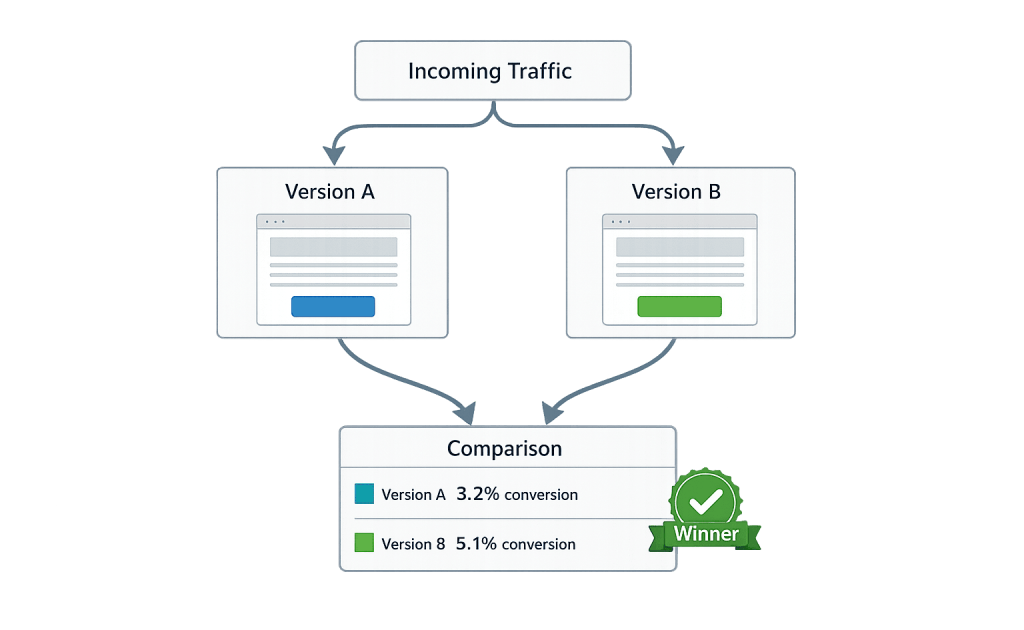
A/B testing is a method of comparing two versions of a webpage, email, ad, or other digital asset against each other to determine which one performs better with real users. Version A (the control) is the existing version; Version B (the variant) includes one specific change. Traffic is split between the two, and performance is measured — typically by conversion rate, click-through rate, or another defined goal. The version that produces better results is then implemented permanently.
The underlying principle is simple: instead of making design or copy decisions based on opinions or assumptions, you let your actual audience tell you what works. That shift from guesswork to evidence is what makes A/B testing one of the most reliable tools in digital marketing. According to industry data, approximately 77% of companies globally now conduct A/B testing on their websites — and businesses that run systematic testing programs see cumulative annual conversion rate improvements of 25–40%.
How A/B Testing Works
The mechanics of a well-run A/B test follow a consistent process:
- Identify a problem or opportunity — Start with a specific page or element that has room for improvement. Low click-through on a CTA button, high bounce rates on a landing page, and poor form completion rates are all good starting points.
- Form a hypothesis — Define what change you believe will improve performance and why. “Changing the CTA button from ‘Submit’ to ‘Get My Free Quote’ will increase form completions because it communicates value.”
- Create the variant — Build the B version with exactly one change from the control. Testing multiple changes at once obscures which variable drove any difference.
- Run the test — Split incoming traffic between A and B. Most testing tools do this automatically, ensuring each visitor consistently sees the same version throughout their session.
- Collect data and reach significance — Run the test until you have enough data for statistically meaningful results — typically a 95% confidence level or higher. This often requires two to four weeks, depending on traffic volume.
- Implement the winner — Apply the better-performing version site-wide, then form the next hypothesis.
[Image: Diagram showing traffic split between Version A and Version B, with arrows leading to a comparison of conversion metrics and a “winner” declaration]
Purpose & Benefits
1. Conversion Rate Improvement Grounded in Real Data
The clearest benefit of A/B testing is measurable conversion growth. Winning tests deliver an average 61% lift in conversion metrics, and systematic programs achieve 25–40% cumulative annual improvement. Rather than redesigning a page based on what looks good, you validate changes before committing to them. This is central to any serious digital marketing strategy — and it protects against wasting budget on changes that feel right but don’t perform.
2. Reduced Risk on Design and Copy Decisions
Every change to a high-traffic page carries risk. A headline rewrite, a new hero image, or a restructured form might hurt performance just as easily as it might help. A/B testing contains that risk by exposing a change to only a portion of traffic until the data is conclusive. If the variant underperforms, you revert and learn — without having permanently damaged conversion rates across the whole page.
3. Compounding Improvements Over Time
The real power of A/B testing isn’t a single test — it’s the compounding effect of running tests continuously. Each winning variant becomes the new control, and the next test builds on it. A PPC landing page that starts at a 3% conversion rate can systematically improve to 6%, then 8%, then 10% through successive rounds of testing. Over a year, this compounds into a fundamentally higher-performing marketing asset.
Examples
1. Headline Test on a Service Page
A home services company notices their main service page has a high bounce rate. They run an A/B test: Version A keeps the existing headline “Professional Roofing Services,” while Version B tests “Get a Free Roof Inspection — Most Jobs Completed in One Day.” Version B communicates a clear benefit and a specific offer. After three weeks and 2,000 visitors per variation, Version B shows a 22% higher form submission rate. The new headline is implemented.
2. CTA Button Color and Text Test
An online software company tests their primary signup button. Version A: a grey button reading “Sign Up.” Version B: a high-contrast blue button reading “Start Your Free Trial.” The color change improves visibility; the copy change communicates the offer more clearly. After reaching statistical significance, Version B converts 34% better — a result that reflects the compounding effect of testing two aligned changes at once (though ideally, color and copy would be isolated in separate tests).
3. Form Length Test for Lead Generation
A law firm’s contact page includes a 9-field intake form. Their hypothesis: reducing friction by cutting to 4 fields (name, phone, email, brief description) will increase completions. The shorter Version B generates 41% more form submissions. The trade-off — slightly less detail at the point of contact — is easily offset by the volume increase, since the intake team can gather additional details during the consultation call.
Common Mistakes to Avoid
- Testing multiple changes at once — Changing the headline, button color, and image simultaneously makes it impossible to know which variable drove any performance difference. Isolate one element per test to get clean, actionable data.
- Ending tests too early — A test that looks promising after 200 visitors may reverse completely after 2,000. Calling a winner before reaching statistical significance leads to bad decisions. Most tools display confidence levels — only act on results at 95% confidence or above.
- Testing low-impact elements first — Testing button color before testing the headline is a common mistake. Focus initial tests on the highest-impact elements: headlines, primary CTAs, form design, and page layout. These changes produce measurably larger gains than minor visual tweaks.
- Not documenting results — Every test produces learning — including tests where no clear winner emerges. Without documentation, teams repeat the same tests and lose institutional knowledge. Keep a log of every test, its hypothesis, results, and the action taken.
Best Practices
1. Start with High-Traffic, High-Stakes Pages
A/B testing requires sufficient traffic to produce statistically significant results in a reasonable timeframe. Prioritize pages that already receive meaningful traffic — your homepage, primary service pages, SEO landing pages, and paid ad destination pages. Testing a page that gets 50 visits a month will take months to reach significance. Testing a page with 1,000+ weekly visits gives you results in weeks.
2. Let Behavioral Data Identify What to Test
Don’t guess at what to test — use data to identify friction points first. Analytics tools like Google Analytics 4 reveal which pages have high exit rates or low time-on-page. Heatmap and session recording tools show where visitors click, where they stop scrolling, and what they ignore. These behavioral signals point directly to what should be tested, making your testing program far more efficient than testing randomly.
3. Align Tests with Specific Business Goals
Every test should map to a measurable business outcome — not just a design preference. If your goal is more phone calls, test elements that affect phone call conversion: the placement and visibility of your number, click-to-call button design, and the messaging that precedes that CTA. If your goal is SEO performance, consider whether changes that improve dwell time and reduce bounce rate should be part of your test criteria alongside conversion metrics.
Frequently Asked Questions
How long should an A/B test run?
Long enough to reach statistical significance — typically two to four weeks for most business websites, regardless of how the early data looks. Running shorter tests risks acting on noise rather than signal. Traffic volume, conversion rate, and the effect size you’re testing for all affect the duration needed. Most A/B testing tools calculate the recommended test duration and confidence level automatically.
Does A/B testing affect SEO?
When done correctly, no. Google has confirmed that A/B testing doesn’t harm SEO. The key is to avoid cloaking — showing different content to search engine crawlers than to users. Use temporary (302) redirects for variant pages rather than permanent (301) redirects, and remove test variations once the test concludes. Properly run tests can actually improve SEO indirectly by improving user experience signals like bounce rate and dwell time.
What tools are commonly used for A/B testing?
Popular platforms include Google Optimize (now part of GA4 integrations), Optimizely, VWO (Visual Website Optimizer), and Unbounce for landing pages. For WordPress sites specifically, plugins like Nelio A/B Testing integrate directly with the CMS. The right tool depends on your traffic volume, technical setup, and how sophisticated your testing program is.
What’s the difference between A/B testing and multivariate testing?
A/B testing compares two complete versions of a page with one variable changed. Multivariate testing simultaneously tests multiple variables and their interactions — for example, testing three headlines against two CTA buttons to find the best combination. Multivariate testing requires significantly more traffic to reach significance and is better suited to high-volume pages. For most businesses, A/B testing is the more practical starting point.
How do I know if my A/B test result is a real win?
Reliability requires reaching 95% statistical confidence or higher before declaring a winner, and running the test long enough to account for day-of-week and time-of-day variation in visitor behavior. If a test shows dramatic results (100%+ improvement), treat that with appropriate skepticism and consider rerunning it to confirm. A 10–30% conversion improvement from a well-designed test is a solid, realistic outcome.
Related Glossary Terms
How CyberOptik Can Help
Getting A/B testing right takes more than picking a tool and flipping a switch — it takes a testing strategy built around your specific conversion goals, enough traffic to produce reliable results, and the analytical discipline to act on data rather than instinct. Our marketing team helps clients identify the right hypotheses, set up tests correctly, and interpret results in the context of their broader digital strategy. Whether you need help with PPC campaign optimization, landing page testing, or a full conversion rate improvement program, we can build the framework that makes testing a competitive advantage. Explore our marketing services or get in touch.