White hat SEO refers to the practice of optimizing a website for search engines using only methods that comply with search engine guidelines — particularly Google’s. It encompasses techniques like producing genuinely useful content, earning backlinks through merit, improving technical site health, and providing a strong user experience. The term distinguishes ethical SEO practices from black hat SEO, which uses manipulative shortcuts, and grey hat SEO, which operates in ambiguous territory.
The phrase draws from old Western films, where heroes wore white hats and villains wore black — a shorthand for good guys versus bad guys. In practice, white hat SEO is the foundation of any sustainable search presence. Sites that grow through ethical methods tend to maintain their rankings when algorithms update, while those built on manipulation often face sudden ranking drops or manual penalties.
Key Concepts in White Hat SEO
White hat SEO operates across several interconnected areas:
Content quality and relevance — Creating original, accurate, and genuinely helpful content that addresses what users are actually searching for. Google’s Helpful Content guidelines specifically reward content written for people first, not for search engines.
Technical SEO — Ensuring your site is crawlable, fast, secure (HTTPS), mobile-friendly, and free of errors that prevent search engines from properly indexing your pages. This includes clean URL structures, proper use of canonical URLs, and a valid XML sitemap.
On-page optimization — Naturally incorporating target keywords into titles, headings, meta descriptions, and body content. Proper use of heading hierarchy, descriptive alt text on images, and structured data (schema markup) are all part of white hat on-page practice.
Earning backlinks — Acquiring links from other websites through the merit of your content, not by purchasing them or participating in link schemes. Guest posting on relevant publications, earning press coverage, and building resources others want to reference are white hat approaches to backlink building.
User experience — Site speed, mobile usability, intuitive navigation, and accessibility all contribute to how users interact with your site. Google increasingly uses engagement rate signals to assess whether users find your site valuable.
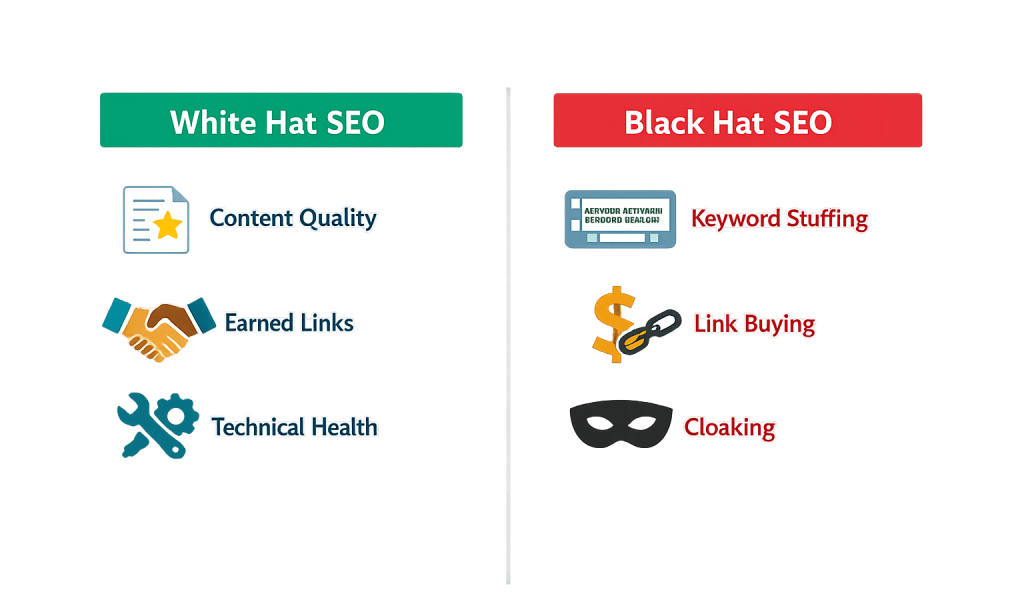
[Image: Diagram contrasting White Hat SEO (content quality, earned links, technical health) vs. Black Hat SEO (keyword stuffing, link buying, cloaking)]
Purpose & Benefits
1. Long-Term Ranking Stability
White hat SEO builds rankings on a durable foundation. Because the approach aligns with how search engines want the web to work, sites optimized this way tend to weather algorithm updates better than those built on shortcuts. Our SEO services focus exclusively on white hat methods — because we’ve seen what happens to sites that don’t. Rankings earned legitimately are harder to take away.
2. Avoids Penalties That Can Erase Rankings Overnight
Google issues manual and algorithmic penalties to sites caught using manipulative tactics. A manual penalty can remove a site from search results entirely until the issues are resolved and reconsideration is granted — a process that can take months. White hat SEO eliminates this risk. You won’t lose years of ranking progress because of a technique that violated guidelines you may not have fully understood.
3. Builds Authority and Trust with Users
White hat SEO naturally aligns with practices that make users trust your site: accurate information, fast load times, transparent authorship, and useful content. This trust compounds over time — the same content investments that improve your rankings also improve conversion rates, time on site, and return visits, making white hat SEO one of the highest-ROI marketing strategies available.
Examples
1. Creating a Comprehensive Resource Page
A financial planning firm builds a detailed guide answering the most common questions about retirement planning — organized, well-sourced, and genuinely more thorough than what competitors offer. Over time, the page earns dozens of backlinks from other financial sites and media, ranks for dozens of related search terms, and generates consistent consultation inquiries. This is white hat SEO in its clearest form: create something worth linking to, let merit do the work.
2. Technical SEO Audit and Remediation
A retail website conducts an SEO audit and discovers that dozens of pages are returning slow load times, several important pages are accidentally blocked in robots.txt, and product images have no alt text. Fixing these issues — improving page speed, unblocking pages, and adding descriptive alt text — leads to a measurable improvement in organic traffic over the following months. No shortcuts, no tricks — just correcting technical barriers.
3. Earning Editorial Backlinks
A business owner writes an article for an industry trade publication about common mistakes in their field. The article links back to the company’s website in the author bio. The publication has high domain authority, the link is editorially placed, and the content genuinely serves the publication’s readers. The result is a high-quality backlink that boosts domain authority and sends qualified referral visitors — earned, not bought.
Common Mistakes to Avoid
- Treating white hat SEO as a one-time project — SEO requires ongoing maintenance. Competitors publish new content, algorithms update, and your site’s technical health can drift. White hat SEO is a continuous practice, not a one-time configuration.
- Confusing “following guidelines” with “doing the minimum” — White hat SEO isn’t just the absence of bad tactics. It’s an active commitment to quality. A page that technically avoids penalties but offers thin, unhelpful content isn’t doing white hat SEO — it’s just not doing black hat SEO.
- Over-optimizing anchor text in link building — Even when earning backlinks ethically, using the exact same keyword-rich anchor text across many links looks manipulative. Natural link profiles have varied anchor text.
- Ignoring technical issues in favor of content — Many businesses focus only on publishing content while their site has crawl errors, slow load times, or broken canonical URLs. Technical health and content quality both matter.
Best Practices
1. Let User Intent Guide Every Content Decision
Before writing any page, ask what the person searching your target term actually needs. Are they researching, comparing options, or ready to buy? Content that fully satisfies the searcher’s intent at each stage — informational, navigational, transactional — is the core of white hat content strategy. Google’s algorithms are increasingly good at distinguishing content written for people from content written for rankings.
2. Earn Links Through Content Worth Referencing
The most reliable white hat backlink strategy is creating resources that other sites genuinely want to cite: original research, comprehensive guides, useful tools, or definitive answers to common questions. Pair this with outreach to relevant publications and industry communities. A single editorial link from a trusted publication is worth more than dozens of directory submissions.
3. Maintain Technical Health Consistently
Run regular SEO audits to catch issues before they compound — checking for crawl errors, duplicate content, broken links, slow-loading pages, and mobile usability problems. Tools like Google Search Console provide ongoing data on how Google sees your site. Pair this with a structured approach to website crawling via third-party tools to catch issues Search Console doesn’t surface.
Frequently Asked Questions
How long does white hat SEO take to show results?
Most businesses see meaningful movement in 3–6 months for less competitive terms, and 6–12 months for competitive ones. White hat SEO doesn’t produce overnight results — that’s a feature, not a bug. Rankings built through quality are more stable and harder for competitors to undercut than those built through manipulation.
What’s the difference between white hat, black hat, and grey hat SEO?
White hat SEO follows search engine guidelines completely. Black hat SEO violates them deliberately — keyword stuffing, link buying, cloaking, and similar tactics. Grey hat SEO sits in the middle: not explicitly banned, but risky and often against the spirit of the guidelines. White hat is the only approach that’s genuinely sustainable long-term.
Can you do white hat SEO without a big content budget?
Yes, but it requires prioritization. A small business with limited resources is better served by a few genuinely excellent pages than by dozens of thin ones. Focus on the terms your customers are actually searching for, answer their questions completely, and maintain your technical health. Quality over quantity is a white hat principle that also happens to suit limited budgets.
Does white hat SEO still work with AI-generated search results?
Yes. Google’s AI Overviews and other AI-driven search features still pull from pages that demonstrate expertise, authority, and trustworthiness. If anything, these features raise the bar for content quality — making white hat principles more important, not less. Thin content that was borderline before is now more likely to be ignored entirely.
Related Glossary Terms
How CyberOptik Can Help
Managing white hat SEO effectively is a critical part of any sustainable online strategy — and it’s something our team handles daily for clients. We take an exclusively ethical approach: no shortcuts, no tactics that put your site at risk. Whether you need a comprehensive SEO audit or ongoing optimization, we can help you build search visibility that holds up over time. Contact us for a free website review or learn more about our SEO services.