Organic reach is the number of people who see your social media content without any paid promotion behind it. When you post on Facebook, Instagram, LinkedIn, or another platform and people see it through normal feed delivery — because they follow your account, because their connections engaged with it, or because the algorithm surfaced it — that’s organic reach. It represents the audience your content earns on its own merit, as opposed to the audience you pay to reach through ads.
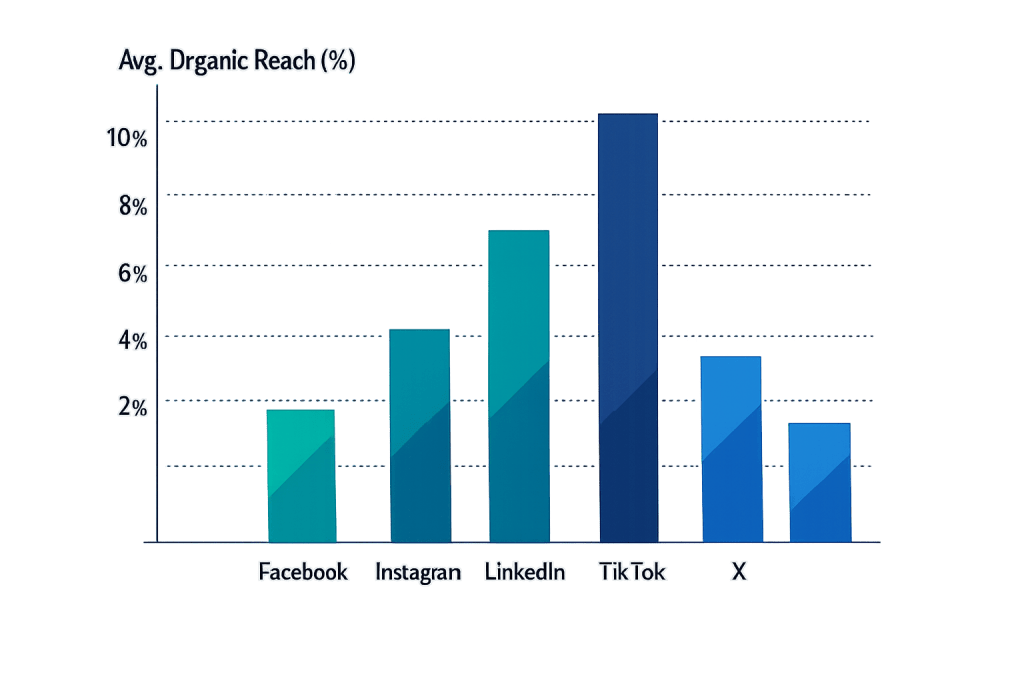
For businesses, organic reach has become one of the most misunderstood metrics in social media marketing. It sounds like a measure of how many followers you have, but that’s not accurate. On most platforms, only a small fraction of your followers see any given post organically. According to industry data, average organic reach rates in 2024 were approximately 4% on Instagram and around 5–6% on Facebook — meaning a page with 10,000 followers might have just 400–600 people see an average post without paid amplification.
[Image: Bar chart comparing average organic reach rates across Facebook, Instagram, LinkedIn, TikTok, and X (Twitter)]
Why Organic Reach Has Declined
Organic reach hasn’t always been this limited. In the early years of Facebook and Instagram, businesses could reliably reach most of their followers with organic posts. The shift happened gradually — and for predictable reasons:
- Content volume — The sheer amount of content posted every minute has made algorithmic selection necessary. Platforms can’t show users everything their connections post.
- Algorithm priorities — Social platforms increasingly favor content from personal connections over business accounts. Facebook’s 2018 News Feed update was a turning point, explicitly deprioritizing brand and publisher content.
- Pay-to-play economics — Advertising revenue is how these platforms make money. Limiting organic reach creates demand for paid promotion.
- Platform maturity — Newer platforms (TikTok, early Instagram) offer higher organic reach to attract creators and brands. As they mature, that reach tends to decline.
LinkedIn remains a partial exception — personal profiles on LinkedIn can still achieve 20–30% organic reach, which is why many B2B marketers prioritize individual thought leadership content over company page posts.
Purpose & Benefits
1. Cost-Effective Brand Presence
Organic social content costs time and creativity, not ad spend. A consistent organic posting strategy builds brand awareness, keeps your audience engaged between campaigns, and creates a library of content that can be repurposed or boosted later. When supported by a broader content marketing strategy, organic posts also drive traffic and signal brand credibility to prospective customers.
2. Audience Relationship Building
Organic content lets you communicate authentically with the people who already chose to follow you. Responses to comments, behind-the-scenes content, and posts that reflect your brand’s voice build relationships that paid advertising alone can’t create. Higher organic engagement — comments, shares, saves — also signals to platform algorithms that your content is worth showing more widely.
3. Testing Ground for Paid Content
Organic posts reveal what your audience responds to before you invest ad budget. A post that earns strong engagement organically is a reliable candidate for paid amplification. Watching organic performance data helps inform which content marketing angles, formats, and messages are worth scaling with paid spend.
Examples
1. Instagram Reel That Earns Broad Reach
A boutique fitness studio posts a short Reel showing a 60-second workout move. Despite having only 2,000 followers, the video earns 18,000 views through shares and the platform’s Reels discovery surface. The organic reach far exceeded the follower base because the format (short video) aligns with what the algorithm currently distributes widely.
2. LinkedIn Article With Strong Personal Reach
A company’s founder writes a personal LinkedIn post sharing a lesson from a recent client project. The post reaches 3,400 people — far more than the company’s LinkedIn Page ever reaches organically. This illustrates why personal profiles on LinkedIn routinely outperform company pages for organic reach.
3. Facebook Post That Drives Low Organic but High Paid Value
A local restaurant posts its weekly special — a post that organically reaches about 3% of its followers (roughly 150 people from a 5,000-follower page). The business boosts the post with $20 in paid promotion, reaching 4,200 people in the local area. The organic post served as the creative; the paid spend delivered the reach.
Common Mistakes to Avoid
- Equating follower count with reach — A large following doesn’t guarantee large organic reach. A page with 20,000 followers may reach fewer people organically per post than an engaged community of 2,000. Engagement rate is the more meaningful measure.
- Posting on all platforms the same way — Each platform has different algorithms, content formats, and audience behaviors. A post formatted for Facebook will underperform if copied directly to Instagram without adapting format, length, and visual style.
- Ignoring organic data before spending ad budget — Boosting a low-performing organic post wastes money. Always look at organic engagement signals before deciding what to amplify.
- Measuring reach without tracking outcomes — Organic reach is a visibility metric, not a business metric on its own. Track what actions people take after seeing your content — clicks, saves, profile visits, direct messages.
Best Practices
1. Prioritize Formats the Algorithm Favors
Short-form video (Reels on Instagram, Shorts on YouTube, TikTok videos) currently earns the widest organic reach across most platforms. Platforms push these formats because they drive engagement and time-on-platform. If organic reach is a priority, short video content should be a core part of your social strategy.
2. Post Consistently and Engage Actively
Algorithms favor accounts that post on a consistent schedule and that actively engage with their audience. Responding to comments, asking questions, and encouraging shares all signal to platforms that your content creates value. Consistency also trains your audience to expect and look for your content.
3. Treat Organic and Paid as Complements
The most effective social media marketing strategies use organic content to build community and test messaging, then use paid promotion to amplify what’s working. Rather than viewing paid ads as a substitute for organic, think of them as tools that extend organic reach to targeted audiences beyond your current followers.
Frequently Asked Questions
Why does my organic reach keep declining even though I’m posting consistently?
Platform algorithm changes are the most common cause. As social networks mature and ad inventory grows, they systematically reduce how much content from business accounts is shown organically to prioritize personal connections and paid content. Consistent posting helps, but the structural trend toward lower organic reach is platform-driven, not something you can fully reverse.
Is organic reach dead on Facebook?
Not dead, but very limited. Average Facebook Page post reach is around 5–6% of followers, and some studies put it even lower. Organic Facebook reach is most effective for maintaining relationships with existing followers and warming up audiences before paid campaigns — not for driving broad brand awareness from scratch.
How do I increase organic reach without paying for ads?
Focus on content formats the algorithm distributes widely (short video), post at peak engagement times, encourage shares rather than just likes, and create content that prompts comments. Cross-platform sharing and collaborations with other accounts can also expand your organic reach by introducing your content to new audiences.
What’s a good organic reach rate?
It depends heavily on the platform. On Facebook and Instagram, anything above 5–10% of your followers seeing a post is considered solid for a business account. On LinkedIn, personal posts can reasonably achieve 20–30% reach. On TikTok, reach is less correlated with followers — content can over-perform significantly based on algorithmic amplification.
Should I focus on organic reach or engagement rate?
Engagement rate is the more useful metric for most businesses. A post seen by 5,000 people that generates 250 comments and shares creates more business value than a post seen by 10,000 people that generates 10 likes. Engagement signals that your content resonated — and it’s engagement, not just reach, that drives the algorithm to distribute your content further.
Related Glossary Terms
- Social Media Marketing
- Content Marketing
- Organic Search Traffic
- Bounce Rate
- Click-Through Rate (CTR)
- Content Strategy
How CyberOptik Can Help
Building a social media presence that actually reaches your audience takes more than a posting schedule — it takes a strategy aligned with how each platform works today. Our team helps businesses create consistent, engaging content that supports broader marketing goals while making smart decisions about when and what to amplify with paid spend. Explore our social media services or get in touch to discuss your marketing strategy.