Machine learning is a subset of artificial intelligence in which computer systems learn from data to improve their performance over time — without being explicitly reprogrammed for each new task. Instead of following a fixed set of rules written by developers, machine learning systems identify patterns in large amounts of data, build internal models from those patterns, and apply those models to new situations. The more data the system processes, the more accurate its predictions and decisions become.
For business owners, machine learning is increasingly relevant not as something to build, but as something that powers the tools you already use — from search engines to spam filters to product recommendations. Google’s search algorithm uses machine learning to understand the intent behind queries, evaluate content quality, and rank results. AI writing assistants, image recognition tools, and chatbots all rely on machine learning at their core. Understanding the concept helps you ask better questions of the vendors and agencies working on your technology.
How Machine Learning Works
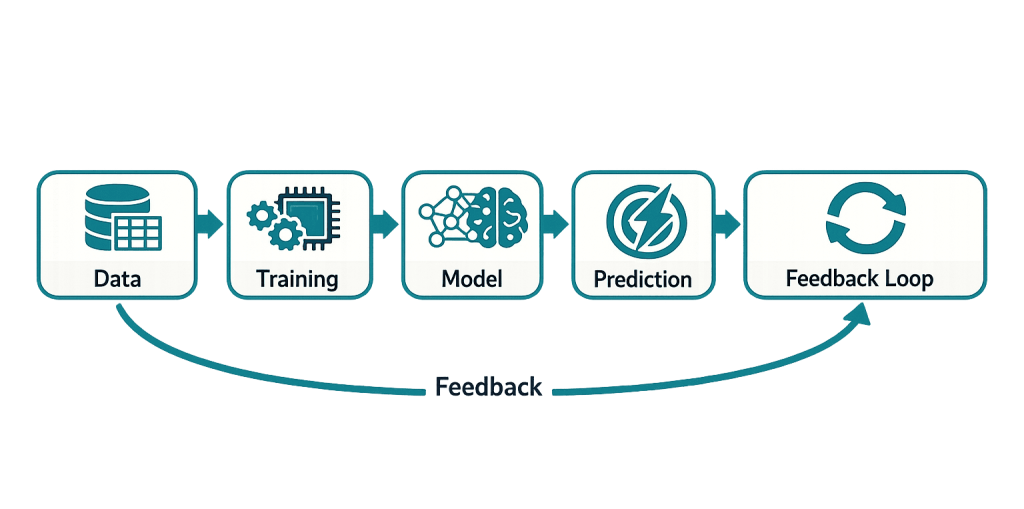
Machine learning follows a general process regardless of the specific application:
- Data collection — The system is fed large amounts of relevant data. A spam filter is trained on millions of emails labeled “spam” or “not spam.” A search algorithm is trained on billions of queries and user behavior signals.
- Model training — Algorithms analyze the training data to identify patterns — relationships between inputs and outcomes. This is the “learning” stage.
- Inference / prediction — Once trained, the model applies what it learned to new, unseen data. It predicts whether a new email is spam, or which search result best matches a query.
- Feedback and refinement — Real-world results feed back into the system. Models are retrained as new data becomes available, improving accuracy over time.
The three main learning approaches are:
– Supervised learning — The model trains on labeled examples (input + correct answer). Most classification and prediction tasks use this approach.
– Unsupervised learning — The model finds structure in unlabeled data on its own. Clustering similar customers or identifying unusual patterns are examples.
– Reinforcement learning — The model learns through trial and error, receiving rewards for correct actions and penalties for incorrect ones.
[Image: Diagram showing the ML pipeline: Data → Training → Model → Prediction → Feedback loop]
Purpose & Benefits
1. Powering Smarter Search and Content Matching
Google’s BERT, MUM, and Neural Matching systems use machine learning to understand what searchers actually mean — not just the words they typed. This is why semantic content quality matters more than keyword density today. A well-written page that genuinely addresses user intent performs better in search than a keyword-stuffed page, because the ML systems scoring it can evaluate meaning. Our AI & SEO services are built around this evolving reality.
2. Enabling AI-Powered Tools Your Business Already Uses
Customer service chatbots, email spam filters, fraud detection systems, product recommendation engines, and predictive analytics dashboards all run on machine learning. When you use Google Analytics to identify traffic anomalies, or when your e-commerce platform recommends related products, ML is working in the background. Understanding the technology helps you evaluate and select tools more effectively.
3. Creating New Possibilities for Content and Personalization
Machine learning enables website features that would have required enormous manual effort just a few years ago: personalized content recommendations, real-time chatbots trained on your product knowledge, AI-generated content drafts for human review, and automated image tagging at scale. As these capabilities become more accessible, businesses that integrate them thoughtfully gain real competitive advantages.
Examples
1. Google Search Algorithm
Every time someone searches Google, machine learning is at work. Systems like BERT (Bidirectional Encoder Representations from Transformers) analyze the full context of a query — not just individual words — to understand intent. This is why a search for “python snake care” returns results about reptiles, not programming, even though “Python” is a major programming language. The model has learned from billions of searches which meaning is intended based on surrounding context.
2. Spam and Malware Detection
Email providers and security tools use machine learning to identify malicious content. Rather than maintaining a fixed list of blocked domains or phrases, ML systems learn the patterns that distinguish spam from legitimate email — adapting continuously as spammers change tactics. The same principle applies to malware detection on websites: ML-powered security tools can identify suspicious code patterns even in novel threats they haven’t explicitly seen before.
3. AI-Powered Content and Image Generation
Tools like image generators, AI writing assistants, and large language models are all trained using machine learning on massive datasets. When a copywriter uses an AI tool to draft initial content, or a designer uses an AI image generator to create concept art, they’re working with the output of machine learning models. The key word is “trained” — these systems didn’t follow rules, they learned patterns from human-created data.
Common Mistakes to Avoid
- Treating ML as magic — Machine learning is powerful but has real limitations. Models are only as good as their training data. Biased data produces biased outputs. Understanding this prevents over-reliance on automated systems without human oversight.
- Ignoring how ML shapes your SEO — If you don’t understand that Google uses ML to evaluate content quality and user satisfaction, you might still be optimizing for outdated signals like keyword density. Modern on-page SEO requires understanding how these systems evaluate meaning, not just matching.
- Expecting ML tools to work without good data — Whether you’re implementing a chatbot, personalization engine, or analytics dashboard, machine learning tools require quality data inputs. Garbage in, garbage out applies at every level.
- Confusing ML with AI broadly — Machine learning is one subset of artificial intelligence. Deep learning (neural networks) is a subset of machine learning. Knowing these distinctions helps when evaluating tools and vendors who use the terms loosely.
Best Practices
1. Understand Which Tools in Your Stack Use ML
Review the software your business depends on — your CMS, analytics platform, email marketing tool, and customer support software. Identify where machine learning is already at work. This knowledge helps you use these tools more effectively, understand their limitations, and ask better questions when vendors make AI-powered claims.
2. Optimize Content for ML-Powered Search
Because Google uses machine learning to evaluate content quality and user intent, the best optimization strategy is the same as the best writing strategy: be genuinely useful. Cover topics thoroughly, answer real questions, and structure content so it’s easy to understand. The natural language processing systems scoring your content are better at detecting quality than keyword counts.
3. Evaluate AI Tools Critically Before Adopting Them
When evaluating AI-powered tools — from chatbots to content generators to analytics platforms — ask about training data, accuracy rates, and how the system handles edge cases. Machine learning systems can perform impressively on average while failing on specific inputs that matter to your business. Test before committing, and maintain human review processes for outputs that affect customers or critical decisions.
Frequently Asked Questions
What is the difference between AI and machine learning?
Artificial intelligence is the broader concept of machines performing tasks that typically require human intelligence. Machine learning is a specific subset of AI focused on systems that learn from data. All machine learning is AI, but not all AI involves machine learning. Rule-based systems that follow fixed instructions are AI without machine learning.
How does machine learning affect my website’s search rankings?
Directly and significantly. Google’s ranking systems use machine learning to evaluate content quality, understand query intent, assess user satisfaction, and detect manipulation attempts. Writing genuinely useful, well-structured content aligned with what searchers need is more effective than any keyword trick, because the ML systems scoring your content are designed to reward real quality.
Do I need to understand machine learning to run a business website?
You don’t need to know how to build ML models. But understanding what machine learning is — and how it shapes the tools you use and the platforms you depend on — helps you make better decisions. It explains why content quality matters more than keyword density, why personalization tools work the way they do, and why AI capabilities are advancing so rapidly.
What’s the relationship between machine learning and large language models?
Large language models (LLMs) like GPT-4 are a specific type of machine learning model — specifically, deep learning models trained on enormous text datasets. They’re a subset within a subset: AI → machine learning → deep learning → large language models.
Is machine learning the same as AI-powered search?
Not exactly. AI-powered search uses machine learning (among other AI techniques) to improve how search engines understand and rank content. Machine learning is the underlying technology; AI-powered search is one specific application of it. The distinction matters when evaluating SEO strategy and understanding what signals actually affect your rankings.
Related Glossary Terms
- Large Language Model (LLM)
- Natural Language Processing (NLP)
- AI-Powered Search
- Generative Engine Optimization (GEO)
- ChatGPT
- On-Page SEO
How CyberOptik Can Help
AI is reshaping how websites are built, optimized, and discovered — and machine learning is at the foundation of that shift. We actively integrate AI-powered approaches into the SEO and content work we do for clients, staying ahead of how search and user behavior are evolving. Whether you need help understanding how these tools apply to your site or want a team that builds with emerging capabilities in mind, we’re here. Learn about our AI & SEO services or contact us to start a conversation.