
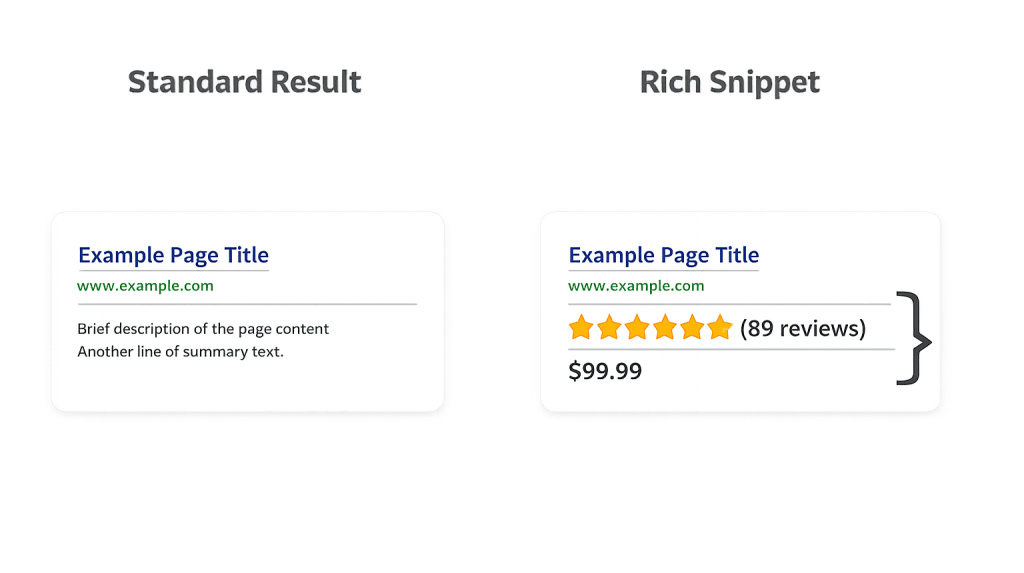
A rich snippet is an enhanced search result that displays additional information beyond the standard title, URL, and meta description — such as star ratings, product prices, review counts, FAQ accordions, recipe details, or event dates. Rich snippets are generated when search engines like Google detect structured data (often in the form of Schema markup) in a page’s code and choose to display it visually in the search results.
The distinction between “rich snippet” and “rich result” is small but worth noting: Google now officially prefers the term “rich results” to encompass the full range of enhanced SERP features, but “rich snippet” remains the widely used term in SEO conversations. Either way, the mechanism is the same — structured data on your page communicates additional context to search engines, which may then present that context visually to users.
[Image: Screenshot of Google search results showing a result with star ratings and review count, compared to a standard result without structured data]
Types of Rich Snippets
Rich snippets come in many forms depending on the content type and the structured data markup applied:
- Review / Rating snippets — Star ratings and review counts displayed beneath the page title. Applicable to products, local businesses, books, recipes, and more.
- FAQ snippets — Expandable question-and-answer pairs displayed directly in the search results, linking to specific sections of the page.
- Product snippets — Price, availability, and rating information for e-commerce product pages.
- Recipe snippets — Cook time, ingredient count, ratings, and calorie information for recipe pages.
- Event snippets — Date, time, and location for event listings.
- Article / breadcrumb snippets — Publication date, author, and breadcrumb navigation path for news and article content.
- HowTo snippets — Step-by-step instructions displayed within the search result.
Not all structured data results in a rich snippet — Google ultimately decides whether to display enhanced results based on content quality, accuracy of the markup, and the specific query context.
Purpose & Benefits
1. Higher Click-Through Rates Without Higher Rankings
Rich snippets make your search listing more visually prominent than standard results. Studies consistently show improved click-through rates for pages displaying rich results — with some analyses reporting 20–30% CTR increases. This means you can earn more traffic from the same ranking position, or compete more effectively against higher-ranking pages that lack structured data. Our SEO services incorporate structured data implementation as a standard optimization practice.
2. Better Pre-Click Qualification
When a user sees star ratings, price ranges, or FAQ content before clicking, they have more context about whether your page will answer their question. This improves the quality of traffic you receive — visitors who click through already know more about what they’ll find, which tends to produce higher engagement and lower bounce rates. The result is traffic that converts better, not just traffic that arrives.
3. Competitive Differentiation on SERP Features
On a page of results where most listings show only title and description, a result with five gold stars or an expandable FAQ stands out immediately. Rich snippets change the visual weight of your listing relative to competitors. In categories where structured data adoption is still incomplete, implementing rich snippets creates a meaningful visual advantage that’s difficult for slower-moving competitors to close quickly.
Examples
1. E-Commerce Product Listing
An online store adds Product schema markup to all product pages, including price, priceCurrency, availability, and aggregateRating fields. When those products appear in Google search results, users see the price, stock status, and star rating directly in the listing — before they click. Searchers ready to buy can immediately compare price and rating, and the store gets pre-qualified traffic.
2. FAQ Rich Snippet for a Service Page
A web design agency adds FAQPage schema markup to a “how much does a website cost?” page, marking up five common questions and answers. Google displays up to three of those Q&A pairs as expandable accordions directly in the search result. The listing takes up significantly more vertical space on the results page, drawing the eye and providing value before the click.
3. Recipe Site with Structured Data
A food blog implements Recipe schema markup on every post, including prepTime, cookTime, nutrition, and aggregateRating. Google displays a rich snippet card with cooking time, calorie count, and star ratings in search results. The same pages also become eligible for Google’s recipe carousel in image and discovery searches, extending reach beyond standard blue-link results.
Common Mistakes to Avoid
- Marking up content that isn’t visible on the page — Google requires structured data to match the actual content users see. Marking up a rating that doesn’t appear on the page, or inflating a review count in the schema, violates Google’s guidelines and can result in manual penalties.
- Using outdated or deprecated schema types — Schema.org and Google regularly update supported types and required fields. Review the current Google Rich Results documentation for the most accurate implementation requirements.
- Assuming structured data guarantees rich snippets — It doesn’t. Structured data makes your content eligible for rich results, but Google decides whether to display them based on content quality, query context, and other signals. Well-implemented markup on thin content rarely produces rich snippets.
- Implementing schema without testing it — Use Google’s Rich Results Test tool to validate your markup before and after implementation. Errors in structured data code can invalidate the entire schema block.
Best Practices
1. Implement Structured Data for Every Relevant Content Type
Identify which page types on your site have eligible content: product pages, FAQ sections, review aggregations, events, articles. Prioritize implementing Schema markup on your highest-traffic, highest-intent pages first. JSON-LD format (a script block in the page’s <head>) is Google’s preferred implementation method and is easiest to maintain.
2. Validate with Google’s Rich Results Test
After implementing schema markup, run every key page through Google’s Rich Results Test. This tool identifies syntax errors, missing required fields, and warnings about recommended properties. After publishing, monitor performance in Google Search Console’s “Enhancements” section, which tracks rich result appearances and flags errors over time.
3. Ensure Your Content Earns the Markup
Rich snippets are a reward for high-quality content, not a shortcut to it. FAQ schema works best when your FAQ section contains genuinely useful answers to real questions. Review schema requires authentic reviews from real users. Structured data amplifies good content — it doesn’t substitute for it. Focus on creating genuinely useful pages, then layer structured data on top to communicate that quality to search engines.
Frequently Asked Questions
Does structured data directly improve my search rankings?
Structured data is not a direct ranking factor — it doesn’t cause Google to rank your page higher. What it does is make your page eligible for rich results, which can significantly improve click-through rates from the same ranking position. Better CTR sends positive engagement signals to Google, which can indirectly support ranking improvements over time.
What’s the difference between a rich snippet, a featured snippet, and a rich result?
A featured snippet is a box at the top of search results that excerpts an answer from a page — Google selects these based on content, and structured data is not required. A rich snippet (or rich result) is an enhanced version of your own regular search listing, displaying additional structured information from your page. They’re related concepts but distinct features.
How do I add rich snippets to my WordPress site?
The easiest method is an SEO plugin like Yoast SEO or Rank Math, both of which generate schema markup automatically for posts, pages, and other content types. For e-commerce, WooCommerce integrations and dedicated schema plugins can add product markup. Custom implementations require adding JSON-LD script blocks to page templates.
Which rich snippet types drive the most clicks?
Product snippets (showing price and ratings) and FAQ snippets tend to have the strongest CTR impact in most industries. Star rating snippets for local businesses and service providers are also very effective. The best type depends on your content — implement the schema type that most accurately represents what your page actually contains.
Can rich snippets appear for any website?
Any website can implement structured data and become eligible for rich results — there’s no minimum site authority or traffic threshold. However, Google does require that the content be accurate, that the schema match the visible page content, and that the site not have a history of structured data guideline violations.
Related Glossary Terms
How CyberOptik Can Help
Implementing structured data correctly — and keeping it valid as Google’s requirements evolve — is the kind of technical SEO work that directly affects how your listings appear in search. Our team implements rich snippet markup as part of our SEO engagements, covering product pages, service pages, FAQs, and more. Contact us for a free website review or learn more about our SEO services.