
Prompt engineering is the practice of crafting and refining the inputs given to AI language models — such as ChatGPT or other large language models (LLMs) — to produce more accurate, relevant, and useful outputs. It’s the discipline of learning how to communicate with AI tools effectively: what context to provide, how to structure requests, what constraints to specify, and how to iterate when the first output misses the mark.
As AI tools become embedded in content creation, research, code generation, and marketing workflows, prompt engineering has moved from a niche developer skill to a practical competency for anyone using these tools regularly. The quality of what an AI produces is almost always a function of the quality of the prompt — not just the capability of the underlying model.
How Prompt Engineering Works
A prompt is the text input you send to an AI model. The model generates a response based on that input, its training data, and any system instructions it operates under. Prompt engineering is the skill of constructing inputs that guide the model toward the response you actually want.
Key components of an effective prompt:
- Task — A clear statement of what you want the model to do (“Write a product description for…”)
- Context — Background information that shapes the output (“The audience is small business owners unfamiliar with technical jargon”)
- Constraints — Specifications on format, length, tone, or style (“Keep it under 150 words, conversational, no bullet points”)
- Examples — Sample inputs and outputs that demonstrate the desired pattern (few-shot prompting)
- Role — Framing the model’s persona for the task (“Act as an experienced e-commerce copywriter”)
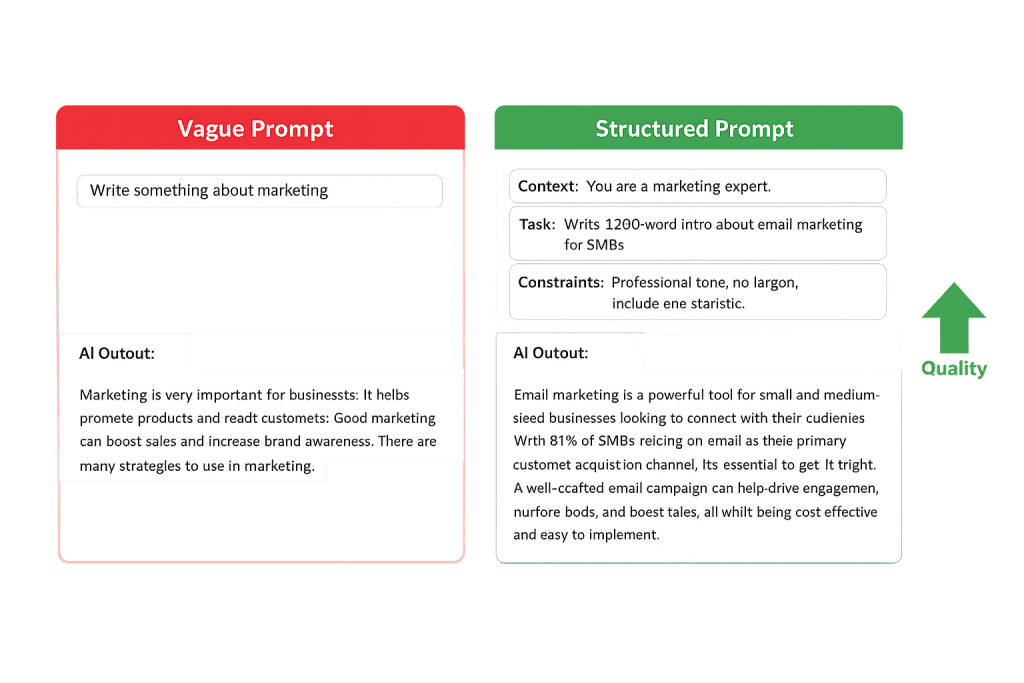
[Image: Side-by-side comparison of a vague prompt versus a structured prompt with context, task, and constraints, showing the quality difference in outputs]
Advanced techniques include chain-of-thought prompting (asking the model to reason through a problem step by step before answering), iterative refinement (improving a draft through multiple prompt cycles), and structured output requests (asking for responses in a specific format like JSON or a numbered list).
Purpose & Benefits
1. More Useful AI Outputs Without Better Tools
The same AI model can produce mediocre or excellent output depending entirely on how it’s prompted. Prompt engineering extracts more value from tools you’re already using — no new subscriptions or technical upgrades required. For content teams using AI-powered search tools or writing assistants, this translates directly into less editing time and higher-quality first drafts.
2. Consistency and Repeatability at Scale
Well-crafted prompts can be saved, shared, and reused across a team. Instead of every team member developing their own approach to getting useful AI output, a documented set of prompts creates consistent results — particularly valuable for recurring tasks like writing product descriptions, generating social post variations, or drafting FAQ responses. This is the workflow foundation of AI-assisted content operations.
3. Better Human-AI Collaboration
Prompt engineering makes the collaboration between human expertise and AI capability more intentional. The human brings the strategic judgment, audience understanding, and quality bar; the AI handles the drafting, iteration, and volume. Understanding how to steer AI tools with clear prompts means the human’s knowledge shapes the output rather than accepting whatever the model defaults to.
Examples
1. Content Creation Prompt
A marketing team needs blog post introductions. A vague prompt: “Write a blog intro about social media marketing.” A structured prompt: “Write a 100-word blog introduction for a small business owner who is skeptical that social media marketing is worth their time. The tone is direct and practical — no enthusiasm clichés. End with a clear preview of what the post covers.” The second prompt produces something usable; the first rarely does.
2. Few-Shot Prompting for Consistent Style
A copywriter needs product descriptions that match an established brand voice. They include two examples of ideal descriptions in the prompt, then add: “Write a description for [Product X] following the same style, length, and format as the examples above.” The model pattern-matches to the examples, producing output that’s stylistically consistent without extensive editing.
3. Chain-of-Thought for Complex Analysis
A business analyst needs to evaluate whether a new market segment is worth pursuing. Instead of asking “Should we expand into the SMB market?”, they prompt: “Think through the key factors that would determine whether expanding into the SMB market makes sense for a B2B SaaS company. Consider pricing, sales motion, support burden, and competitive dynamics. After reasoning through each factor, provide a recommendation.” The chain-of-thought approach yields structured analysis rather than a single, unsupported opinion.
Common Mistakes to Avoid
- Being too vague — “Write something about X” gives the model no direction. The more context and constraints you provide, the more predictably useful the output will be. Precision in prompting is a skill that pays off quickly.
- Accepting the first output without iteration — The first response is rarely the best response. Effective prompt engineers treat AI interaction as a dialogue — they refine, redirect, and build on outputs rather than accepting whatever the model first produces.
- Over-relying on AI without human review — LLMs can produce confident-sounding errors — inaccurate facts, fabricated sources, outdated information. Every AI output should be reviewed by a person with relevant knowledge before being published or shared externally.
- Ignoring model limitations — AI models have knowledge cutoffs, can’t access real-time data (unless given tools), and can struggle with highly specific or niche information. Understanding what a model is and isn’t good at prevents wasted prompting cycles on tasks where other tools would serve better.
Best Practices
1. Structure Prompts with Clear Sections
Organize your prompt into distinct sections: role, context, task, constraints, and format. Some practitioners use XML-style tags (<context>, <task>) or numbered sections to make the structure explicit. Well-organized prompts produce more consistent outputs because the model can clearly identify what each part of the instruction means.
2. Iterate and Save What Works
Treat prompt engineering as an iterative process. When a prompt reliably produces good output, save it as a template. Build a personal or team library of effective prompts for recurring tasks. Over time, this library becomes a productivity asset — a set of tested, reliable instructions that produce consistent results without starting from scratch each time.
3. Test Across Different Phrasings
Small changes in phrasing can produce noticeably different outputs. If a prompt isn’t producing what you need, try reframing the task, adding a constraint, or providing an example. Testing several variations of a prompt — especially for high-frequency tasks — identifies which formulation most reliably produces the quality you’re looking for.
Frequently Asked Questions
Do I need technical skills to learn prompt engineering?
No. Prompt engineering is primarily a communication and critical thinking skill. Understanding what you want, being specific about it, and knowing how to evaluate whether the output is useful are the core competencies — not programming or AI expertise. Anyone who writes regularly can develop effective prompting skills with practice.
Is prompt engineering a long-term skill, or will AI improve to where it’s unnecessary?
Newer AI models are more capable and require less explicit instruction for simple tasks. But for complex, nuanced, or high-stakes outputs, well-crafted prompts continue to produce significantly better results than vague ones. As models improve, the skill shifts from basic instruction to higher-level direction — but the ability to communicate clearly with AI remains valuable.
What’s the difference between prompt engineering and fine-tuning an AI model?
Fine-tuning involves retraining a model on a specific dataset to change its underlying behavior — a technical, resource-intensive process. Prompt engineering uses the existing model as-is and guides it through carefully crafted inputs. For most business applications, prompt engineering delivers better results per unit of effort than fine-tuning.
Can prompt engineering replace a copywriter?
Not in any direct sense. What it does is change how copywriters work — shifting time from drafting to directing, editing, and quality control. A skilled copywriter who understands prompt engineering produces more work in less time than one who doesn’t. The judgment, strategy, and audience understanding that make copy effective still require human expertise.
How does prompt engineering relate to AI-powered search?
As AI-powered search tools like Google’s AI Overviews become more prevalent, how users phrase their queries functions like informal prompt engineering — more specific, context-rich queries produce more useful AI-generated answers. Content creators who understand this dynamic can produce content that better serves both human readers and the AI systems that surface and summarize it.
Related Glossary Terms
How CyberOptik Can Help
AI tools are reshaping how content is created, how sites are optimized, and how businesses interact with search — and we’re actively integrating these capabilities into the work we do for clients. Whether you need help developing AI-assisted content workflows, optimizing for AI-powered search, or understanding how emerging tools fit into your marketing strategy, we can help. Learn about our AI & SEO services or contact us.