
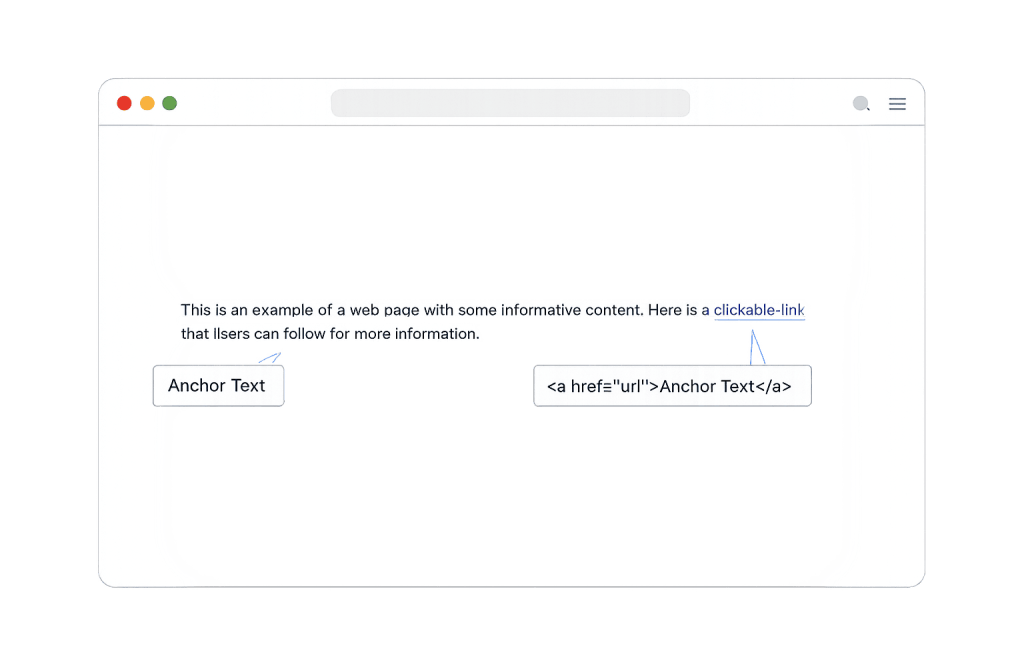
Anchor text is the visible, clickable text in a hyperlink. When you underline a phrase and link it to another page, that phrase is the anchor text. Search engines use it as a signal to understand what the destination page is about — making it one of the more influential on-page and off-page SEO elements that many site owners underestimate.
The relationship between anchor text and backlinks is direct: every link pointing to your site carries anchor text, and the collective pattern of those anchors shapes how search engines categorize your pages. The same principle applies to internal linking — the words you choose when linking between your own pages send relevance signals throughout your site.
[Image: Screenshot of a hyperlink in a web page with the anchor text highlighted and labeled]
Types of Anchor Text
Understanding the different anchor types helps you make intentional decisions about how you link across your site and evaluate the quality of links pointing to you.
- Exact match — The anchor text is the exact keyword the linked page targets. Example: linking to an SEO services page using the anchor “SEO services.” Effective but risky if overused — search engines treat excessive exact-match anchors as a red flag for manipulation.
- Partial match — Includes the target keyword alongside other words. Example: “learn more about our SEO services” instead of just “SEO services.” This is generally safer and looks more natural.
- Branded — Uses the company or site name as the anchor. Example: “CyberOptik” or “CyberOptik’s team.” Branded anchors make up the bulk of a healthy backlink profile.
- Generic — Phrases like “click here,” “read more,” or “visit this page.” These provide no context to search engines and should be used sparingly.
- Naked URL — The URL itself is the anchor. Example: “https://example.com/seo-services.” Common in citations, press mentions, and directories.
- Image anchors — When an image is hyperlinked, search engines use the image’s alt text as the effective anchor text.
Purpose & Benefits
1. Helps Search Engines Understand Page Topics
When a page receives multiple links with the anchor text “WooCommerce development,” search engines interpret that as a strong relevance signal for that topic. This is one of the reasons anchor text matters so much for on-page SEO and for building topical authority across your site.
2. Guides Users Through Your Content
Descriptive anchor text sets user expectations before they click. A link that reads “how to reduce cart abandonment” tells the visitor exactly what they’ll find — which improves click rates and reduces pogo-sticking back to the previous page. Our team builds SEO services with internal linking structures that serve both users and search engines.
3. Distributes Link Equity Across Your Site
Strategic internal linking with thoughtful anchor text spreads ranking authority from high-authority pages (like your homepage) to deeper pages that need a boost. This is one of the most underutilized levers in on-page SEO — and it costs nothing to implement on content you already have.
Examples
1. Internal Linking on a Service Page
A web design agency’s homepage links to its SEO services page using the anchor “search engine optimization services.” Meanwhile, a blog post on the same site links to that same page with “how we approach keyword research.” This variety of anchors — some descriptive, some broader — builds a natural internal linking profile while reinforcing the page’s relevance.
2. Backlink Profile for an E-Commerce Store
A WooCommerce store earns a link from a product review blog. The anchor reads “this portable blender” — a partial match for the product page it points to. That same store might have dozens of branded links from other sources reading “Brand Name” or “visit Brand Name’s store.” This mix of partial match and branded anchors reflects a healthy, natural-looking backlink profile.
3. Guest Post Outreach Gone Wrong
A site that aggressively pursues guest posts and instructs every contributor to use the exact anchor “best WordPress agency” will build an unnatural anchor pattern. Post-Penguin, Google’s algorithm is well-equipped to detect this. The safer approach: let contributors use natural phrasing, and let branded and generic anchors fill out the profile.
Common Mistakes to Avoid
- Over-optimizing exact match anchors — Using your target keyword as the anchor on every internal and external link is a pattern that raises algorithmic flags. Industry guidance suggests exact-match anchors should make up no more than 5–10% of a page’s total link profile.
- Relying on “click here” and “read more” — Generic anchors waste an opportunity to signal relevance. They tell neither users nor search engines anything about the linked content.
- Ignoring internal link anchor text — Most SEO conversations about anchor text focus on backlinks, but internal links are fully within your control. Using vague anchors on internal links is a missed SEO opportunity.
- Using the same anchor text repeatedly for the same page — Repeating the exact same anchor across multiple links to one page looks manufactured. Vary the phrasing while maintaining topical relevance.
Best Practices
1. Build a Diverse Anchor Profile
A healthy link profile for an inner page might look roughly like this: 40–50% partial match, 30–40% branded or natural phrasing, and no more than 5–10% exact match. For homepages, branded anchors should dominate. Aiming for diversity protects against algorithm updates and looks credible to both users and search engines.
2. Make Anchor Text Descriptive and Concise
Good anchor text tells the user what they’ll find on the other side. “How to set up free shipping in WooCommerce” is far more useful than “our tutorial.” Aim for 3–8 words — long enough to be descriptive, short enough to be readable in a sentence. This is the standard Google explicitly recommends for crawlable links.
3. Audit Your Internal Linking Regularly
Use a tool like Screaming Frog or Ahrefs to audit the anchor text on your internal links. Look for pages that are only linked with generic anchors, pages with excessive exact-match repetition, and orphaned pages that receive no internal links at all. A clean internal linking structure supports both user navigation and crawl efficiency.
Frequently Asked Questions
Does anchor text still matter for SEO in 2025?
Yes. Anchor text remains one of the clearest signals search engines use to understand what a linked page is about. The strategy around it has evolved — diversity and naturalness matter more than raw keyword density — but the fundamental role anchor text plays in SEO hasn’t changed.
What’s the difference between anchor text for internal links vs. backlinks?
The principles are the same (descriptive, varied, relevant), but the stakes differ. You control internal link anchors completely, so there’s no excuse for generic text on your own site. Backlink anchors are largely controlled by other sites, which is why a natural-looking profile — one that doesn’t appear to have been engineered — is the goal.
How do I know if my anchor text profile has a problem?
Tools like Ahrefs, Semrush, or Moz show your backlink anchor distribution. Red flags include a disproportionate amount of exact-match anchors for the same keyword, a sudden spike in new links with identical anchor text, or a very high ratio of generic anchors with no descriptive variation.
Can bad anchor text from other sites hurt my rankings?
It can, though Google’s algorithms have gotten better at discounting low-quality links rather than penalizing them outright. If you believe you have a large volume of toxic backlinks with manipulative anchor text, a disavow file submitted through Google Search Console is the appropriate remedy.
What anchor text should I use for the “nofollow” links?
The same principles apply — use descriptive, natural anchor text. The nofollow attribute tells search engines not to pass link equity through the link, but it doesn’t change the user experience. Clear anchor text still helps users understand where they’re going.
Related Glossary Terms
- Backlink
- Internal Linking
- On-Page SEO
- Alt Text
- Dofollow / Nofollow Link
- Domain Authority / Domain Rating
- Keyword
- Black Hat SEO
How CyberOptik Can Help
Managing anchor text effectively — both in your internal linking structure and your backlink profile — is a core part of any sound SEO strategy. Our team audits link profiles, builds internal linking frameworks, and creates optimization plans that help your pages rank for the right terms. Whether you need a full SEO audit or ongoing optimization support, we can help you build a linking strategy that holds up over time. Contact us for a free website review or explore our SEO services.