
A drip campaign is a series of pre-written emails sent automatically to contacts on a set schedule or triggered by specific actions they take. Rather than sending all your messages at once, you deliver them in a deliberate sequence — “dripping” content over days or weeks — designed to move recipients through a defined journey, whether that’s onboarding a new subscriber, nurturing a sales prospect, or re-engaging an inactive customer.
The term comes from the irrigation concept of drip watering: consistent, measured delivery over time rather than a single flood. In practice, drip campaigns power some of the highest-performing email programs because they reach people at the right moment with contextually relevant messages. An automated email sent hours after someone downloads a resource performs meaningfully better than the same email sent three weeks later in a generic newsletter blast.
How Drip Campaigns Work
Every drip campaign has two core components: a trigger and a sequence.
Triggers that start a drip campaign:
– A new subscriber joins your email list
– A contact downloads a lead magnet or fills out a form
– Someone signs up for a free trial or demo
– A customer makes their first purchase
– A contact hasn’t engaged with your emails in 90 days (re-engagement trigger)
– A prospect visits a specific page on your website (behavioral trigger)
Sequence structure:
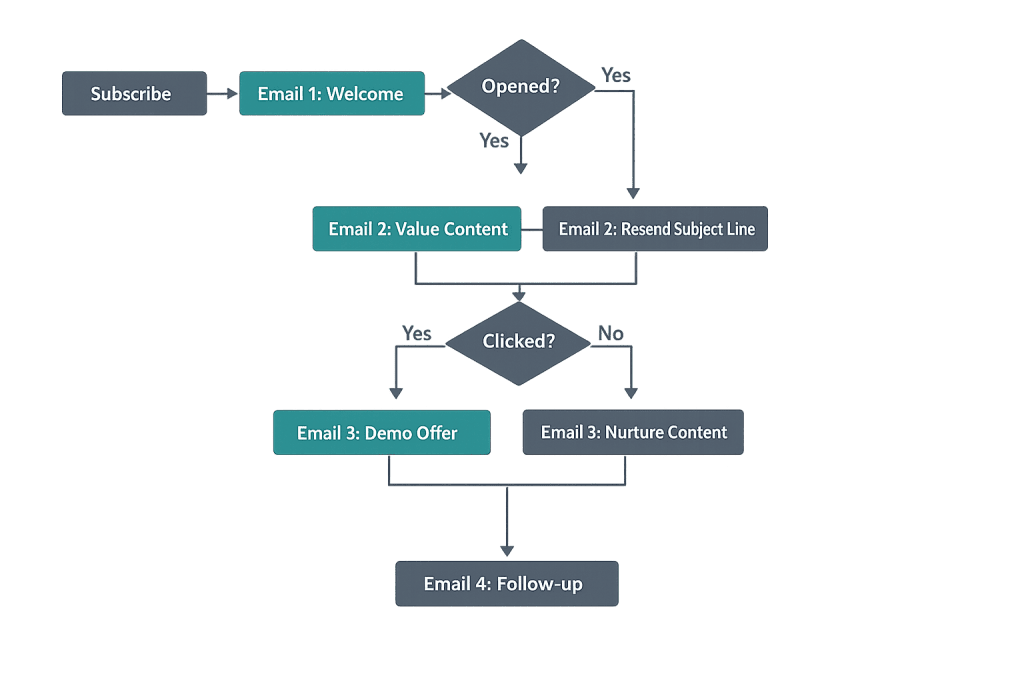
Once triggered, each email in the sequence sends at a predetermined interval — 1 day after trigger, 3 days after, 7 days after — or waits for an action like an email open or link click before advancing to the next message. More sophisticated campaigns use branching logic: contacts who click a specific link receive a different next email than those who don’t.
Most email automation platforms — Klaviyo, Mailchimp, HubSpot, ActiveCampaign, Drip — offer visual workflow builders for creating and managing drip sequences. The campaigns run continuously in the background, sending to new contacts as they qualify.
[Image: Flowchart showing a 4-email drip sequence with branching logic based on opens and clicks]
Purpose & Benefits
1. Consistent Follow-Up Without Manual Work
Once built, a drip campaign runs without intervention. Every new lead gets the same structured follow-up in the same sequence regardless of when they enter. This consistency is nearly impossible to achieve with manual follow-up at any volume — and consistency is what converts prospects who aren’t ready to buy on day one. Our marketing services include email strategy and campaign setup.
2. Higher Engagement Through Timing and Relevance
Triggered emails — sent in response to a specific action — outperform generic scheduled blasts because they’re timely and contextually relevant. According to industry data, automated emails generate 320% more revenue than non-automated campaigns. When someone just downloaded your guide, an email the next day about related resources is far more welcome than the same email three weeks later.
3. Progressive Qualification and Segmentation
Well-designed drip campaigns reveal where prospects are in their decision process. Contacts who click “View Pricing” in email three are further along than those who only opened the first email. These behavioral signals let you segment your list more intelligently — sending more sales-oriented messages to engaged prospects and more educational content to those still in early research. This feeds naturally into a broader conversion funnel.
Examples
1. Welcome Sequence for a New Subscriber
Someone opts in for a free resource on a professional services firm’s website. The drip campaign activates:
– Day 0: Confirmation email with the promised resource
– Day 2: Introduction to the team and what makes them different
– Day 5: Case study or client result relevant to the subscriber’s interest
– Day 9: Soft invitation to schedule a consultation
The sequence introduces the firm progressively without overwhelming a new contact, and the consultation offer arrives only after establishing some familiarity and value.
2. Post-Purchase Onboarding for a SaaS Product
A customer signs up for a software trial. The drip campaign guides them through the product:
– Day 1: “Your account is ready” — key first steps
– Day 3: Feature spotlight — the feature most correlated with retention
– Day 7: How other customers use the platform in similar scenarios
– Day 14: Check-in with a help offer and upgrade prompt if engagement is high
Each email addresses likely points of friction at predictable stages of the trial, improving activation rates.
3. Re-Engagement Drip for Inactive Subscribers
Contacts who haven’t opened an email in 90 days enter a re-engagement sequence. The sequence starts with a compelling subject line designed to elicit a click, follows with a direct question (“Still interested in hearing from us?”), and ends with an explicit choice: re-confirm their subscription or unsubscribe. Contacts who don’t engage get removed from the active list — improving list health and deliverability metrics for everyone else.
Common Mistakes to Avoid
- Too many emails, too fast — Aggressive drip sequences that send daily for two weeks feel like spam to most recipients. Starting with 3–5 emails spaced 2–7 days apart and measuring unsubscribe rates guides the right cadence.
- One-size-fits-all sequences — A drip campaign that ignores behavioral signals treats a highly engaged prospect the same as someone who never opened the first email. Use click and open behavior to branch sequences appropriately.
- Forgetting to update sequences — Drip campaigns run indefinitely once built. Outdated pricing, discontinued offers, or stale case studies damage credibility. Review active sequences at least quarterly.
- No clear goal per email — Each email in a drip should have one specific purpose — introduce, educate, demonstrate value, or ask for an action. Emails that try to accomplish everything at once accomplish nothing well.
Best Practices
1. Map the Sequence to the Buyer’s Journey
Before writing a single email, define the journey: where is the contact when they enter, and what’s the goal when they exit? Each email should advance them one step. This structure produces cleaner, more purposeful copy and makes it easier to diagnose which message in a sequence is underperforming.
2. Write as If to One Person
Drip emails work best when they read like a direct, personal message rather than a broadcast. Use the recipient’s first name, write in second person (“you”), and maintain a conversational tone. The goal is to feel like a thoughtful follow-up, not a marketing template. This connects directly to the autoresponder best practice of genuine personalization.
3. Monitor and Iterate on Performance
Track open rates, click rates, and conversion rates per email in your sequence. If email three has a dramatically lower open rate, check the subject line and timing. If the sequence generates opens but no conversions, the ask may be coming too early or the value proposition isn’t landing. Regular review of drip performance feeds continuous improvement.
Frequently Asked Questions
What’s the difference between a drip campaign and a newsletter?
A newsletter is a broadcast sent to your full list at a scheduled time — everyone gets the same email at once. A drip campaign is personalized and triggered — each subscriber gets the sequence timed to when they entered, based on their behavior. Newsletters create connection; drips guide individuals through a journey.
How many emails should a drip campaign have?
It depends on the goal and how complex the journey is. A simple welcome sequence might have 3–5 emails. A full sales nurture sequence might span 10–15 emails over several weeks. Start with fewer emails and extend the sequence based on engagement data — if contacts are still engaging with email eight, there’s room for more.
What tools do you need for drip campaigns?
Any email platform with automation capabilities — Klaviyo, ActiveCampaign, Mailchimp, HubSpot, or Drip, among others. The platform needs to support trigger-based enrollment and ideally branching logic based on opens and clicks. The right tool depends on your list size, budget, and integration needs with your CRM or e-commerce platform.
Can drip campaigns work for B2B businesses?
Yes — B2B drip campaigns often perform especially well because B2B sales cycles are longer and require multiple touchpoints before a decision is made. A well-designed nurture sequence can maintain a relationship with a prospect over weeks or months, building familiarity and trust at each touchpoint until they’re ready to engage with sales.
What is the difference between a drip campaign and email automation?
A drip campaign is a specific type of email automation — a pre-planned sequence sent on a schedule or based on triggers. Email automation is the broader category that includes drip campaigns plus any other triggered or scheduled email logic — transactional emails, behavioral follow-ups, re-engagement campaigns, and more.
Related Glossary Terms
- Autoresponder
- Email Automation
- Conversion Funnel
- Average Time on Page
- Click-Through Rate (CTR)
- Conversion Rate
- Content Strategy
How CyberOptik Can Help
Email remains one of the highest-ROI channels in digital marketing, and getting drip campaigns right is key to making it work. Our team can help you build automated email sequences that reach the right people with the right message at the right moment — from strategy to copywriting to platform configuration. Contact us to discuss your email strategy or learn about our marketing services.