
GPL (General Public License) is an open-source software license that governs how software can be used, modified, and distributed. In the context of WordPress, it’s the license under which WordPress itself is released — and that license has significant implications for every theme and plugin built on top of it.
WordPress uses the GPLv2+ license (version 2 or later), which was originally created by the Free Software Foundation as part of the GNU project. At its core, the GPL guarantees four freedoms: the freedom to run the software for any purpose, to study and modify its source code, to redistribute copies to others, and to distribute modified versions under the same license. This last point — known as “copyleft” — is what makes the GPL self-perpetuating.
How the GPL Applies to WordPress
The GPL’s reach within the WordPress ecosystem is broader than most site owners realize.
WordPress core is released under GPLv2+. This means anyone can download, use, modify, and redistribute WordPress at no cost, and any modifications they distribute must also be released under the GPL.
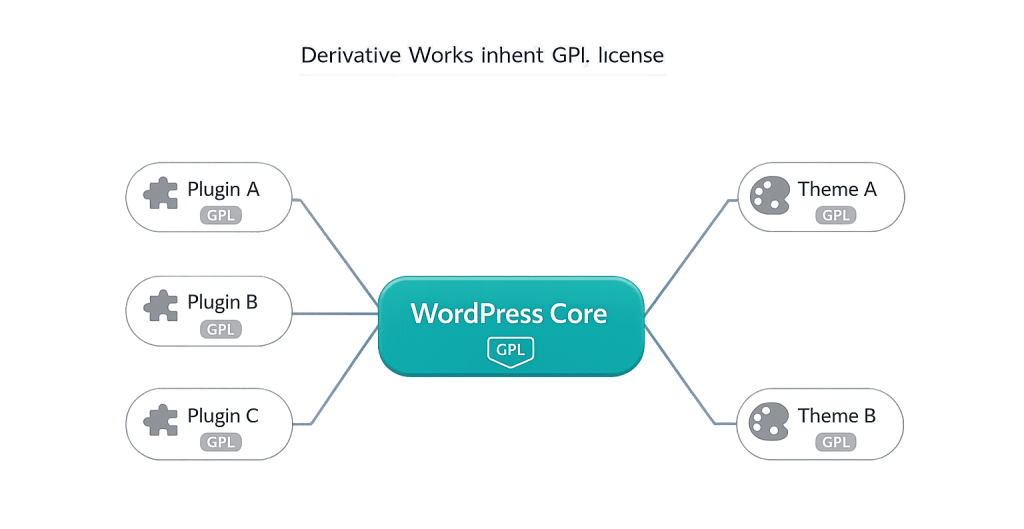
Plugins and themes are considered derivative works of WordPress because they interact directly with WordPress’s core code. As a result, they inherit the GPL license. Any plugin or theme distributed through WordPress.org is required to be GPL-compatible. This is why you can download thousands of free plugins and themes from the official WordPress.org directory without paying for them.
Premium plugins and themes operate within the GPL in a nuanced way. Developers can sell their work — and many do, running successful businesses around it — because the GPL’s four freedoms refer to use and distribution, not price. A developer can charge for a plugin while still technically making it GPL. What they cannot do is prevent the buyer from redistributing it. In practice, what premium developers are selling is support, updates, and access — not the license itself.
[Image: Diagram showing WordPress core at the center with plugins and themes as derivative works inheriting the GPL license]
Purpose & Benefits
1. Freedom to Customize Without Legal Risk
Because WordPress, its plugins, and its themes are GPL-licensed, WordPress development teams can modify any aspect of the code to meet a client’s specific needs. You’re not locked into using software exactly as-is. If a theme needs structural changes, or a plugin needs a feature added, developers can legally make those modifications — a freedom that doesn’t exist with proprietary software.
2. A Thriving, Collaborative Ecosystem
The GPL is the legal foundation that enabled the WordPress open-source community to grow into what it is today. Because anyone can build on top of WordPress and distribute their work freely, tens of thousands of contributors have added to the plugin and theme ecosystem. Businesses benefit from this directly: the tools available for WordPress sites are vast, actively maintained, and frequently improved by a global community.
3. Protection Against Lock-In
With GPL software, you’re never entirely dependent on a single vendor. If a plugin developer abandons their product or shuts down, the code still exists and another developer can fork it and continue development. This differs significantly from proprietary software, where a vendor going out of business can leave customers stranded with code they’re unable to modify or maintain.
Examples
1. The Free Plugin Directory
Every plugin available on the WordPress.org plugin directory is GPL-licensed. A business installs a contact form plugin, a caching plugin, and an SEO plugin — all for free, all modifiable, all redistributable. The GPL is what makes this entire ecosystem legally functional.
2. Premium Themes With Open Code
A design agency purchases a premium WordPress theme for $79. Because the theme is GPL-licensed, the agency can install it on multiple client sites, modify the code extensively, and pass those modifications to their clients without any additional licensing fees. The developer earns money from the initial sale and ongoing support subscriptions — not from restricting how the code is used.
3. Agency Customization for Clients
A web agency builds a client site using GPL-licensed plugins. The client later decides to move to a new agency. Because the plugins are GPL, the new agency can legally access, modify, and continue working with the code without needing to purchase new licenses or negotiate access — the GPL guarantees this continuity.
Common Mistakes to Avoid
- Assuming “GPL” means it’s free to use commercially — GPL-licensed software can absolutely be used for commercial purposes. The license governs how you can distribute and modify it, not what you use it for. Running a business on a GPL-licensed WordPress site is completely legal and common.
- Confusing GPL with “no support” — GPL only means the code is freely available. Premium GPL plugins typically come with paid support, update subscriptions, and documentation. You can find the code for free elsewhere, but the support tier is what you’re paying for.
- Thinking you can remove the GPL license from derivative works — If you build a plugin that extends WordPress functionality, it must also be released under the GPL if distributed. You can’t strip the GPL and make it proprietary.
- Ignoring license compliance on client sites — If your development work involves distributing modified plugins or themes to clients, those modifications technically need to be GPL-compatible. Most agencies handle this automatically, but it’s worth understanding.
Best Practices
1. Source Plugins and Themes From Reputable GPL Repositories
The safest place to find GPL-compliant plugins and themes is WordPress.org itself, where every submission is reviewed for license compliance. For premium plugins, stick to established marketplaces and developers who clearly state their GPL licensing. Avoid “GPL club” sites that offer paid premium plugins for free — they’re often distributing nulled software that may contain malware.
2. Keep Track of What’s GPL-Licensed on Client Sites
When building or managing WordPress sites for clients, maintain a clear inventory of the plugins and themes in use, including their licensing terms. Most professional plugins are GPLv2+, but occasionally a plugin uses a split license (GPL for PHP, commercial for CSS/JavaScript). Knowing what’s on a site makes future modifications and handoffs cleaner.
3. Understand the Split License Reality
Some premium theme and plugin developers use a “split license” model — the PHP code is GPL (because it must be, as a WordPress derivative), but the CSS, JavaScript, and images are licensed separately under a commercial license. This is a legally debated area within the WordPress community. For practical purposes, it means you can use the PHP freely but may have restrictions on redistributing the other assets.
Frequently Asked Questions
Why is WordPress GPL? Couldn’t they use a different license?
WordPress is built on top of code that was originally licensed under the GPL, which requires derivative works to remain GPL. Even if the original WordPress developers wanted to change the license, the GPL’s copyleft provisions make that effectively impossible without rewriting significant portions of the platform from scratch.
Does the GPL mean anyone can steal my WordPress theme or plugin?
Not exactly. Someone can legally redistribute your GPL-licensed code, but they can’t do so under your brand or claim it as their own original work — that would be a trademark or copyright issue separate from the GPL. What they can do is offer it elsewhere, potentially for free. This is why premium plugin and theme developers focus on selling support and services rather than trying to restrict code access.
Can I build a business on GPL software?
Yes, and many successful companies do. Automattic, the company behind WordPress.com, is built on GPL software. The GPL doesn’t restrict commercial activity — it restricts attempts to restrict others’ freedoms with the software. You can charge for services, customization, support, and hosting around GPL software.
What happens if I use a GPL plugin and the developer stops updating it?
Since the code is GPL, you (or another developer) have the legal right to fork it — take the existing code and continue developing it independently. This is one of the key protections the GPL provides: software doesn’t die with its original author.
Are all WordPress plugins GPL?
All plugins listed in the WordPress.org directory must be GPL-compatible. Premium plugins sold through third-party marketplaces may use split licenses. Occasionally, a plugin sold outside WordPress.org may attempt to use a different license, though this is legally questionable if the plugin is built directly on WordPress’s GPL code.
Related Glossary Terms
How CyberOptik Can Help
Understanding the GPL matters when you’re making decisions about which plugins and themes to build your site on, how to handle licensing across multiple sites, and what your rights are when something needs to be customized. Our team works within the WordPress GPL ecosystem every day — selecting the right tools, modifying code when needed, and ensuring client sites are built on a solid, legally sound foundation. Get in touch to discuss your project or explore our WordPress development services.