
Content calendar is a planning tool — typically a spreadsheet, project management board, or dedicated software — that maps out what content will be created, who is responsible for it, and when it will be published. It brings together all content types across all channels: blog posts, social media updates, email newsletters, videos, and any other content a business produces. Instead of deciding what to publish on the fly, a content calendar makes the production process predictable, consistent, and aligned with business goals.
For businesses that take content seriously, the calendar is where strategy becomes execution. A well-maintained content calendar ensures that seasonal opportunities don’t get missed, that content aligns with campaigns and product launches, and that the team isn’t constantly scrambling for ideas at the last minute. Content marketing generates over three times as many leads as traditional outbound marketing while costing 62% less — but those results require consistency, and consistency requires planning.
Key Concepts
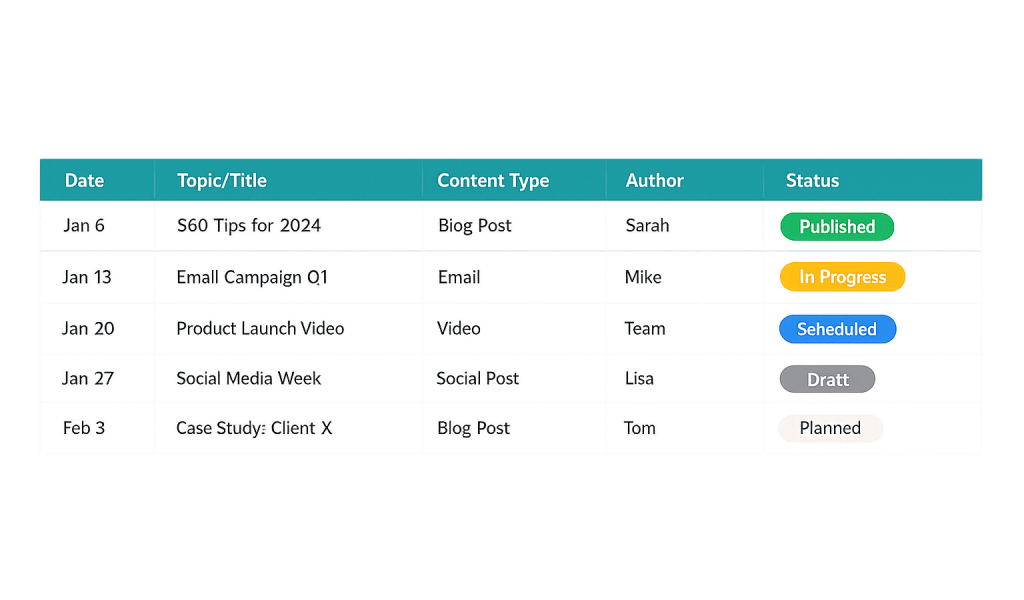
A content calendar is more than a schedule. The most useful versions include:
- Publication date — When the content goes live
- Content type — Blog post, email, social post, video, case study, etc.
- Topic / title — What the content covers, often including a target keyword
- Author / owner — Who is responsible for producing it
- Stage / status — Idea, in progress, draft, in review, scheduled, published
- Distribution channels — Where it will be published or promoted
- Campaign alignment — Which business initiative or content strategy goal it serves
Calendars range from simple spreadsheets to purpose-built tools like CoSchedule, Notion, or editorial modules within marketing platforms. The right tool is the one the team will actually use — complexity isn’t an advantage if it creates friction.
[Image: Example content calendar in spreadsheet format showing dates, topics, authors, and status columns]
Purpose & Benefits
1. Ensures Publishing Consistency
Search engines favor sites that publish new content regularly. Social media algorithms reward consistency. Email subscribers stay engaged when newsletters arrive on a predictable schedule. A content calendar removes the guesswork by locking in publication dates in advance. When the deadline is on a calendar rather than just an intention, content gets produced. Our copywriting team uses editorial calendars on every content engagement to maintain momentum for clients.
2. Aligns Content With Business Goals
Without a calendar, content creation tends to be reactive — responding to whatever seems relevant in the moment. With a calendar, content is planned around product launches, service announcements, seasonal demand, and blog topics that support SEO goals. This turns content from a random collection of posts into a coherent strategy that moves people through the buying process.
3. Improves Team Collaboration and Accountability
When multiple people are involved in content production — a writer, a designer, a reviewer, a publisher — a shared calendar makes each person’s role visible. Deadlines are explicit. Bottlenecks become obvious before they become crises. For agencies and in-house teams alike, a content calendar is the foundation of a functional content workflow.
Examples
1. Small Business Blog Planning
A landscaping company wants to attract local organic search traffic. Their content calendar plans 12 blog posts per year — one per month — aligned with seasonal topics: spring cleanup, summer lawn care, fall leaf removal, winter prep. Each post is assigned to a freelance writer six weeks before publication. The result: consistent publishing without last-minute scrambles.
2. Product Launch Content Coordination
An e-commerce brand launches a new product line in Q4. Their content calendar coordinates the supporting content: a blog post explaining the product’s benefits (4 weeks out), social media teaser posts (2 weeks out), an email announcement (launch day), a follow-up case study featuring the product (4 weeks post-launch). Everything aligns, and nothing gets forgotten.
3. Multi-Channel Marketing Agency
A marketing agency manages content for a client across blog, LinkedIn, email, and Google Business Profile. Their content calendar maps all four channels in one view, showing how blog content gets repurposed into social posts, how email newsletters link back to recent blog posts, and how seasonal promotional content runs in all four channels simultaneously. The calendar prevents duplication and ensures each channel reinforces the others.
Common Mistakes to Avoid
- Over-planning without execution — A beautiful, detailed content calendar that never gets executed is just a document. Start with a realistic publishing cadence for your current resources, even if that means one blog post per month. Consistency at a lower volume beats ambition that collapses under its own weight.
- Creating content without an SEO purpose — Each content calendar entry for organic channels should have a target keyword or topic cluster. Publishing without keyword intent is like building a store with no sign. Our team integrates keyword research into the planning phase so content works for both readers and search engines.
- Not building in time for review and revision — Rushing content to meet a deadline results in errors and lower quality. Build review time into the calendar — at minimum, a day between draft completion and publication. For regulated industries or complex topics, build in more.
- Treating the calendar as static — News breaks, priorities shift, and seasonal opportunities emerge. A rigid calendar that can’t absorb changes becomes a burden rather than a tool. Leave buffer slots in each month for reactive or opportunistic content.
Best Practices
1. Audit Before You Plan
Before building your calendar for a new period, review the performance of past content. What topics drove the most traffic? What generated the most leads? What fell flat? Let that data inform the next cycle’s priorities. Connecting your calendar to analytics — even loosely — shifts content planning from guesswork to evidence-based decision-making.
2. Plan Themes, Then Fill In Topics
Rather than trying to generate a complete list of post titles up front, plan themes by month or quarter first. A legal firm might plan “estate planning” for October and “business law basics” for November. Then generate specific post topics within each theme. This top-down approach ensures coverage of important topic areas rather than random topic selection.
3. Include Evergreen and Timely Content
Balance your calendar between evergreen content (pieces that stay relevant for years) and timely content (posts tied to current events, seasons, or news cycles). Evergreen content builds long-term organic traffic; timely content captures short-term search spikes and social sharing opportunities. A healthy content strategy includes both.
Frequently Asked Questions
How far in advance should I plan my content calendar?
Most teams plan one to three months in advance for specific topics and titles, and sketch out themes or campaigns six to twelve months ahead. Planning too far in advance with rigid specifics creates a calendar that feels outdated before execution. Quarterly detailed planning with annual theme-level planning is a common approach that balances structure and flexibility.
What tools work well for a content calendar?
Options range from free Google Sheets templates to dedicated tools like CoSchedule, Notion, Asana, or Trello. For small teams, a shared Google Spreadsheet with columns for date, topic, owner, channel, and status is often sufficient. For larger teams with complex workflows, a dedicated content operations platform adds automation and approval workflows.
Should social media be on the same calendar as blog content?
Yes, ideally. A unified content calendar — showing blog posts, email, and social media in one view — makes it easy to coordinate cross-channel campaigns and repurpose content systematically. You can use separate tabs or color coding to organize by channel while maintaining a single source of truth.
How do I measure whether my content calendar is working?
Look at publication consistency (are you hitting your planned cadence?), content performance (are planned posts reaching traffic and lead goals?), and team efficiency (are deadlines being met without constant firefighting?). The calendar is a means to an end — the end is content that supports business growth.
Related Glossary Terms
How CyberOptik Can Help
Strong content is the foundation of every effective website and marketing strategy. Our copywriting team builds and executes content calendars for clients, ensuring consistent publishing aligned with SEO goals and business objectives. Whether you need help planning a content strategy or a team to produce and publish content on a regular schedule, we can help. Explore our copywriting services or get in touch.