
Page Authority (PA) is a metric developed by Moz that predicts how well a specific web page is likely to rank on search engine results pages. It’s scored on a logarithmic scale from 1 to 100, with higher scores indicating greater ranking potential. A score of 40 represents significantly more predicted ranking strength than a score of 20 — and moving from 70 to 80 requires considerably more effort than moving from 20 to 30.
Page Authority is a third-party metric, not a Google ranking factor. Google doesn’t use Moz’s PA score in its algorithm. What Moz has done is model the relationship between link data and actual Google rankings to create a predictive score — and that prediction has proven useful for SEO practitioners who want a quick, quantified way to assess and compare the strength of individual pages. Understanding PA helps you evaluate link-building targets, audit your own site’s authority distribution, and benchmark pages against competitors.
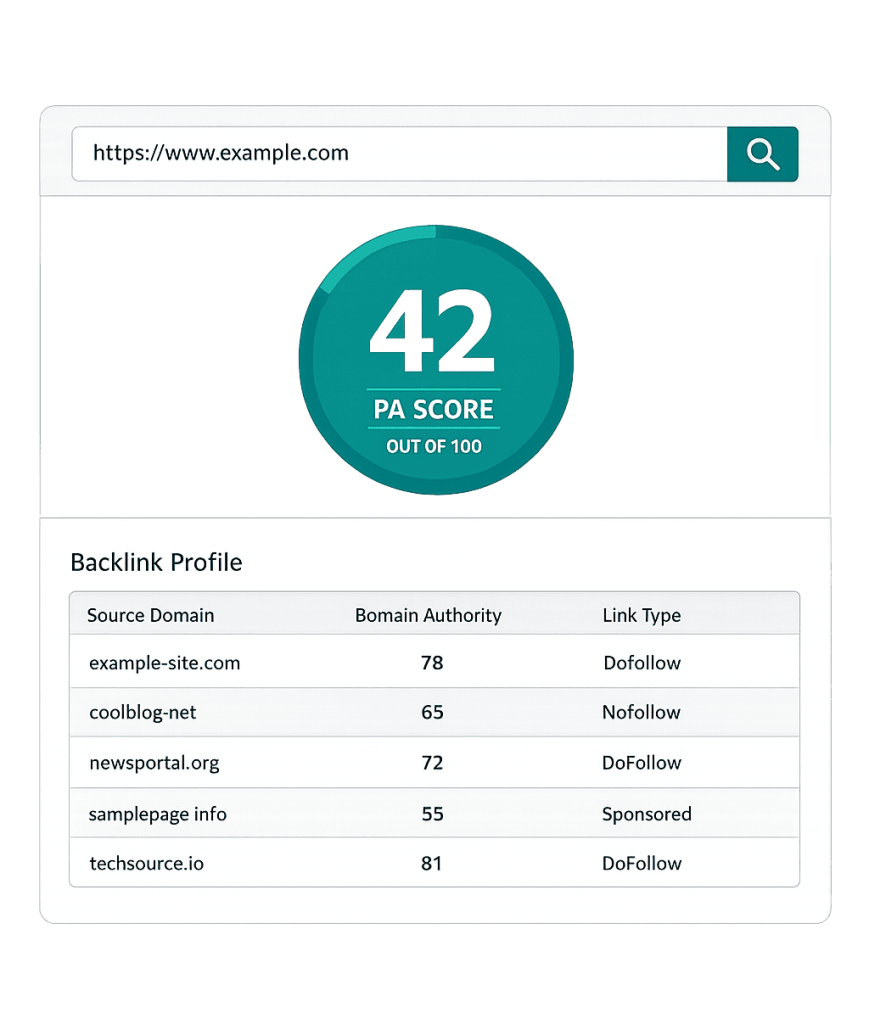
[Image: Screenshot of Moz Link Explorer showing the Page Authority score and backlink profile for a specific URL]
How Page Authority Is Calculated
PA is computed using data from Moz’s web index and incorporates over 40 link-based signals. Key factors include:
- Linking URLs — The number of external URLs pointing to the page
- Linking root domains — How many unique domains those links come from (more diverse = stronger signal)
- MozRank and MozTrust — Moz’s internal link quality and trustworthiness metrics
- Link anchor text distribution — What words are used in links pointing to the page
- Followed vs. nofollowed links — The proportion of links that pass equity
- Spam Score — A penalty-like signal for low-quality link patterns
Notably, PA does not account for on-page factors like content quality, keyword use, or page speed. It is purely a link-based metric. This means a page can have a high PA from strong backlinks but still rank poorly if the content doesn’t match search intent — and conversely, a low-PA page with exceptional content can outrank higher-PA pages for queries where Google’s quality signals favor the content.
Because PA uses a machine learning model that recalibrates regularly as Moz updates its index, scores can shift over time even without changes to a page’s actual link profile.
Purpose & Benefits
1. Evaluating Link-Building Opportunities
When prospecting for backlinks, PA helps you quickly compare the relative strength of potential linking pages. A link from a PA 55 page on a relevant site is generally more valuable than a link from a PA 20 page on the same site. PA alone shouldn’t be the only criteria — relevance and traffic matter — but it provides a fast, quantified baseline for evaluation.
2. Auditing Authority Distribution Across Your Site
PA varies across pages on the same domain. Your homepage and most-linked service pages may have high PA, while interior pages and less-linked blog posts may have very low scores. Reviewing PA distribution helps identify pages that would benefit most from additional internal links or external link-building efforts — part of a well-rounded off-page SEO strategy.
3. Competitive Benchmarking for Target Keywords
Before targeting a keyword, comparing the PA of pages currently ranking for it tells you roughly how much link authority you’d need to compete. If the top-ranking pages for your target query have PA scores of 45–60 and your page has a PA of 15, you’ll need significant link acquisition before ranking is realistic. Our SEO services use PA alongside other signals to set realistic ranking timelines for clients.
Examples
1. Assessing a Guest Post Opportunity
A company receives an offer to contribute a guest post to an industry blog in exchange for a backlink. Using Moz Link Explorer, they check the PA of the page they’d be linked from. It’s PA 38 on a DR 52 domain with relevant topical authority. The link is worth pursuing. Contrast this with a low-PA (8) page on a barely active site — not worth the effort.
2. Internal Link Strategy Informed by PA
An SEO audit of a company’s website shows the homepage has PA 52, key service pages are around PA 35, and most blog posts are PA 10–15. By strategically adding internal links from the high-PA service pages to target blog posts, the team begins redistributing some of the homepage and service page authority toward content they want to rank for long-tail queries.
3. Comparing Competing Pages Before a Content Investment
Before investing in a comprehensive guide targeting “best WordPress page builders,” a content team checks the PA of pages currently ranking in the top 5. They range from PA 42 to PA 68. The team knows they need a strong content investment and active link-building to compete — or they should consider targeting a related but less competitive sub-topic first.
Common Mistakes to Avoid
- Treating PA as a Google ranking factor — It isn’t. PA is Moz’s predictive model, not Google’s metric. A page can rank above a higher-PA competitor if it better satisfies search intent, has stronger E-E-A-T signals, or is technically superior in ways PA doesn’t capture.
- Focusing on PA instead of Domain Authority — Domain Authority measures the strength of the entire domain and is often more useful for high-level benchmarking. PA is most valuable when comparing specific pages head-to-head.
- Chasing PA scores rather than relevant links — A high PA score from irrelevant sites carries little actual SEO value. Link quality and relevance matter more than raw PA numbers on source pages.
- Ignoring PA score recalibrations — Moz periodically recalibrates its PA model, which can cause widespread score shifts across all sites simultaneously. A PA change doesn’t always mean your actual link profile changed.
Best Practices
1. Use PA as One Signal Among Many
When evaluating links or competitive positioning, combine PA with other metrics: Domain Authority of the source domain, relevance of the linking page, estimated organic traffic, and Spam Score. A link from a PA 30 page on a topically relevant, high-traffic site may deliver more SEO value than a PA 50 link from an unrelated site.
2. Build Internal Links to Low-PA Pages Worth Improving
You don’t always need external backlinks to improve a page’s authority. Strategic internal linking from your high-PA pages to low-PA pages you want to rank better distributes existing link equity throughout your site. This is one of the most underused and cost-effective off-page SEO levers available to any site.
3. Track PA Trends Over Time, Not Just Point-in-Time Scores
A single PA reading is less useful than watching how it changes over a 6–12 month period during an active link-building campaign. Rising PA on key pages signals that your link acquisition efforts are being recognized in Moz’s index and that ranking improvements may follow — especially when combined with good backlink quality.
Frequently Asked Questions
What’s the difference between Page Authority and Domain Authority?
Page Authority predicts how well a single page will rank. Domain Authority predicts how well the entire domain will rank overall. A site can have high DA but specific pages with low PA if those pages aren’t well-linked externally or internally — and vice versa. Both metrics come from Moz and are calculated using similar methods at different levels.
What’s a good Page Authority score?
PA scores are relative, not absolute. Whether PA 35 is “good” depends entirely on what you’re comparing it to. For most small business websites, page-level PAs in the 20–40 range are typical. What matters more is whether your PA is competitive against the pages you’re trying to outrank for specific keywords.
Can I improve my Page Authority quickly?
PA growth is directly tied to link acquisition, which takes time. There’s no quick fix. The most reliable approaches are earning high-quality backlinks from relevant, authoritative sites and building strategic internal links to the pages you want to strengthen. Shortcuts like buying links create short-term PA gains but carry significant Google penalty risk.
Does every page on my site have the same PA?
No. Each page has its own PA based on the links pointing specifically to that URL. Your homepage almost always has the highest PA on your site because it typically receives the most backlinks. Deep interior pages — product pages, blog posts — often have much lower PA scores unless they’ve earned their own backlink profiles.
Related Glossary Terms
- Domain Authority / Domain Rating
- Backlink
- Off-Page SEO
- Internal Linking
- SEO (Search Engine Optimization)
- Referring Domain
- Anchor Text
How CyberOptik Can Help
Building page-level authority is a long-term SEO play that requires a clear link-building strategy and smart internal linking — not just adding more content. Our team evaluates PA alongside the full range of technical and on-page signals to build SEO strategies that produce durable ranking improvements. Contact us for a free website review or explore our SEO services.