
A Google penalty or manual action is a negative action taken against a website that reduces its visibility in Google Search results. There are two distinct types: manual actions, which are applied by a human reviewer at Google after determining a site violates Google’s spam policies, and algorithmic penalties, which are automated demotions triggered by Google’s ranking systems detecting quality or policy issues. Both result in ranking losses — but they’re caused differently, diagnosed differently, and recovered from differently.
The distinction matters because the response differs. A manual action appears in Google Search Console under Security & Manual Actions and includes specific information about what violation was detected. An algorithmic demotion doesn’t appear in Search Console and must be diagnosed by analyzing traffic data against the timeline of known Google algorithm updates. Knowing which type you’re dealing with determines your recovery path. Conflating the two leads to wasted effort — fixing the wrong thing while the actual problem persists.
[Image: Screenshot of the Manual Actions report in Google Search Console showing a penalty notification with details]
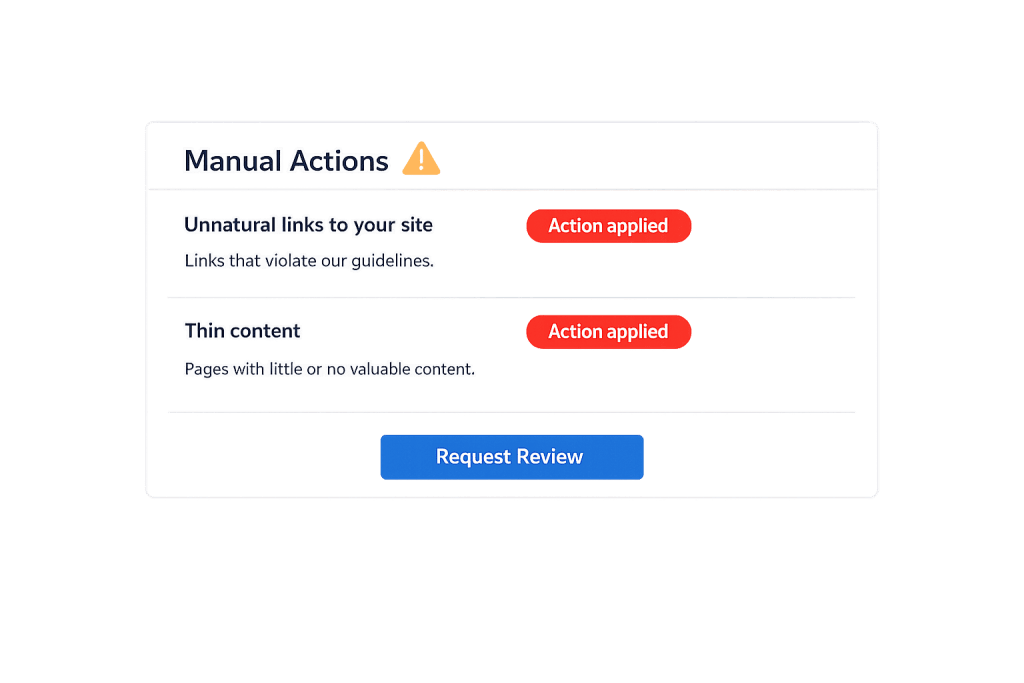
Types of Manual Actions
Google’s spam team issues manual actions for deliberate policy violations. Common types include:
- Unnatural links to your site — A link profile that shows purchased, exchanged, or manipulative backlinks designed to artificially inflate rankings
- Unnatural links from your site — Selling or exchanging links to other sites in a way that manipulates PageRank
- Thin content with little or no added value — Large volumes of low-quality, auto-generated, or scraped content
- Pure spam — Aggressive black hat techniques: cloaking, doorway pages, sneaky redirects
- User-generated spam — Spam posted in comments, forums, or other user-generated sections of your site
- Hidden text or keyword stuffing — Concealed text or unnatural keyword repetition
- Hacked content — Malware, spam links, or other content injected into your site by a third party
Manual actions can be site-wide (affecting all pages) or page-specific (affecting only certain sections or pages). In severe cases — particularly for pure spam — Google can remove the site entirely from search results.
Types of Algorithmic Demotions
Algorithmic penalties don’t appear in Search Console. They’re applied automatically by Google’s ranking systems when they detect quality or policy issues:
- Content quality demotions — Connected to updates like Helpful Content, where sites with predominantly search-engine-first content see ranking reductions
- Link-related demotions — Similar to manual link penalties, but applied algorithmically by systems like the current Penguin integration
- User experience signals — Sites with poor Core Web Vitals, slow load times, or aggressive interstitials may see ranking suppression
- E-E-A-T deficiencies — Particularly in YMYL (Your Money or Your Life) topics — health, finance, legal — sites without demonstrated expertise and authority face algorithmic quality challenges
The key diagnostic difference: manual actions show up in Search Console; algorithmic issues don’t. If rankings dropped suddenly and there’s no Search Console notification, look at whether the timing aligns with a known algorithm update.
Purpose & Benefits
1. Understanding Manual Actions Enables Direct Recovery
Unlike algorithmic issues, manual actions give you specific information about what’s wrong. Google’s notification describes the violation type and scope. This clarity is valuable — it points directly to what needs to be fixed. Recovery requires: addressing the specific violation, documenting the changes made, and submitting a Reconsideration Request through Google Search Console for Google’s spam team to review. Knowing this process exists is the first step toward using it effectively.
2. Algorithmic Awareness Guides Long-Term Strategy
Understanding that algorithmic demotions exist and how to diagnose them helps businesses avoid misattributing ranking drops to manual penalties (and vice versa). Tracking traffic against Google algorithm update timelines — using resources like Google’s Search Status Dashboard and SEO industry tracking tools — turns an apparent mystery into a diagnosable event. Our SEO audit services include penalty diagnosis as a standard component.
3. Prevention Is More Efficient Than Recovery
Both manual actions and algorithmic penalties are far easier to avoid than to recover from. The white hat SEO practices that prevent penalties — quality content, legitimate link building, no manipulation of ranking signals — are also the practices that build sustainable rankings. Understanding what triggers penalties reinforces why ethical SEO strategy is the right long-term approach. Our SEO services are built around this principle from the start.
Examples
1. Unnatural Links Manual Action — Detection and Recovery
A business discovers through Google Search Console that they received an “Unnatural links to your site” manual action. Investigation reveals a previous agency had purchased links from low-quality directories and private blog networks. Recovery involved: auditing all backlinks via Search Console and third-party tools, reaching out to webmasters to request removal, compiling a disavow file for links that couldn’t be removed, submitting the disavow file to Google, documenting all recovery actions, and submitting a Reconsideration Request. Rankings began recovering approximately 3 months after the reconsideration request was approved.
2. Algorithmic Demotion After Helpful Content Update
A B2B software company sees organic traffic drop 40% in September 2022, coinciding with Google’s Helpful Content Update. No manual action appears in Search Console. Analysis reveals a large portion of their blog content was written by non-subject-matter-expert freelancers covering broad topics with surface-level information. Recovery required: auditing content quality, removing or substantially improving thin articles, having genuine experts write or revise key pages, and building E-E-A-T signals through author profiles and original research. Traffic recovery was gradual over 6–9 months.
3. Hacked Website Manual Action
A small business site is compromised, and hackers inject hidden spam links and pharmacy keyword content into pages. Google detects this and issues a “Hacked site” manual action. The recovery sequence: identify and remove all malicious code (often requiring professional cleanup), secure the site against re-compromise (update credentials, patch vulnerabilities, add a web application firewall), submit a Reconsideration Request documenting the hack and cleanup actions. This type of manual action is resolved relatively quickly once the security issues are genuinely addressed — typically 1–4 weeks after reconsideration.
Common Mistakes to Avoid
- Submitting a Reconsideration Request before fixing the problem — Google’s spam team will review the site for the specific violation. If it still exists, the request is denied and you lose time. Fix everything thoroughly before submitting.
- Assuming an algorithmic demotion will resolve itself — Unlike manual actions that respond to reconsideration requests, algorithmic demotions recover only when the underlying quality issues are addressed. Waiting without making substantive changes doesn’t work.
- Confusing a manual action with any ranking drop — Not all ranking drops are penalties. An algorithm update, new competition, a technical issue on your site, or seasonal patterns can all cause ranking changes without any penalty involvement. Diagnose before treating.
- Using black hat SEO tactics and hoping Google won’t notice — Google’s systems review the web constantly, and manual reviewers are alerted to suspicious patterns. The short-term gains from manipulative tactics rarely outweigh the long-term cost of a penalty and the work required to recover.
Best Practices
1. Monitor Search Console for Manual Actions Regularly
Manual actions appear in Google Search Console under Security & Manual Actions → Manual Actions. Check this section during your regular SEO maintenance — at minimum monthly, or immediately when you notice an unexplained ranking drop. Catching a manual action early allows faster remediation than discovering it months after the fact. Set up email alerts in Search Console to receive notifications automatically.
2. Audit Your Backlink Profile Periodically
Unnatural link profiles are among the most common triggers for both manual actions and algorithmic link-related demotions. Use Google Search Console’s Links report and third-party tools to review your backlink profile annually. If you acquire an existing website or take over SEO from a previous agency, a link audit should be one of the first steps. Disavow low-quality links proactively if your site has a history of aggressive link building.
3. Build Content That Genuinely Helps Users
The simplest long-term protection against Google penalties is creating content that genuinely serves users — content that demonstrates real expertise, answers questions thoroughly, and provides value beyond what’s available from competing sources. Content created primarily to rank rather than to help is precisely what Google’s Helpful Content systems are designed to demote. E-E-A-T investment is both a penalty prevention strategy and a quality strategy.
Frequently Asked Questions
How do I know if I have a manual action?
Log in to Google Search Console, navigate to Security & Manual Actions → Manual Actions. If you have a manual action, it will appear here with a description of the violation and whether it affects the whole site or specific pages. If this section shows “No issues detected,” you don’t have a manual action.
How long does it take to recover from a Google penalty?
Manual action recovery: once you’ve fixed the issue and submitted a Reconsideration Request, Google typically reviews and responds within a few weeks. Ranking recovery after the manual action is lifted varies — from a few days to several months depending on how long the site was penalized and how much ground was lost.
Algorithmic recovery: significantly slower. Meaningful recovery typically takes 3–9 months after making substantive improvements, as it depends on Google recrawling and re-evaluating your site’s quality signals over multiple algorithm updates.
Can a penalty affect the whole site or just specific pages?
Both. Manual actions can be site-wide (affecting all pages, potentially removing the site from search results) or page/section-specific. Algorithmic demotions are often page- or section-specific, affecting the content that triggered the quality signal rather than the whole domain — though site-wide patterns can produce site-wide effects.
What’s a Reconsideration Request and how do I submit one?
A Reconsideration Request is a formal communication to Google’s spam team asking them to review your site after you’ve addressed the issues that triggered a manual action. Submit it via Google Search Console under Manual Actions. It should document specifically what the violation was, what actions you took to fix it, and why you believe the site now complies with Google’s policies. Be specific and thorough — vague requests are typically rejected.
Can my site be removed from Google entirely?
Yes, in extreme cases. Sites with “pure spam” manual actions (cloaking, doorway pages, manipulative patterns at scale) can be entirely deindexed — removed from all Google search results for all queries. This is the most severe form of manual action and requires a very thorough Reconsideration Request demonstrating complete remediation to restore inclusion.
Related Glossary Terms
How CyberOptik Can Help
Recovering from a Google penalty — or preventing one — requires both technical knowledge and strategic patience. Our SEO team diagnoses ranking drops, audits backlink profiles, reviews content quality, and guides clients through the manual action reconsideration process when needed. If you’ve experienced unexplained traffic loss or suspect a penalty, we can help identify the cause and map a recovery path. Contact us for a free website review or learn more about our SEO services.