
Dofollow and nofollow are link attributes that tell search engines whether to pass authority — often called “link equity” or “PageRank” — from one page to another. A dofollow link passes that authority along; a nofollow link does not. By default, every hyperlink on the web is dofollow unless explicitly marked otherwise.
When a reputable website links to your page with a dofollow link, it acts as a vote of confidence that signals trust and relevance to search engines. Those signals contribute to your domain authority and can improve your rankings over time. Nofollow links still serve a purpose — they drive real referral traffic and contribute to a natural, healthy backlink profile — but they don’t directly transfer ranking power.
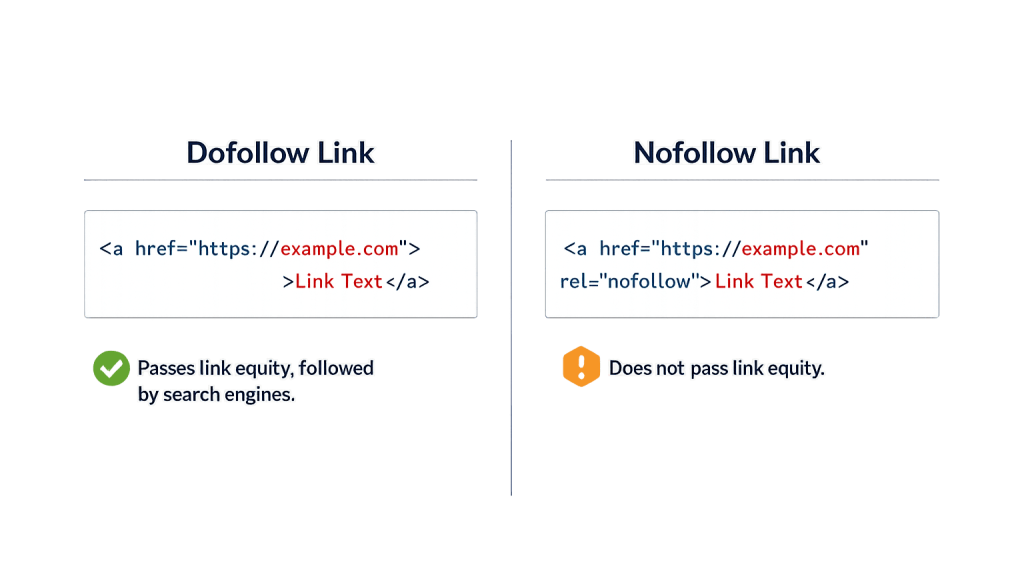
[Image: Side-by-side HTML comparison of a dofollow link with no rel attribute versus a nofollow link with rel=”nofollow”]
Types of Link Rel Attributes
Google introduced additional rel values in 2019, giving webmasters more ways to classify links:
- Dofollow (default) — No
relattribute. The link passes PageRank and is followed by search engine crawlers. Written as:<a href="https://example.com">Anchor Text</a> - nofollow —
rel="nofollow"— Used for links you don’t want to endorse: user-generated content, comment links, or general links where you don’t want to vouch for the destination. - sponsored —
rel="sponsored"— Required for paid links, affiliate links, and other compensated placements. Google treats these similarly to nofollow for PageRank purposes. - ugc (User Generated Content) —
rel="ugc"— Designed for links in forum posts, comments, and community contributions. Signals the link was created by a third party, not the site owner.
Google now treats nofollow, sponsored, and ugc as “hints” rather than hard directives — meaning crawlers may still follow and index the linked content, they simply won’t pass PageRank.
A natural backlink profile includes both dofollow and nofollow links. Profiles made up entirely of dofollow links can appear manipulative; healthy profiles typically show 15–30% nofollow links.
Purpose & Benefits
1. Build Search Authority with Dofollow Links
Dofollow backlinks from relevant, authoritative sites remain one of the most important ranking signals in off-page SEO. Each quality dofollow link reinforces your site’s authority in your niche, contributing to higher search rankings over time. Our SEO services include strategic link-building designed to earn these kinds of links naturally.
2. Maintain a Natural Link Profile
Search engines expect a mix of followed and unfollowed links pointing to your site. A profile that’s 100% dofollow looks unnatural and can trigger algorithmic scrutiny. Nofollow links from high-traffic sources like forums, news sites, and social platforms contribute to profile diversity — even without passing PageRank directly.
3. Control Which External Links You Endorse
Adding rel="nofollow" or rel="sponsored" to outbound links protects your site from passing authority to low-quality destinations or paid placements. Google requires the sponsored attribute for paid or affiliate links — failing to mark compensated links correctly is a violation of their link spam policies.
Examples
1. Blog Comment Links
A visitor leaves a comment on your WordPress post with a link to their website. By default, many comment systems add rel="nofollow" to these links automatically. This is intentional — it prevents comment sections from becoming spam targets where people post solely to harvest dofollow links. The ugc attribute is the modern, semantically correct alternative.
2. Sponsored Content and Affiliate Links
A product review blog includes links to Amazon with affiliate tracking codes. These links must use rel="sponsored" because the blogger earns a commission from clicks and purchases. Failing to attribute paid links correctly risks a manual penalty from Google’s webspam team, which can directly harm off-page SEO performance.
3. Editorial Dofollow Links
A journalist at an industry publication writes about a company’s research and links to their website without any compensation or relationship. That’s an organic editorial dofollow link — exactly what Google designed PageRank to reward. These links carry the most weight in any link-building strategy.
Common Mistakes to Avoid
- Buying dofollow links — Purchasing links that pass PageRank violates Google’s spam policies and can result in manual penalties. The
sponsoredattribute exists precisely to handle compensated links correctly. - Nofollowing all internal links — Some site owners mistakenly nofollow internal navigation links thinking it helps “sculpt” PageRank. This practice is outdated and can prevent search engines from properly crawling your site.
- Ignoring the sponsored attribute — Many affiliate marketers still use
rel="nofollow"for paid links when Google now expectsrel="sponsored". Using the wrong attribute isn’t penalized, but using no attribute at all for paid links is a policy violation. - Over-valuing nofollow link ratios — While link diversity matters, obsessing over exact dofollow/nofollow percentages misses the bigger picture. Relevance and source quality matter far more than ratios.
Best Practices
1. Mark Paid and Affiliate Links Correctly
Any link you receive compensation for — whether cash, products, or services — should use rel="sponsored". Affiliate links fall into this category. This keeps your site compliant with Google’s link spam policies and protects your organic rankings from unnecessary risk.
2. Let Editorial Links Be Dofollow
When you create outbound links to genuinely helpful, relevant resources in your content, let them remain dofollow. Adding nofollow to all outgoing links suggests you don’t trust the pages you’re linking to, which contradicts the purpose of linking in the first place. Reserve nofollow for links you’d rather not endorse.
3. Build Dofollow Backlinks Through Content and Relationships
The most sustainable path to earning dofollow backlinks is creating content worth citing — original research, detailed guides, useful tools — and building relationships with other creators in your industry. Link-building tactics that shortcut this process tend to either fail or create risk. Our SEO services focus on earning links that last.
Frequently Asked Questions
What’s the difference between dofollow and nofollow links?
A dofollow link passes PageRank (ranking authority) from the linking page to the destination page. A nofollow link does not. Both can send referral traffic; only dofollow links contribute directly to a destination site’s search rankings. Most links on the web are dofollow by default.
Do nofollow links help SEO at all?
Yes — indirectly. Nofollow links drive referral traffic, diversify your link profile, and help search engines discover your content. Since 2019, Google treats nofollow as a “hint,” meaning it may choose to follow and index the linked content anyway. A mention from a major publication is valuable even if the link carries the nofollow attribute.
What is a rel=”ugc” link?
UGC stands for User Generated Content. The rel="ugc" attribute signals that a link was created by a third party — in a comment, forum post, or community platform — rather than by the site owner. It’s semantically more precise than nofollow for these contexts, though both function similarly in terms of PageRank.
Does the sponsored attribute affect the linking site’s rankings?
No. Using rel="sponsored" on outbound links does not hurt your own rankings. It simply tells Google that the link is part of a paid arrangement, so it won’t pass PageRank to the destination. Not marking paid links correctly is the actual risk — that can result in penalties for the site selling or purchasing the links.
Should I nofollow all external links on my site?
Not by default. Nofollowing all outgoing links is generally unnecessary and can signal poor quality to search engines. Use nofollow or sponsored selectively: for paid links, user-submitted content, and links to pages you don’t want to endorse. Let genuine editorial links remain dofollow.
Related Glossary Terms
- Backlink
- Domain Authority / Domain Rating
- Off-Page SEO
- Anchor Text
- Referring Domain
- Black Hat SEO
- Canonical URL
How CyberOptik Can Help
Managing link attributes correctly is one layer of a well-executed SEO strategy — and it’s something our team handles as part of every SEO engagement. From auditing your backlink profile to building editorial links that pass real authority, we help businesses earn the right kind of attention from search engines. Contact us for a free website review or learn more about our SEO services.