
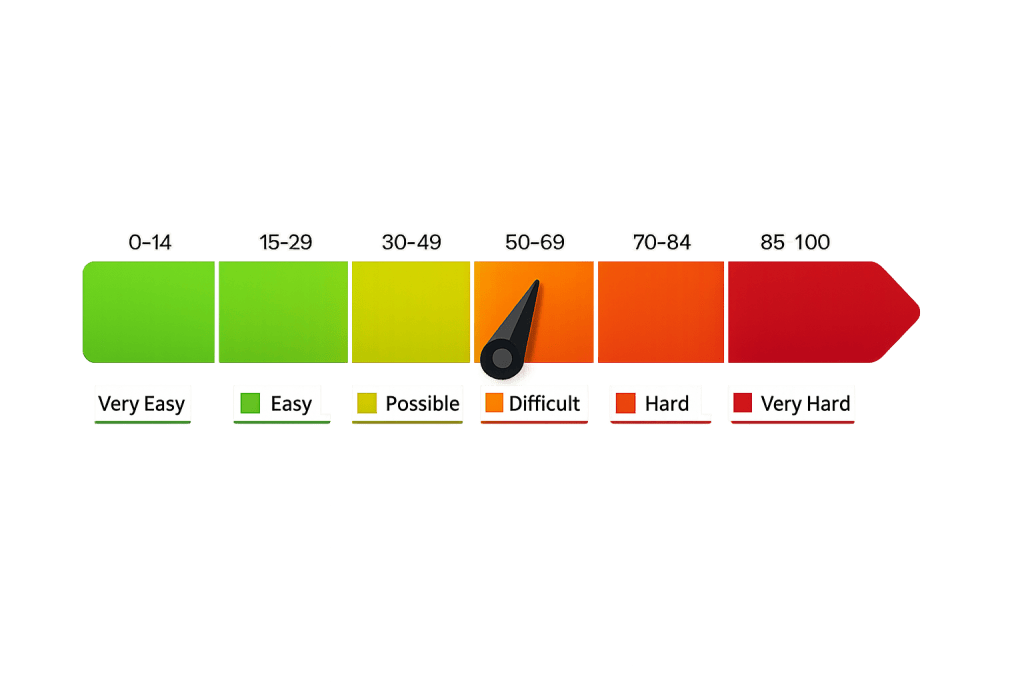
Keyword difficulty is a metric used in SEO tools to estimate how hard it would be to rank a new page in the top 10 organic search results for a given keyword. It’s typically expressed as a score from 0 to 100 — with higher numbers indicating more competitive keywords that require more authority, more backlinks, or more established domain reputation to rank for. Keyword difficulty isn’t a Google metric; it’s calculated by third-party SEO tools (Ahrefs, Semrush, Moz, and others) based on analyzing the current top-ranking pages for each query.
Understanding keyword difficulty helps you make better decisions about which keywords to pursue and when. Chasing high-difficulty keywords with a newer or lower-authority site is like a local restaurant trying to outrank national chains for “best restaurant in the country” — technically not impossible, but not a strategic use of time and resources. Difficulty scores help you calibrate your efforts toward keywords where you have a realistic chance of ranking in a timeframe that produces business value.
[Image: Visual scale showing keyword difficulty ranges: 0–14 Very Easy, 15–29 Easy, 30–49 Possible, 50–69 Difficult, 70–84 Hard, 85–100 Very Hard]
How Keyword Difficulty Is Calculated
Different tools calculate keyword difficulty using slightly different methods, but they share common inputs:
- Backlink profile of top-ranking pages — The number and quality of referring domains linking to the pages currently ranking in positions 1–10. Ahrefs primarily uses this factor; more links to the top results = higher difficulty.
- Domain authority of ranking sites — If the top 10 results are all major publications, enterprise brands, or highly authoritative domains, the difficulty is higher than if they include smaller sites.
- On-page optimization quality — Some tools (Semrush, Moz) also factor in how well the current top results are optimized for the target keyword — title tags, content relevance, heading structure.
- SERP features — Whether Google displays AI Overviews, featured snippets, knowledge panels, or local packs for the query affects the available organic positions and their click-through rates.
It’s worth noting that keyword difficulty scores for the same keyword can differ meaningfully between tools because each tool weighs these factors differently and draws from its own backlink database.
Purpose & Benefits
1. Prioritizing the Right Keywords for Your Site’s Current Authority
Not every keyword worth ranking for is rankable today. Keyword difficulty lets you filter your target keyword list by what’s achievable at your site’s current domain authority level. A newer site should focus heavily on keywords scoring below 30; an established site with strong backlinks can compete for terms in the 50–70 range. This prioritization prevents wasted content investment on terms where you won’t appear in the top 10 regardless of how good your content is.
2. Identifying Low-Difficulty Opportunities with Commercial Value
The goal isn’t to only target easy keywords — it’s to find keywords where difficulty is low relative to the business value they deliver. A long-tail keyword with 200 monthly searches and a difficulty score of 12 may convert better and rank faster than a head term with 10,000 searches and a difficulty of 85. Finding these asymmetric opportunities — where difficulty is disproportionately low relative to the value — is where keyword research pays off most. Our SEO services include surfacing these opportunities for clients.
3. Building a Realistic Long-Term Keyword Strategy
Keyword difficulty also guides a sequenced content strategy. Start with low-difficulty, specific terms to build early rankings and traffic. Use the authority gained from those rankings to gradually compete for harder terms. This compounding approach — sometimes called the “beachhead” strategy — produces more sustainable growth than attempting to rank for competitive head terms before your domain has the authority to support it.
Examples
1. New Local Business Website
A recently launched landscaping company’s website has low domain authority and few backlinks. Their keyword research reveals “lawn care services” has a difficulty of 72 and is dominated by national directories and large local chains. “Weekly lawn maintenance [city]” scores 18. “Lawn aeration service spring” scores 12. The business focuses their first six months of content on the low-difficulty, specific terms — building early rankings and traffic — before attempting to compete for the broader, higher-volume term.
2. Established SaaS Company Targeting Mid-Difficulty Terms
A SaaS project management tool has been publishing content for three years and has accumulated solid domain authority. Their keyword difficulty analysis shows that terms in the 40–65 range are now realistic targets based on their site’s authority. They identify “best project management software for remote teams” (KD 52) as a priority term — specific enough to indicate intent, achievable given their authority, and aligned with their target customer profile. They invest in a comprehensive comparison article targeting this term.
3. E-Commerce Store Using Difficulty to Guide Product Pages
An online knife retailer analyzes their product keyword targets. “Kitchen knives” (KD 78) is dominated by major retailers. “8-inch stainless steel chef knife” (KD 22) and “Japanese gyuto knife” (KD 31) are far more achievable — and more aligned with purchase intent. They prioritize optimizing product pages around the specific, lower-difficulty terms and see measurable ranking improvements within 60–90 days of optimization.
Common Mistakes to Avoid
- Using keyword difficulty as the only filter — A keyword with low difficulty may have extremely low search volume, or its intent may not align with your business goals. Difficulty is one variable; volume, intent, and business relevance all matter equally.
- Confusing paid search competition with organic difficulty — Google Keyword Planner shows a “competition” score that reflects advertiser bidding competition in Google Ads, not organic ranking difficulty. A keyword can have high paid competition but low organic difficulty (or vice versa). Use SEO-specific tools for organic difficulty, not Keyword Planner’s competition metric.
- Chasing only low-difficulty keywords indefinitely — Building authority requires eventually competing for more difficult terms. A strategy that never targets competitive keywords remains limited in traffic ceiling. Use easy wins to build authority, then incrementally target harder terms.
- Ignoring SERP features in difficulty assessment — A keyword with a moderate difficulty score may have AI Overviews, featured snippets, and knowledge panels dominating the top of the page, effectively pushing organic results far down. Always check the actual SERP for a keyword before concluding it’s a viable target.
Best Practices
1. Match Keyword Difficulty to Your Site’s Domain Authority
Before targeting any keyword, assess your site’s current domain authority or domain rating and compare it against the authority of sites currently ranking in the top 10. If your site has a DR of 25 and the top 10 results all have DR 60+, a difficulty score of 50 is effectively much harder for you than the tool’s score suggests. The absolute difficulty score matters less than your site’s difficulty relative to the current competition.
2. Prioritize Long-Tail Keywords for Early Wins
Long-tail keywords — specific 3–5 word phrases — consistently show lower difficulty scores than head terms while delivering higher conversion intent. A focused strategy of targeting 15–20 long-tail terms per month produces compounding results: early rankings build authority, that authority unlocks more competitive terms over time, and the specific-intent traffic converts better throughout. This is the practical reason long-tail strategy outperforms head-term chasing for most businesses.
3. Use Difficulty Alongside Volume and Intent
Build a scoring framework that evaluates each keyword candidate on three dimensions: difficulty (is this achievable?), volume (is there enough demand to justify the investment?), and intent (will people searching this be likely to become customers?). A term that scores well on all three is a priority target. A term with low difficulty but zero transactional intent may not be worth the content investment, regardless of how easy it is to rank for.
Frequently Asked Questions
What keyword difficulty score should I target?
It depends on your site’s authority. As a rough guide: new sites (DR 0–20) should focus on keywords under 30; established sites (DR 20–50) can target 30–55; high-authority sites (DR 50+) can compete for 55 and above. But always check the actual SERP — some keywords punch above or below their nominal difficulty score depending on the quality of current competition.
Does keyword difficulty affect how long it takes to rank?
Yes, broadly. Low-difficulty keywords (under 20) on a decent site can rank within weeks of publishing. Medium-difficulty keywords (30–50) may take 3–6 months of consistent optimization and link building. High-difficulty keywords (60+) often require 12+ months of investment and may require significant link acquisition to achieve top-10 results. These timelines vary substantially based on site authority, content quality, and how aggressively you build links.
Is a keyword difficulty of 0 worth targeting?
Sometimes. Extremely low difficulty often means extremely low search volume — the keyword exists but almost nobody searches for it. That said, some niche business terms have low difficulty because they’re specific, not because demand is nonexistent. Evaluate these on a case-by-case basis: if a keyword is specific to your product or service and shows any search volume at all, it’s often worth targeting even at minimal volume.
How do different SEO tools calculate keyword difficulty differently?
Each tool uses different data sources and weighting formulas. Ahrefs weighs the backlink profile of top-ranking pages most heavily. Semrush incorporates both backlinks and on-page factors. Moz uses Page Authority and Domain Authority signals. Because of these differences, the same keyword may score 35 in Ahrefs and 55 in Semrush. Rather than comparing absolute scores across tools, use one tool consistently so you’re comparing apples to apples within your keyword research.
Can I outrank a high-difficulty keyword with exceptional content?
Content quality matters, but it doesn’t override authority at very high difficulty levels. Exceptional content on a low-authority domain will still lose to good content on a high-authority domain when backlinks are the primary ranking signal. For high-difficulty terms, exceptional content is necessary but not sufficient — you also need authority from external links and the established trust that comes with time and link acquisition.
Related Glossary Terms
- Keyword
- Domain Authority / Domain Rating
- Long-Tail Keywords
- Backlink
- On-Page SEO
- Keyword Cannibalization
- Google Search Console
- Content Strategy
How CyberOptik Can Help
Keyword difficulty analysis is a core part of every keyword research engagement we run. We don’t just identify the terms your audience searches for — we evaluate which of those terms are realistic targets based on your site’s current authority, and we sequence your content strategy to build toward competitive terms over time. Contact us for a free website review or learn more about our SEO services.