
Evergreen content is content that remains relevant, useful, and capable of attracting search traffic long after its original publication date — months or years, not just days or weeks. The term comes from evergreen trees, which stay green year-round regardless of season. Unlike news articles, trend-based posts, or time-sensitive announcements, evergreen content addresses questions and topics that people consistently search for over time.
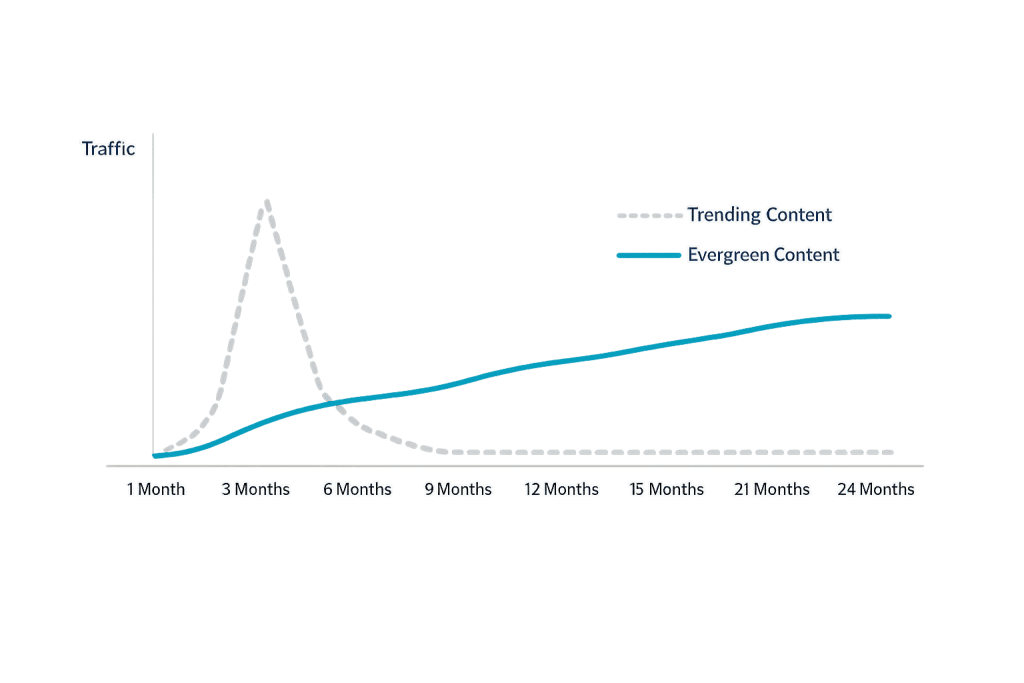
For businesses investing in a content strategy, evergreen content is the highest-leverage type of content you can create. A single well-written guide or tutorial can generate organic traffic continuously for years, building authority, attracting backlinks, and supporting organic search traffic without ongoing promotion. It’s the difference between a one-time traffic spike from a trending post and a steady, compounding stream of visitors who find your content through search.
[Image: Traffic graph showing a seasonal/trending content spike that drops off vs. an evergreen content line that gradually rises and stays elevated over 24 months]
Types of Evergreen Content
Certain content formats lend themselves naturally to evergreen treatment:
- How-to guides — Step-by-step instructions for processes that don’t change frequently (“how to set up a business email address”)
- Glossaries and definitions — Explanations of terms in your industry that people consistently search for
- FAQ pages — Answers to questions your customers ask repeatedly, regardless of season
- Tutorials and beginner guides — “Getting started with X” content that new entrants to your field always need
- Case studies — Well-documented examples of results that remain illustrative even as time passes
- Listicles with lasting relevance — “10 ways to improve website speed” rather than “10 website trends for this year”
- Resource pages — Curated collections of tools, templates, or references that serve an audience’s recurring needs
What makes content evergreen isn’t just the topic — it’s the framing. A post about “WordPress plugins for 2022” ages immediately. A post about “how to choose the right WordPress plugin for your business” is evergreen because the decision-making framework doesn’t change year to year.
Purpose & Benefits
1. Sustained Organic Traffic Without Ongoing Promotion
Evergreen content earns its value over time. A well-optimized guide published today can still be driving organic search traffic three years from now — without ad spend, ongoing promotion, or active distribution. Content that addresses persistent user needs ranks well because Google values pages that consistently satisfy search intent. The compounding effect is significant: each new piece of evergreen content adds to an existing library that collectively drives more and more traffic.
2. Stronger Backlink Profile and Domain Authority
Timeless content earns links because it’s a reference people return to. Industry blogs, news sites, and educational resources are more likely to link to a comprehensive, enduring guide than to a trend post that will be irrelevant in six months. Each earned backlink strengthens your overall domain authority, which benefits your entire site’s SEO performance — including your service pages, product pages, and blog posts.
3. Efficient Use of Content Investment
Creating quality content requires time and resources. Evergreen content maximizes the return on that investment by continuing to perform long after the initial effort. Our work with clients on content marketing consistently shows that a handful of strong evergreen pieces can outperform dozens of trend-driven posts in long-term traffic and lead generation. The ROI compounds rather than decaying.
Examples
1. Professional Services Glossary
A web design agency publishes a glossary of web design and digital marketing terms. Each page targets a specific search query (“what is a meta description,” “what is bounce rate”), answers it comprehensively, and links to related topics. Over 18 months, the glossary collectively drives thousands of monthly visitors — all through organic search — and positions the agency as an authoritative resource. The content requires no promotion; it earns traffic by being useful and well-optimized.
2. Service Business How-To Guide
A property management company publishes “How to Screen Tenants: A Complete Guide for Landlords.” The guide addresses a question their ideal customers search for year-round and answers it in genuine depth — covering application process, background checks, legal considerations, and red flags. This single page generates steady monthly traffic from property owners and serves as an entry point to the company’s services. Three years after publication, it still ranks on the first page of results for its target terms.
3. eCommerce Buying Guide
An outdoor gear retailer publishes “How to Choose the Right Hiking Boots: Size, Fit, and Terrain Guide.” Shoppers searching for this information are actively in the research phase of a purchase decision. The guide answers their questions thoroughly, links to relevant products, and captures email subscribers through a gear checklist offer. Unlike a seasonal sale page, this guide generates relevant traffic every month of the year and contributes to product page rankings through internal linking.
Common Mistakes to Avoid
- Publishing and abandoning it — Evergreen doesn’t mean zero maintenance. Statistics become outdated, tools get discontinued, best practices evolve. Content that was accurate three years ago may now be misleading. Review high-performing evergreen pieces every 6–12 months and update anything that’s stale.
- Framing evergreen content as time-sensitive — Including specific years in titles (“Best Practices for 2023”) undermines evergreen value. Opt for timeless framing: “Best Practices for [Task]” rather than pinning it to a calendar year. If you do use a year in a title for initial ranking purposes, update it regularly.
- Confusing evergreen with comprehensive — Length isn’t the same as timelessness. A 5,000-word post about a short-lived social media trend is not evergreen. Conversely, a focused 800-word explanation of a foundational concept can be highly evergreen. The topic and framing determine longevity, not word count.
- Neglecting internal linking — Evergreen content earns value through links — but the links your site creates to it matter too. Link to your evergreen content from new posts, service pages, and related content to signal its importance and help visitors and search engines find it.
Best Practices
1. Target Topics with Stable, Consistent Search Demand
Before creating evergreen content, validate that the topic has sustained search interest rather than a seasonal pattern. Tools like Google Trends can show you whether a topic has consistent volume year-round or peaks at certain times. Terms like “how to write a meta description” hold steady search volume indefinitely; “best Super Bowl ads” spikes annually. Choose topics in the former category for your evergreen investments.
2. Prioritize Depth and Genuine Usefulness Over Length
The best evergreen content answers the searcher’s question so completely that they don’t need to go anywhere else. That doesn’t mean writing the longest article possible — it means addressing every meaningful aspect of the topic clearly and concisely. Anticipate follow-up questions, include relevant examples, and structure the content so it’s easy to navigate. Connect it to your related content strategy through internal links to other relevant pages.
3. Schedule Regular Content Audits
Build evergreen maintenance into your content calendar. A quarterly or semi-annual review of your top-performing pieces should check: Are the statistics current? Are the tools and platforms mentioned still relevant? Has anything changed in how the topic is understood or practiced? A well-maintained evergreen piece consistently outperforms a neglected one and signals to search engines that the content is actively curated and trustworthy.
Frequently Asked Questions
How is evergreen content different from cornerstone content?
Evergreen content is defined by its longevity — it stays relevant over time regardless of news cycles. Cornerstone content is defined by its strategic importance to your site — it’s your most comprehensive, authoritative coverage of a core topic, and other pages link to it. Many pieces of cornerstone content are also evergreen, but not all evergreen content is cornerstone. The terms overlap but aren’t synonymous.
How long does it take for evergreen content to rank?
It varies significantly by site authority, competition, and content quality, but evergreen content typically takes three to nine months to reach its full ranking potential in organic search. This is why publishing evergreen content consistently — rather than in bursts — builds long-term SEO value. Each piece you publish and optimize adds to a compounding library rather than producing a one-time spike.
Can product or service pages be evergreen?
Yes. A service page that clearly explains what you offer, who it’s for, and how it works — without relying on time-sensitive language — can function as evergreen content. The challenge is that service pages often don’t target informational search queries, so they typically attract less raw traffic than educational evergreen pieces. The combination of educational evergreen content and well-optimized service pages is more powerful than either alone.
Should I update an evergreen post or publish a new one on the same topic?
Generally, update the existing post. Search engines value pages that build up authority over time through links, engagement, and history. A new post on the same topic competes with your existing one and can create duplicate content issues. Update the existing post with current information, refresh the publication date, and add any new sections that improve its completeness.
Related Glossary Terms
How CyberOptik Can Help
Strong content is the foundation of every effective website and SEO strategy — and evergreen content is where that investment pays off most over time. Our copywriting team can help you identify the topics your audience consistently searches for, create content that genuinely answers their questions, and build a library that drives organic traffic for years. Explore our copywriting services or learn about our SEO services to see how content and search work together, or get in touch.