
An ad group is a container within a Google Ads campaign that holds a set of related ads and the keywords that trigger them. Every keyword and ad you create in Google Ads lives inside an ad group — it’s the organizational layer between a campaign (which controls budget and targeting) and the individual ads and keywords (which determine when and what users see).
Ad groups exist to keep your keywords, ads, and landing pages tightly aligned. When a search term matches a keyword in your ad group, Google serves one of the ads in that group. The closer the keyword, ad copy, and landing page are to each other in theme, the more relevant your ad is — which affects both your Quality Score and your actual cost per click.
[Image: Hierarchy diagram showing Account → Campaigns → Ad Groups → Keywords / Ads, with arrows indicating how each level controls the next]
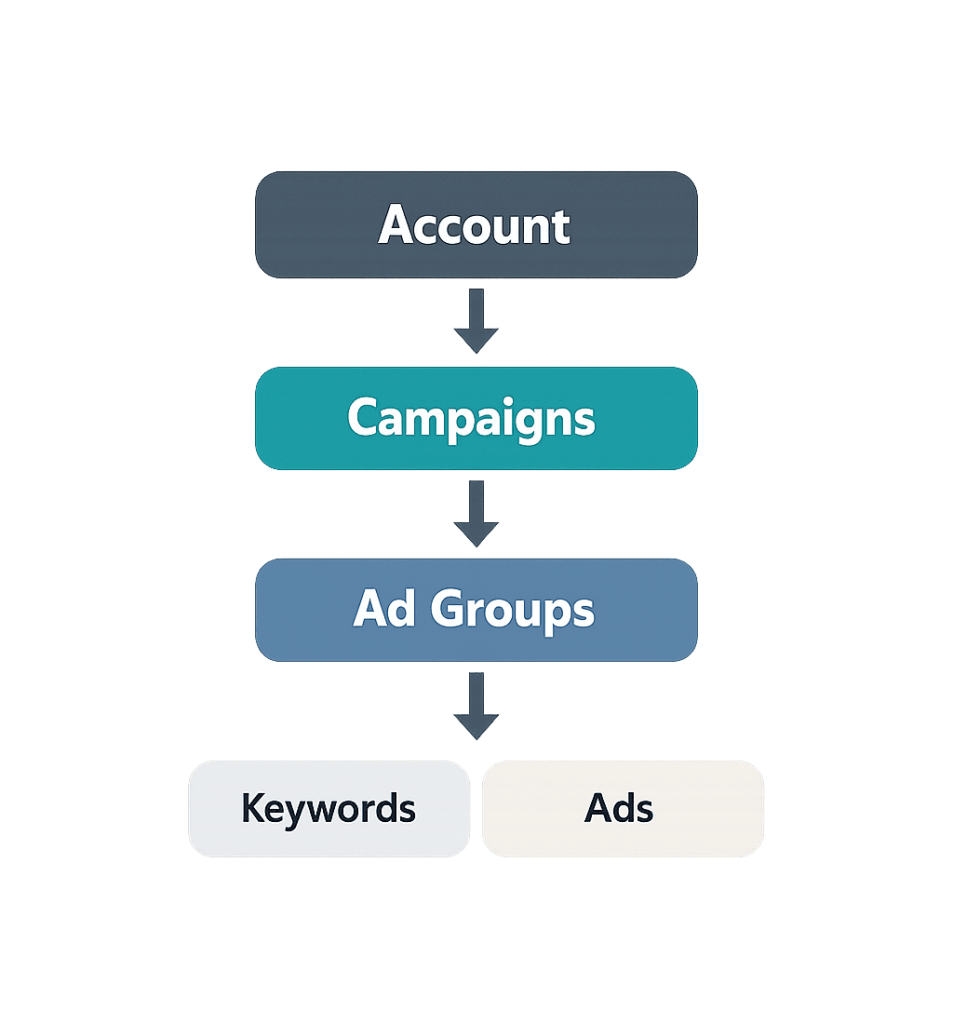
The Google Ads Hierarchy: Campaign → Ad Group → Ads and Keywords
Understanding the ad group requires understanding where it sits in the Google Ads account structure:
- Account — Your top-level Google Ads account. Holds all campaigns, billing information, and shared settings.
- Campaign — Sets the budget, bidding strategy, targeting (geographic, device, network), and ad type. A campaign might represent an entire product line, a service category, or a seasonal promotion.
- Ad Group — Lives inside a campaign. Contains a set of thematically related keywords and the ads that run when those keywords match a search.
- Ads — The actual text (or image/video, depending on campaign type) shown to users. Each ad group holds at least one ad, typically two or three.
- Keywords — The search terms you’re bidding on. Each keyword in an ad group can trigger any ad in that group.
The logic is straightforward: if your campaign is for a roofing company, you might have separate ad groups for “roof repair,” “roof replacement,” and “commercial roofing.” Each ad group would contain keywords specific to that topic and ads written to match that specific intent.
Purpose & Benefits
1. Tighter Keyword-to-Ad Relevance
When keywords and ads share the same theme within an ad group, Google can match the right ad to the right search — and the right ad is one that directly addresses what the searcher is looking for. A user searching “emergency roof repair” should see an ad about emergency repairs, not a generic roofing ad. Tight thematic grouping improves click-through rates and reduces wasted spend. Our PPC management work consistently shows that well-structured ad groups outperform loosely organized ones on both CTR and conversion rate.
2. Better Quality Score and Lower Costs
Google evaluates the relevance of your keywords, ads, and landing page together as part of your Quality Score. Ad groups that keep all three aligned — relevant keywords triggering relevant ads that link to a relevant landing page — earn higher Quality Scores. A higher Quality Score typically means a lower cost per click for equivalent ad positions, which directly improves your return on ad spend.
3. Easier Campaign Management and Optimization
When ad groups are organized by clear themes, it’s straightforward to identify which topics are performing well, which keywords are draining budget, and where to invest more. Messy ad groups — with dozens of unrelated keywords all competing for the same ads — make it nearly impossible to diagnose problems or make informed optimizations. Clean structure is the foundation of manageable paid search campaigns.
Examples
1. Home Services Business with Multiple Services
A plumbing company creates one campaign for residential plumbing with separate ad groups for “drain cleaning,” “water heater installation,” and “leak repair.” Each ad group has 5–10 keywords specific to that service and ads written to address exactly that need. When someone searches “how to fix a leaky pipe,” they see the leak repair ad — not a generic “we do all plumbing” message. Each ad group links to a service-specific landing page.
2. E-Commerce Retailer Segmenting by Product Category
An online shoe retailer creates ad groups for “men’s running shoes,” “women’s running shoes,” “trail running shoes,” and “running shoe sale.” Each group has keywords matching that specific intent and ads featuring the relevant products. The “running shoe sale” ad group includes promotional copy about discounts; the others focus on selection and quality. This prevents discount messaging from cannibalizing full-price searches.
3. Professional Services Firm Testing Ad Copy Variations
A law firm has an ad group for “personal injury attorney” with three ad variations — one emphasizing “No Fee Unless We Win,” one emphasizing case results, and one emphasizing free consultations. All three ads run against the same keyword set. Over time, Google’s responsive search ad system learns which headline and description combinations perform best for that audience, and the firm can make data-driven decisions about its messaging.
Common Mistakes to Avoid
- Putting all keywords in one ad group — Dumping 50–100 unrelated keywords into a single ad group is the most common structural mistake we see in inherited accounts. Every keyword needs to be served by the same ads, so one ad group can’t speak to both “emergency plumber” and “bathroom remodel” without one of them being poorly served.
- Using the same ad copy for different intent signals — Ad groups work best when the ads are written specifically for that group’s keyword theme. Reusing identical ads across multiple ad groups misses the opportunity to speak directly to what each group of searchers is looking for.
- Too many ad groups, too little data — Splitting ad groups too granularly fragments your data and prevents Google’s machine learning from optimizing effectively. Each ad group needs sufficient search volume to generate meaningful performance signals. The current best practice leans toward consolidation — fewer, well-themed groups rather than dozens of narrow ones.
- Neglecting negative keywords — Without negative keywords, your ad groups will match unintended searches. A “roof repair” ad group without “DIY” as a negative keyword will spend budget on people who want to repair their own roof, not hire a contractor. Negative keywords define the boundary of each ad group just as much as the positive keywords do.
Best Practices
1. Organize Ad Groups Around One Clear Theme
Each ad group should have a single, unambiguous theme — one product, one service, one intent cluster. A good test: if you can’t write a single ad headline that’s relevant to every keyword in the group, the group is too broad. The goal is for every keyword to feel at home in the same ad, and for every ad to speak directly to what those keywords represent. Aim for 5–20 closely related keywords per group.
2. Write Ads That Reflect the Ad Group’s Keywords
Include the ad group’s primary keyword theme in your ad headlines and descriptions. If the ad group is for “commercial roof inspection,” the ad should say something about commercial roof inspections — not just “roofing services.” This alignment improves relevance, Quality Score, and click-through rate. Use at least two responsive search ads per ad group so Google can test different headline and description combinations and surface the best performers.
3. Use Negative Keywords to Define Each Group’s Boundaries
Negative keywords prevent your ad groups from matching searches that don’t fit their theme. They also prevent ad groups within the same campaign from competing against each other. If you have separate ad groups for “repair” and “replacement,” add “replacement” as a negative to the repair group and vice versa. This keeps traffic clean, spend targeted, and reporting meaningful. Regularly review the search terms report to identify new negative keywords worth adding.
Frequently Asked Questions
How many ad groups should a campaign have?
Most practitioners recommend 3–10 ad groups per campaign, though the right number depends on how many distinct themes your campaign covers. The bigger risk is having too few ad groups (lumping unrelated keywords together) or too many (fragmenting data to the point where none has enough volume to optimize). When you find yourself needing more than 10 focused groups, it’s often a sign you need a new campaign rather than more ad groups in the existing one.
What’s the difference between a campaign and an ad group?
A campaign controls budget, bidding strategy, and targeting settings (location, device, network). An ad group sits inside a campaign and controls which keywords and ads are grouped together. You can have multiple ad groups inside one campaign, all sharing the same budget and targeting settings but each with distinct keywords and ad copy.
How many keywords should each ad group have?
Current best practice is 5–20 closely related keywords per ad group, with many experienced practitioners recommending staying on the lower end. With Google’s modern match types (especially broad match with Smart Bidding), a small set of well-chosen keywords can cover a wide range of actual search queries. Adding more keywords doesn’t necessarily increase reach — it can add noise and complicate optimization.
Can one keyword be in multiple ad groups?
Technically yes, but it’s generally not recommended. When the same keyword appears in two ad groups within the same campaign, Google uses its own prioritization logic to determine which ad group “wins” the auction. This can make performance data confusing and bidding harder to control. If a keyword fits multiple themes, decide which ad group owns it and use negative keywords in the other to prevent overlap.
Do ad groups work the same way in Performance Max campaigns?
No. Performance Max (PMax) campaigns don’t use ad groups — they use “asset groups” instead. Asset groups bundle your headlines, descriptions, images, videos, and other assets together, and Google’s AI decides how to combine and serve them across Search, Display, YouTube, and other channels. The campaign/asset group structure in PMax serves a similar organizational purpose as campaign/ad group in Search campaigns, but the targeting and optimization logic is entirely different.
Related Glossary Terms
How CyberOptik Can Help
Ad group structure is one of the most consequential — and commonly overlooked — factors in Google Ads performance. Getting it right from the start saves budget and produces cleaner data. Getting it wrong means spending months paying more per click than you should. Our marketing team builds and manages Google Ads accounts with structured, theme-based ad groups designed to keep Quality Scores high and costs controlled. Explore our PPC services or get in touch to discuss your campaign.